
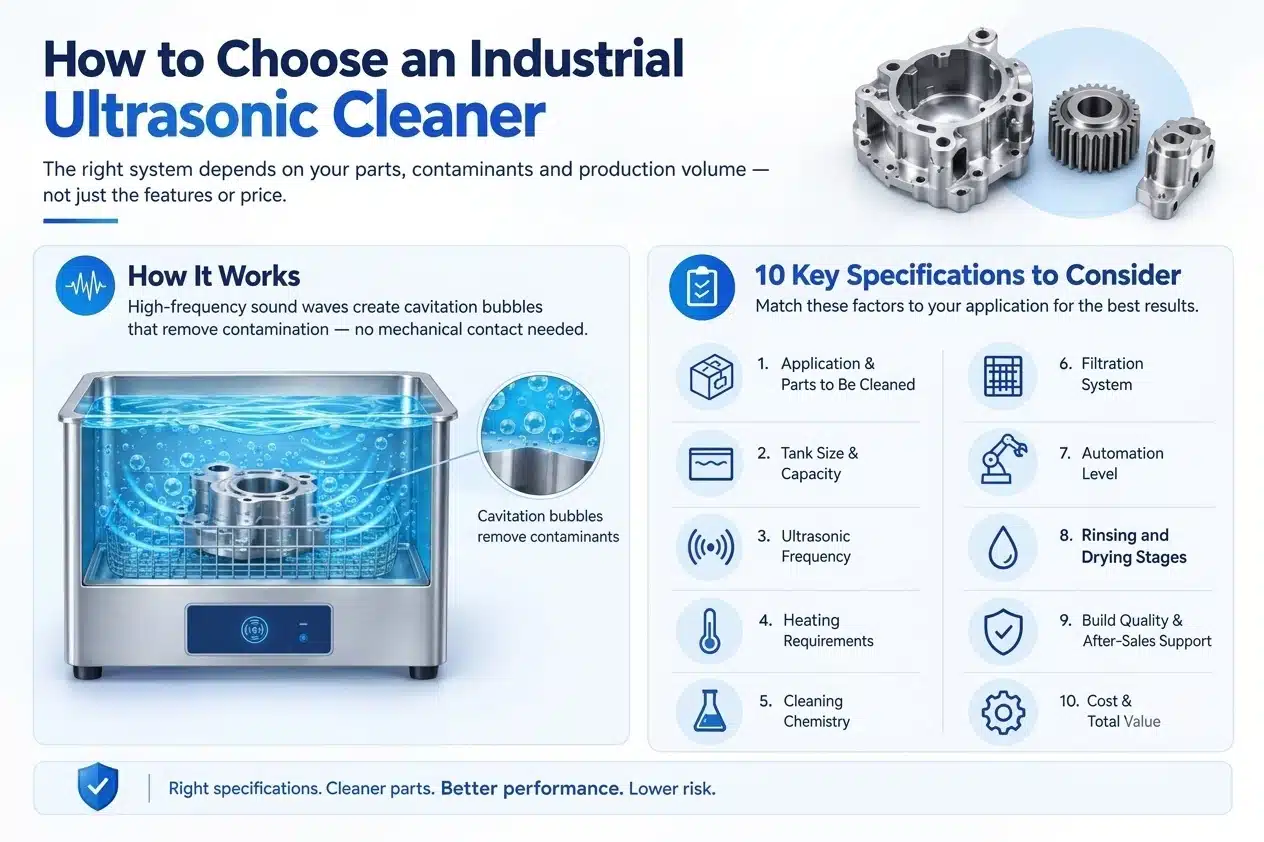
The right industrial ultrasonic cleaner is the one specified around your parts, your contaminants, and your production volume, not the one with the most features or the lowest quoted price. Buying the wrong system is expensive twice: once at purchase, and again in rework, downtime, or a replacement system once the first one can’t keep up with real production requirements. This guide walks through what actually determines fit, so you can specify or evaluate a vendor’s recommendation for an industrial ultrasonic cleaning system with confidence.
What Is an Industrial Ultrasonic Cleaner?
An industrial ultrasonic cleaner is a piece of production equipment that uses high-frequency sound waves to generate cavitation (the rapid formation and collapse of microscopic bubbles in a liquid) to remove contamination from parts. It differs from a consumer or benchtop ultrasonic cleaning machine in construction and duty rating: industrial systems use stainless steel tanks, continuous-duty generators, and (in many cases) filtration, heating, and automation designed to run reliably across full production shifts, not occasional use.
An industrial parts washer is sometimes used as a general term for this category, though it can also refer to spray-wash or agitation-based systems that don’t use ultrasonic cavitation. If cavitation-driven cleaning is what your application needs because parts have recesses, blind holes, or complex geometry that spray washing can’t reach or remove the contaminants, an ultrasonic system is the relevant category to evaluate.
Key Factors to Consider Before Buying
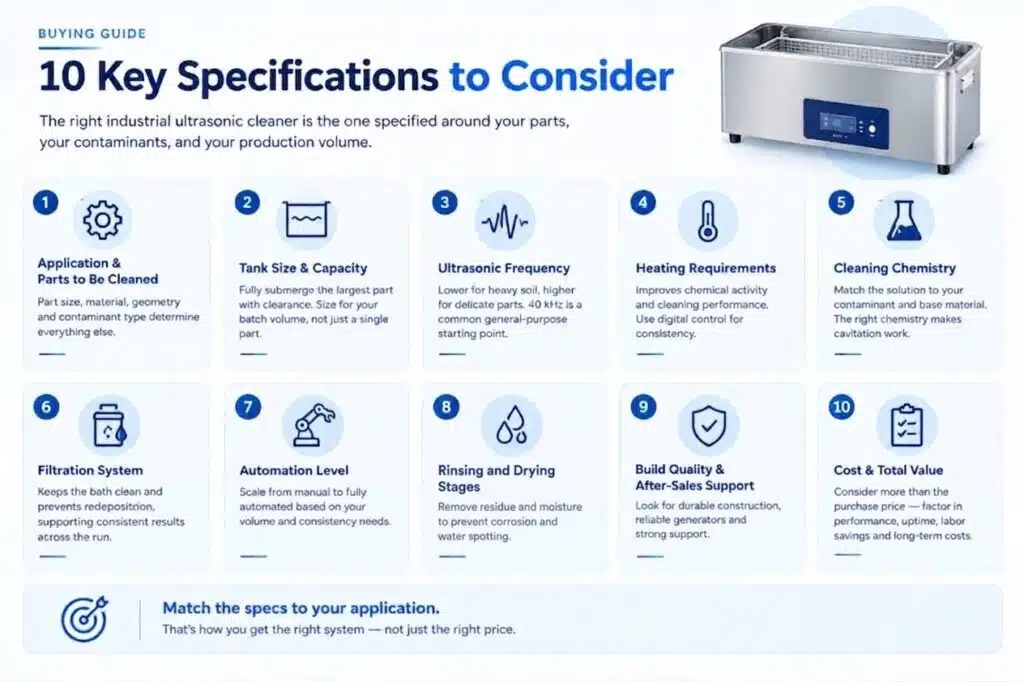
Every factor below interacts with the others. Changing one – tank size, frequency, or automation level, for example – usually changes what’s needed elsewhere in the system. Treat this as a checklist to work through together, not independently.
Application & Parts to Be Cleaned
Start here, not with equipment specs. Part material, size range, geometry (recesses, blind holes, threads), and the contaminant you’re removing (oil, grease, rust, carbon, particulate, flux residue) determine almost everything else on this list – frequency, chemistry, and cycle time all follow from this.
Tank Size & Capacity
- The tank needs to fully submerge the largest part in your production mix, with clearance on all sides – parts placed too close to the tank walls or to each other create shadowing, where cavitation intensity drops off before it reaches the surface. For larger parts or higher-volume applications, large ultrasonic cleaners may be more appropriate.
- Size for your batch volume, not just a single part. If you’re cleaning baskets of small components, tank capacity needs to accommodate a full batch without overcrowding.
- Oversizing wastes energy and solution volume; undersizing creates a production bottleneck. Both are common buying mistakes, covered in more detail below.
Ultrasonic Frequency
Frequency selection determines cavitation bubble size, which determines how aggressively or how gently – the cleaning energy acts on the part surface. Lower frequencies produce larger, more forceful bubbles suited to heavy contamination on durable parts; higher frequencies produce smaller, gentler bubbles suited to delicate or precision components.
| Frequency Range | Bubble Characteristics | Typical Use | Considerations |
|---|---|---|---|
| 25–28 kHz | Larger, more aggressive bubbles | Heavy oil, grease, and rust on durable metal parts – engine components, castings, tooling | Higher removal force; not suited to delicate or polished surfaces |
| 40 kHz | Balanced bubble size and force | General-purpose industrial cleaning – machined parts, most metal components | The most widely used industrial frequency; a reasonable default when unsure |
| 60–80 kHz | Smaller, gentler bubbles | Electronics, medical instruments, moderately delicate components | Lower mechanical force; better suited to sensitive surfaces and fine geometry |
| Above 80kHz | Very fine, low-force bubbles | Precision optics, semiconductor components, ultra-fine particulate removal | Not general-purpose; specify only when the application requires this level of gentleness |
Some applications don’t fit neatly into one frequency band, a part with both heavy external soil and delicate internal features, for example. Multi-frequency systems, including Zenith’s CROSSFIRE® Multiple Frequency technology (US Patent 5,865,199 and 6,019,852), address this by combining frequencies in a single system rather than forcing a single-frequency compromise. Multi-frequency systems also maximize the range of particle sizes most effectively removed when all included frequencies operate simultaneously.
Heating Requirements
Most industrial cleaning chemistries perform significantly better within a specific temperature range – elevated temperature generally improves chemical activity and helps break down oils and greases. Whether you need a heated tank, and to what temperature, depends on your cleaning chemistry manufacturer’s recommendations and your contaminant. Digital temperature control with continuous readout supports more consistent, repeatable results than a manual or unmonitored heater.
Cleaning Chemistry
The cleaning solution has to match both the contaminant and the base material of the part – a chemistry that’s effective on oil and grease may not be the right choice for rust or oxide removal, and a chemistry that works well on one metal can etch or discolor another. Chemistry selection should be treated as its own decision, not an afterthought once the equipment is chosen.
Filtration System
Without filtration, contaminants removed from parts stay suspended in the bath and can redeposit onto parts in later cycles, especially as a batch progresses. Filtration sized to your tank volume and contaminant load keeps the bath usable longer and supports more consistent results across a production run.
Automation Level
Manual systems make sense for lower-volume or prototype work. As volume increases, semi-automated or a fully automated cleaner reduces labor, improves cycle-to-cycle consistency, and removes variation introduced by manual handling. Size automation to where your production volume is heading, not just where it is today – this is one of the more common specification mistakes, covered below.
Rinsing and Drying Stages
Cleaning is only one stage of the process. Incomplete rinsing can leave residue or redeposited contaminant on the part, and incomplete drying can trap moisture that causes corrosion or water spotting after the fact. Multi-stage systems that sequence clean, rinse, and dry in a single line reduce the risk of a gap between stages.
Build Quality & After-Sales Support
Tank construction (typically 304 or 316L stainless steel for industrial use), generator duty rating, and warranty terms are a reasonable proxy for how a system will hold up under continuous production use. After-sales support – access to technical guidance if a process needs adjustment, and a warranty that reflects confidence in the equipment – matters as much as the initial specification, particularly for a system that will run for years.
Common Buying Mistakes to Avoid
| Mistake | Why It Causes Problems |
|---|---|
| Undersizing the tank | Parts too close to the tank walls or each other create shadowing, where cavitation cannot reach every surface evenly. |
| Choosing frequency by habit, not application | Defaulting to 40 kHz for everything overlooks cases where a lower frequency is needed for heavy soil or a higher frequency is needed to protect delicate parts. |
| Ignoring chemistry compatibility | A cleaning solution mismatched to the contaminant or base metal can leave residue behind or attack the part itself. |
| Skipping filtration | Without filtration, removed contaminants stay in the bath and can redeposit onto parts on later cycles. |
| Underestimating automation needs | A manual system sized for today’s volume can become a production bottleneck if throughput requirements grow. |
| Treating rinsing and drying as an afterthought | Incomplete rinsing or drying can leave residue, water spots, or trapped moisture that causes corrosion later. |
Industry-Wise Recommendations
Cleaning requirements vary meaningfully by industry, mainly because contaminant type, part sensitivity, and cleanliness documentation requirements differ:
- Automotive: Typically, machining oils, metal shavings, and carbon residue on durable metal parts; mid-to-low frequency ranges and higher-volume automation are common.
- Aerospace: Precision components requiring documented, repeatable cleanliness and chemistry compatible with aluminum, titanium, and other aerospace alloys.
- Medical: Devices and instruments requiring thorough, validated contaminant removal, often with corrosion-sensitive materials and strict process documentation.
- General Manufacturing: Machined parts and metal stampings where machining oils, burrs, and particulate are the primary contaminants, usually at 40 kHz or a similar general-purpose frequency.
These are starting points, not fixed rules – the specific part and contaminant in front of you still determines the right specification within any industry.
Why Choose Zenith Ultrasonics?
Zenith Ultrasonics has engineered ultrasonic cleaning equipment since 1935, and applies that experience the same way this guide has approached the decision: starting from the application, not the equipment. Zenith builds standard and custom-engineered systems, and where a standard system doesn’t fit an unusual part or process, Zenith can design around it rather than asking the customer to compromise.
- CROSSFIRE® Multiple Frequency technology for applications that don’t fit a single frequency band.
- Custom-engineered systems sized to your specific parts, contaminant load, and production volume, not a generic catalog fit.
- Automation capabilities ranging from semi-automated part handling to fully automated, multi-stage production lines.
- An included test cleaning to validate performance on your actual parts before you commit to a system.
- Technical support from initial specification through ongoing operation, backed by a two-year warranty.
Need help specifying a system?
Discuss your parts, contaminants, throughput, and process requirements with Zenith Ultrasonics. Application-focused engineering and test cleaning can help determine the right configuration before you commit to equipment.


Leave A Comment