

Ultrasonic cleaning uses high-frequency sound waves to generate cavitation – microscopic bubbles that implode against a part’s surface and dislodge oils, grease, particles, and residues without mechanical contact. It reaches into blind holes, threads, and geometries that manual or spray cleaning can’t touch.
But “most materials can be cleaned ultrasonically” isn’t the same as “every material should be.” Suitability depends on the material, part construction, cleaning solution, and the specific temperature, frequency, and time applied. Get any variable wrong and you risk damaging the part, which is why knowing what not to put in an ultrasonic cleaner matters as much as knowing what the process can do.
Which Materials May Not Be Suitable for Ultrasonic Cleaning?
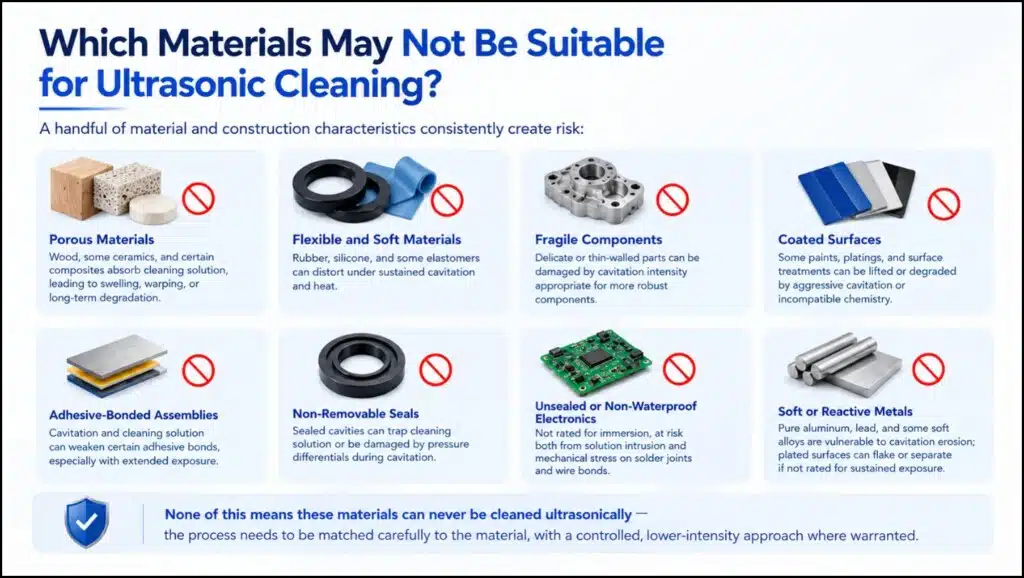
A handful of material and construction characteristics consistently create risk:
- Porous materials: Wood, some ceramics, and certain composites absorb cleaning solution, leading to swelling, warping, or long-term degradation.
- Flexible and soft materials: Rubber, silicone, and some elastomers can distort under sustained cavitation and heat.
- Fragile components: Delicate or thin-walled parts can be damaged by cavitation intensity appropriate for more robust components.
- Coated surfaces: Some paints, platings, and surface treatments can be lifted or degraded by aggressive cavitation or incompatible chemistry.
- Adhesive-bonded assemblies: Cavitation and cleaning solution can weaken certain adhesive bonds, especially with extended exposure.
- Non-removable seals: Sealed cavities can trap cleaning solution or be damaged by pressure differentials during cavitation.
- Unsealed or non-waterproof electronics: Not rated for immersion, at risk both from solution intrusion and mechanical stress on solder joints and wire bonds when cavitation isn’t matched to the assembly.
- Soft or reactive metals: Machined aluminum, lead, and some soft alloys are vulnerable to cavitation erosion; plated surfaces can flake or separate if not rated for sustained exposure.
None of this means these materials can never be cleaned ultrasonically – the process needs to be matched carefully to the material, with a controlled, lower-intensity approach where warranted.
Operating Practices That Protect Both Parts and Equipment
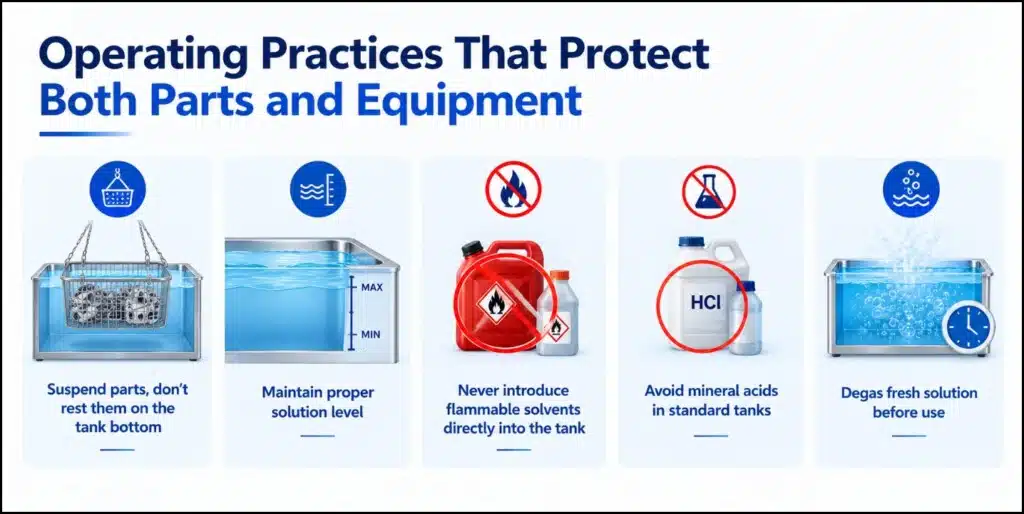
Material selection is half the equation – tank operation matters just as much:
- Suspend parts, don’t rest them on the tank bottom: Cavitation is most intense near the transducers; a basket or tray gives controlled, uniform exposure.
- Maintain proper solution level: An underfilled tank reduces cavitation effectiveness and risks concentrating energy unevenly.
- Never introduce flammable solvents directly into the tank: Alcohol, gasoline, and similar liquids create a genuine fire and explosion risk – use solutions formulated for ultrasonic use.
- Avoid mineral acids in standard tanks: Strong mineral acids can damage tank construction; acid cleaning requires tanks rated for that chemistry.
Can You Put Plastic in an Ultrasonic Cleaner?
Yes, in many cases – but “plastic” covers materials with very different tolerances. Rigid engineering plastics like PEEK, polycarbonate, and acetal generally handle ultrasonic cleaning well within appropriate limits. Softer, more flexible plastics are more prone to warping or clouding under sustained exposure, particularly at elevated temperatures.
The variables that determine whether ultrasonic cleaning plastic succeeds are the same for any material: plastic type and chemical resistance, solution compatibility, process temperature relative to heat tolerance, and frequency and power level. A cycle appropriate for removing heavy grease from steel isn’t automatically right for a delicate plastic housing – cleaning plastic in ultrasonic cleaner applications generally call for gentler, higher-frequency settings and matched chemistry.
What Cleaning Solutions Can Be Used in an Ultrasonic Cleaner?
The cleaning solution does the chemical work cavitation make possible – cavitation dislodges contamination, carries it away while simultaneously reducing the contaminant-to-substrate bond thereby making it easier for the ultrasonics to remove the contaminant. Ultrasonic detergents are formulated for specific contaminants: alkaline for oils and grease, acidic or specialty formulations for oxides and scales, and neutral formulations for sensitive materials and finishes.
Selecting chemistry means matching it to both the contaminant and the material. A detergent aggressive enough to strip carbon from a steel casting could damage a softer plastic or degrade plated finishes. Zenith application engineers help match chemistry to both – the wrong pairing can mean incomplete cleaning, surface damage, or both.
How Does Ultrasonic Cleaning Work?
Understanding the ultrasonic cleaning process makes it easier to see why material suitability matters. Transducers convert electrical energy into high-frequency sound waves, generating cavitation – millions of microscopic bubbles that form and collapse continuously, releasing energy against the part’s surface without physical contact.
Four variables control that energy: ultrasonic cleaner frequency (lower is more aggressive, higher is gentler and more even), temperature (improves chemistry performance but raises risk to heat-sensitive materials), cleaning time, and solution chemistry. Adjusting any one changes how the process interacts with the part – why the same ultrasonic cleaning method that suits one material can be wrong for another.
How to Determine If a Material Is Suitable for Ultrasonic Cleaning
Before committing a part to a standard ultrasonic cleaning procedure, check:
- Material properties: Porosity, flexibility, heat tolerance, and chemical resistance of the base material.
- Contamination type: What’s being removed, and how aggressive a cleaning chemistry and cavitation intensity that removal actually requires.
- Coatings and finishes: Whether any surface treatment could be affected by cavitation, temperature, or solution chemistry.
- Part construction: Seals, cavities, bonded joints, or assemblies that could trap solution or be affected by pressure changes.
- Cleaning chemistry compatibility: Confirming the detergent or solution is chemically compatible with the part material, not just effective against the contaminant.
- Process conditions: Frequency, temperature, and cycle time appropriate to the material’s tolerances – not just the contamination level.
- Representative-part testing: Testing a sample part under proposed process conditions before committing full production volume – the most reliable way to confirm suitability.
Need Help Evaluating Your Cleaning Application?
The right ultrasonic cleaning applications approach depends on your specific part, material, contamination, and production requirements. Zenith Ultrasonics provides a wide range of ultrasonic cleaning machines, and our application engineers can help evaluate whether your part is suited to standard cleaning or needs a modified process.
Submit Your Application for Evaluation

