
Ultrasonic Cleaner Temperature: What Temperature Is Best?
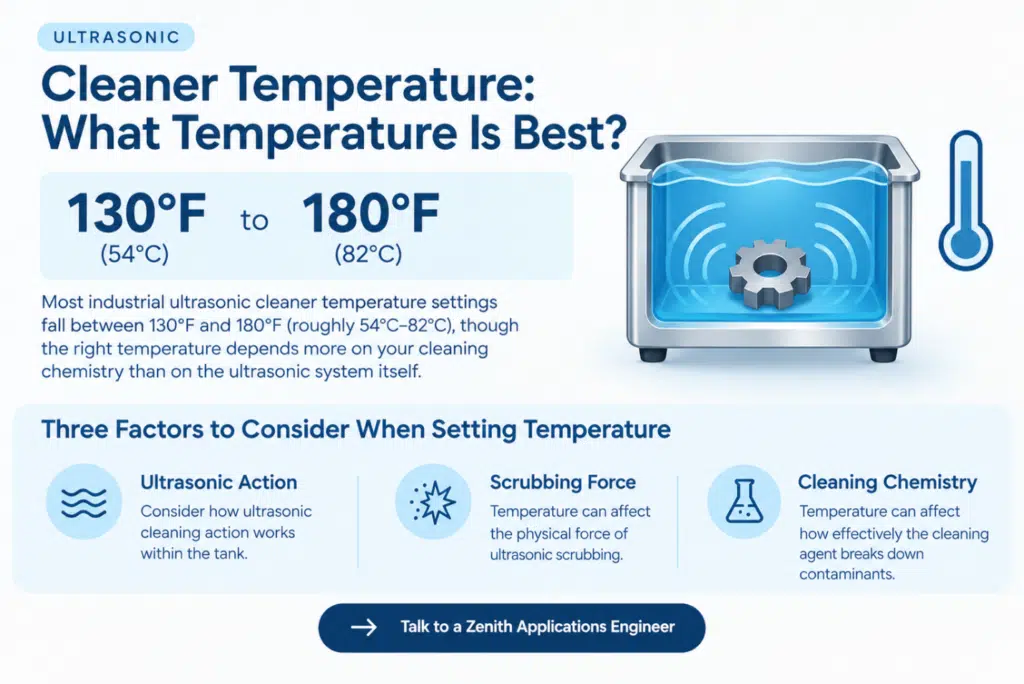
Most industrial ultrasonic cleaner temperature settings fall between 130°F and 180°F (roughly 54°C–82°C), though the right temperature for your process depends more on your cleaning chemistry than on the ultrasonic system itself. Temperature affects how forcefully ultrasonic cleaning action scrubs the part surface and how effectively your cleaning agent breaks down the contaminant. Getting the balance right matters more than choosing a single best temperature for every ultrasonic cleaning application.
What Is the Best Temperature for an Ultrasonic Cleaner?
There isn’t one universal answer, the best temp for ultrasonic cleaner performance depends primarily on the cleaning agent in use, not a fixed ultrasonic setting. Traditional ultrasonic theory suggests operating at roughly 65% of the cleaning solution’s boiling point, and this guideline has been used for decades as a general starting point. In practice, though, the temperature that matters most is whichever temperature your specific cleaning chemistry performs best at – each cleaning fluid has its own optimum temperature range, and that’s typically what determines the setting used for a given application, more than the ultrasonic system’s own characteristics.
What Is the Typical Operating Temperature?
Most industrial ultrasonic cleaning systems operate within an ultrasonic cleaner temperature range of 130°F to 180°F (approximately 54°C to 82°C). Where your process falls within that range depends on the cleaning chemistry and the contaminant being removed – general-purpose alkaline detergents often run toward the middle or upper end of the range, while acidic cleaning agents should be run as low as possible within their effective range, since excessive heat can attack the stainless-steel tank construction over time.
How Does Temperature Affect Cleaning Results?
Temperature affects ultrasonic cleaning through both mechanical action and cleaning chemistry. As fluid temperature increases, the physical force of ultrasonic scrubbing can decrease, while many cleaning agents work more effectively when heated.
The effect on overall cleaning results depends on the cleaning chemistry, the contaminant, and the process conditions. The right temperature should be selected based on the cleaning agent’s performance requirements, not the ultrasonic system’s raw power alone.
One caution applies specifically to acidic cleaning chemistries: excessive heat can attack the stainless steel used in the tank. When using acidic cleaning agents, the lowest effective temperature is generally the safest choice.
Need Immediate Assistance?
Fill out the contact form to provide us with information regarding your cleaning application.
