
Cannulations, Coatings, and Cleanliness Validation
Cleanliness is a critical part of orthopedic implant manufacturing, supporting biocompatibility and controlling contamination before subsequent processing, including sterilization where applicable. Residual machining oils, polishing compounds, or particulate can compromise the cleanliness of the implant and may affect downstream processing or biological performance if not adequately removed.
Zenith Ultrasonics engineers orthopedic ultrasonic cleaning systems for manufacturers producing implants and instruments in titanium, cobalt-chromium, stainless steel, and other orthopedic-grade materials – matching frequency, chemistry, and automation according to the defined cleanliness specifications and acceptance criteria.

Made in the USA

Custom Engineered Solution

Comprehensive Warranty
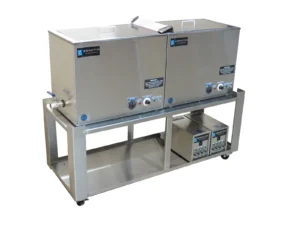
Ultrasonic Cleaning Systems for Orthopedic Cleaning
Zenith offers several platforms commonly configured for orthopedic manufacturing applications:
TRANSTAR II Automated Cleanroom Washer: Overhead gantry automation for cleanroom and controlled-environment processing, transferring parts through multi-stage cleaning without manual handling.
ADVANTAGE® Automated Ultrasonic Washer: Patented automation (US Patent 10,112,221) eliminates submerged basket-support structures in the ultrasonic tank, a design Zenith uses to increase ultrasonic energy reaching the part load.
ANGSTROM Automated Passivation System: Integrates ultrasonic pre-cleaning with nitric or citric acid passivation for stainless and other orthopedic-relevant alloys requiring a passivated finish.
MEC Multi-Stage Ultrasonic Cleaning Systems: Flexible multi-tank configurations that can include ultrasonic cleaning, rinsing, and drying, depending on the model and application.
ULTRAMATIC HV Multi-Process Cleaning System: A compact, high-performance clean/rinse/dry system combining ultrasonic cleaning, ultrasonic and spray rinsing, and oscillation in a small production footprint.
VORTEX Centrifugal Small Parts Sonic Washer: A four-tank automated system for small to medium-size parts that uses centrifugal rotation during processing to expose parts to ultrasonic cleaning while minimizing part movement. It is designed to drastically reduce detergent transfer into rinse tanks to increase rinse water longevity and reduce water consumption, and to speed the drying process and reduce the potential for water spotting
Why Orthopedic Manufacturers Choose Zenith Ultrasonics
- Engineering-led process design: Systems are configured around your specific components, materials, and cleanliness requirements — not adapted from a generic industrial platform.
- Application testing: Zenith can evaluate cleaning performance against your actual components before a purchase commitment, providing documented results tied to your specific parts.
- CROSSFIRE® Multiple Frequency Technology (US Patent 5,865,199 and 6,019,852): Available where mixed geometries or surface treatments benefit from combining the scrubbing force of lower frequencies with the even distribution of higher frequencies in a single process.
- Passivation integration: Ultrasonic pre-cleaning and passivation can be engineered into a single passivation system for stainless and other applicable orthopedic alloys.
- Manufacturing experience since 1935: Zenith has engineered industrial ultrasonic cleaning systems in the United States for decades, supporting manufacturers across medical device and other precision manufacturing sectors.
Overcome the Cleaning Challenges of Orthopedic Implant and Instrument Manufacturing
Orthopedic components present a specific combination of challenges: complex geometries – porous coatings, threaded features, internal cannulations, textured surfaces designed for bone ingrowth – combined with tight, often validated cleanliness requirements and materials that must not be chemically or mechanically altered during processing. Machining oils, cutting fluids, polishing and buffing compounds, and handling residues all need to be removed thoroughly and consistently, without affecting surface finish, dimensional tolerances, or the porous or textured surfaces engineered into many implant designs.
Manual cleaning struggles with the internal cannulations and textured porous coatings common in orthopedic components – cavitation reaches these areas without requiring line-of-sight access, but only when frequency and process parameters are matched correctly to the material and geometry.
Ultrasonic Cleaning Applications Across Orthopedic Manufacturing
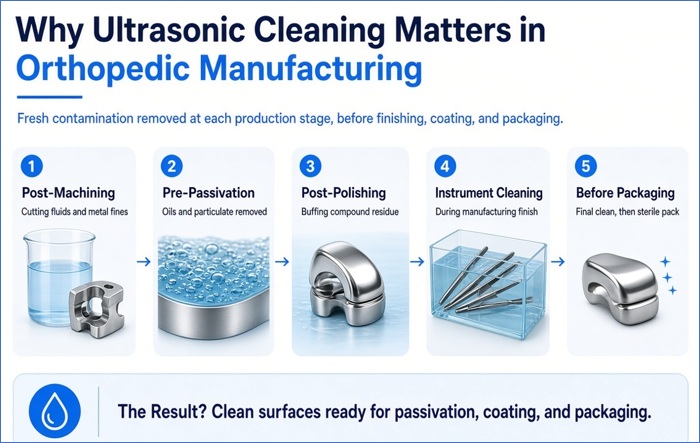
- Post-machining cleaning: Removing cutting fluids and metal fines from machined implant and instrument components before finishing or passivation.
- Pre-passivation and pre-coating cleaning: Ensuring surfaces are free of oils and particulate before passivation or coating processes, since residual contamination interferes with both.
- Post-polishing cleaning: Removing buffing and polishing compound residue from finished implant surfaces.
- Instrument cleaning and reprocessing support: Cleaning surgical instruments as part of the manufacturing and finishing process.
- Final cleaning before packaging: Validated final-stage cleaning ahead of sterile packaging and sterilization.
What Orthopedic Components Can Be Cleaned?
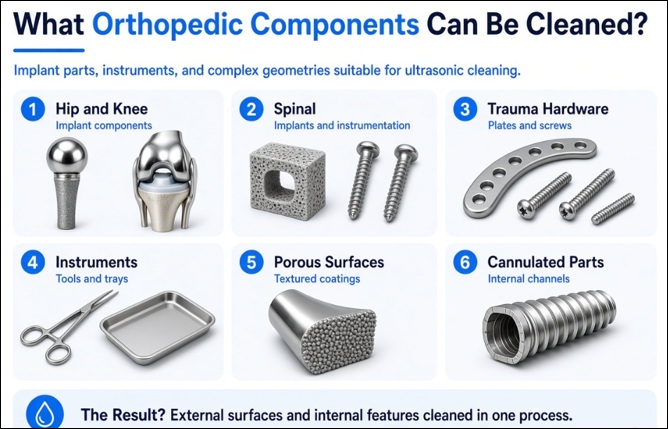
- Hip and knee implant components
- Spinal implants and instrumentation
- Trauma fixation plates, screws, and hardware
- Surgical instruments and instrument trays
- Porous and textured coated implant surfaces
- Cannulated components with internal channels
Why Use Ultrasonic Cleaning for Orthopedic Components?
Cavitation reaches internal cannulations, threaded features, and porous coated surfaces without mechanical contact – relevant for orthopedic components where mechanical abrasion risks damaging a textured surface engineered for bone ingrowth or altering a critical dimensional tolerance. Controlled process parameters support the consistency orthopedic manufacturers need across production batches, and documented, repeatable cleaning cycles support the process validation orthopedic manufacturing typically requires.
Zenith ultrasonic systems are used with materials common to orthopedic manufacturing, including titanium, cobalt-chromium alloys, and stainless steel – with frequency, chemistry, and cycle parameters matched to the specific alloy and surface treatment involved, since aggressive parameters appropriate for one material or geometry are not automatically appropriate for another.

