
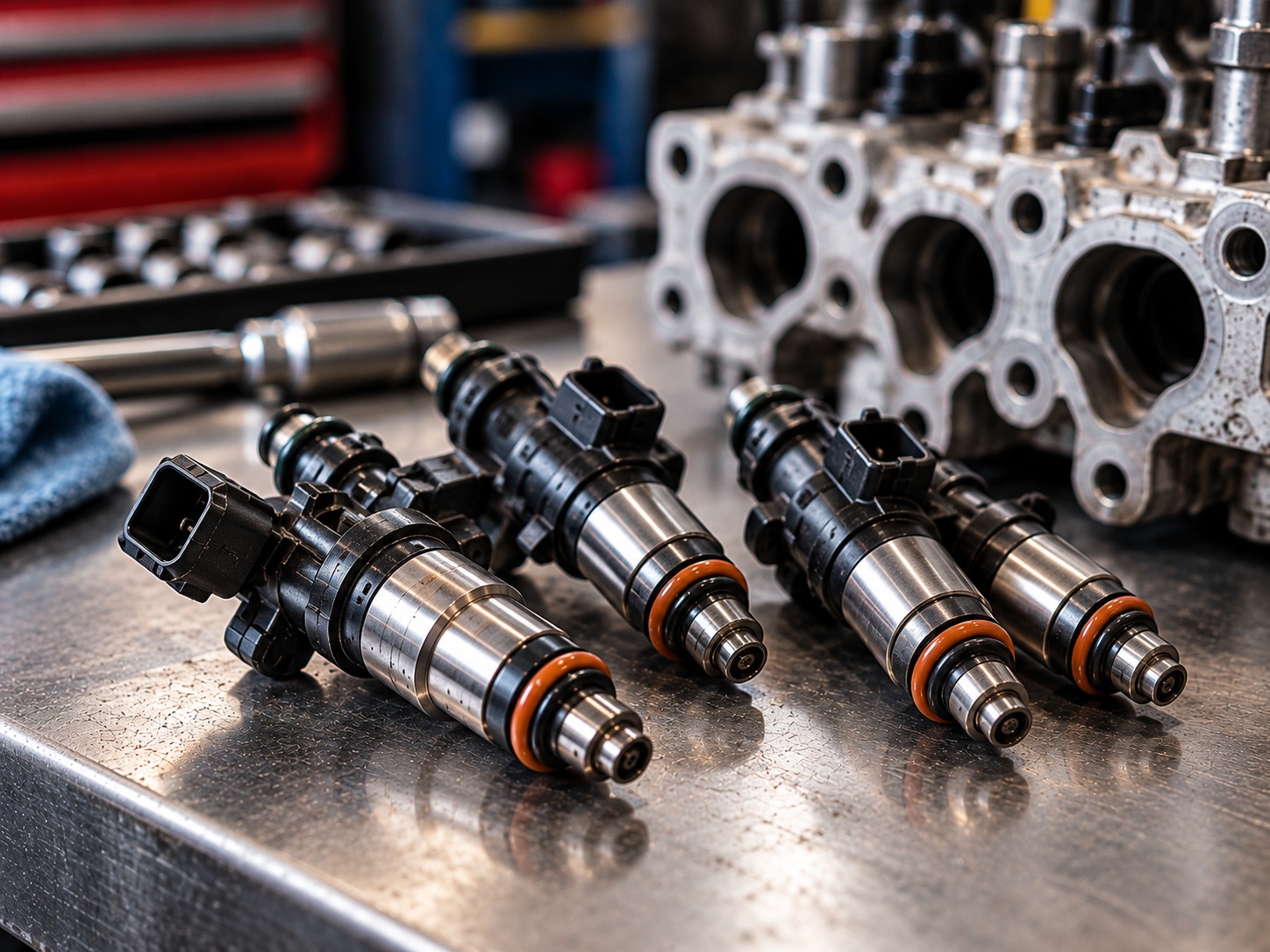
Injector cleanliness is not a cosmetic concern, it is a direct determinant of spray pattern, flow rate, and atomization, which in turn determine combustion efficiency and emissions compliance. Whether injectors are coming off a production line or back from the field for reconditioning, residual carbon, varnish, and particulate at the nozzle or in internal passages changes how an injector performs, often in ways that don’t show up until final test or, worse, after the part is back in service. An ultrasonic fuel injector cleaner is built specifically to reach that contamination – at the orifice, in internal fuel galleries, and around the pintle or valve seat without the inconsistency of manual soaking or the limited reach of fuel-rail additive treatments.

Made in the USA

Custom Engineered Solution

Comprehensive Warranty
Overcome the Cleaning Challenges of Fuel Injector Manufacturing and Reconditioning
Production and reconditioning environments face different versions of the same core problem: contamination in geometry too fine and too enclosed for line-of-sight cleaning to reach reliably.
- New Production: Machining oils, metal fines, and polishing residue from precision drilling and turning on the injector body and nozzle.
- Remanufacturing: Baked-on carbon, varnish, and fuel-system gum accumulated over years of field service, often heavier and more chemically stubborn than anything seen on a new part.
- Both Environments: Internal fuel passages and orifices small enough that manual tools, brushes, and fuel-rail additive treatments cannot consistently reach or verify.
How Does Ultrasonic Fuel Injector Cleaning Work?
Ultrasonic cleaning uses high-frequency sound waves to generate cavitation – microscopic bubbles that form and collapse in a liquid cleaning solution. Each collapse releases concentrated energy directly against whatever surface is nearby, including internal passages and nozzle orifices with no direct line of access. Because cavitation occurs throughout the submerged solution rather than only where a tool or spray nozzle makes contact, it reaches internal injector geometry with the same cleaning action applied to the external housing – without the physical contact that could stress delicate internal components.
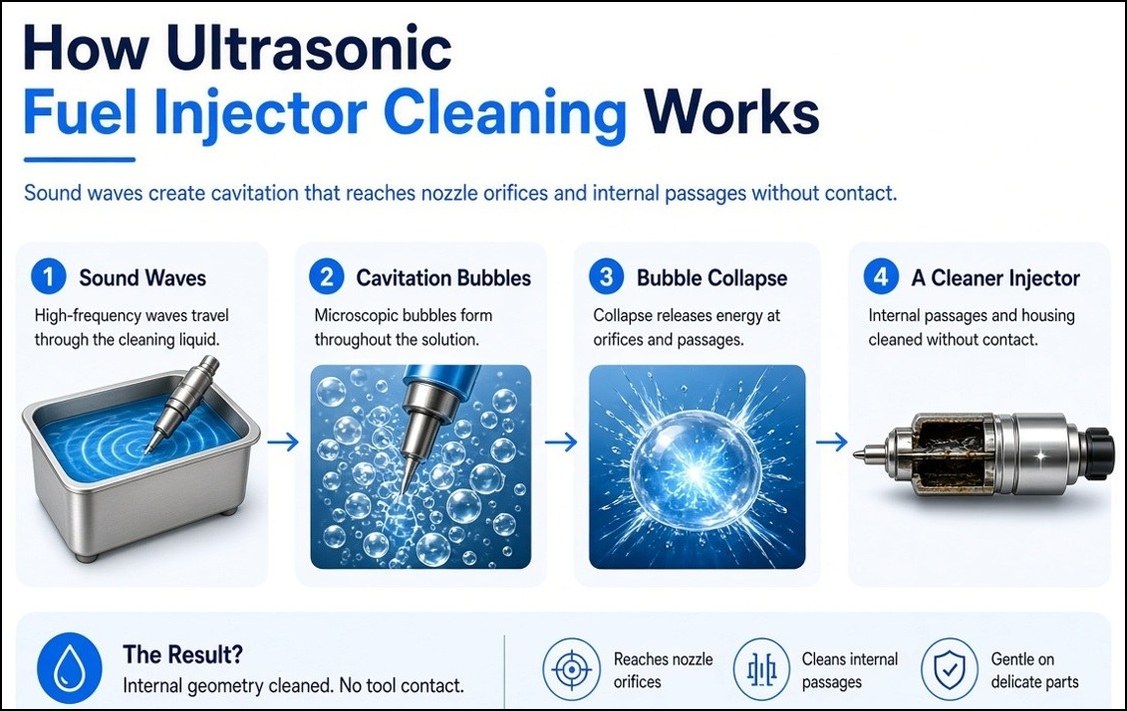
Frequency selection matters for injectors specifically. Lower frequencies in the 25–40 kHz range provide more aggressive cavitation suited to heavier carbon and varnish deposits, while production facilities cleaning more delicate or precision-finished injector bodies may favor a gentler frequency to avoid stressing fine internal features. Many injector cleaning processes also electrically cycle the injector open and closed during the ultrasonic cycle, so solution and cavitation energy reach the internal solenoid and pintle assembly directly rather than only the exterior and visible passages.
Common Fuel Injector Contaminants
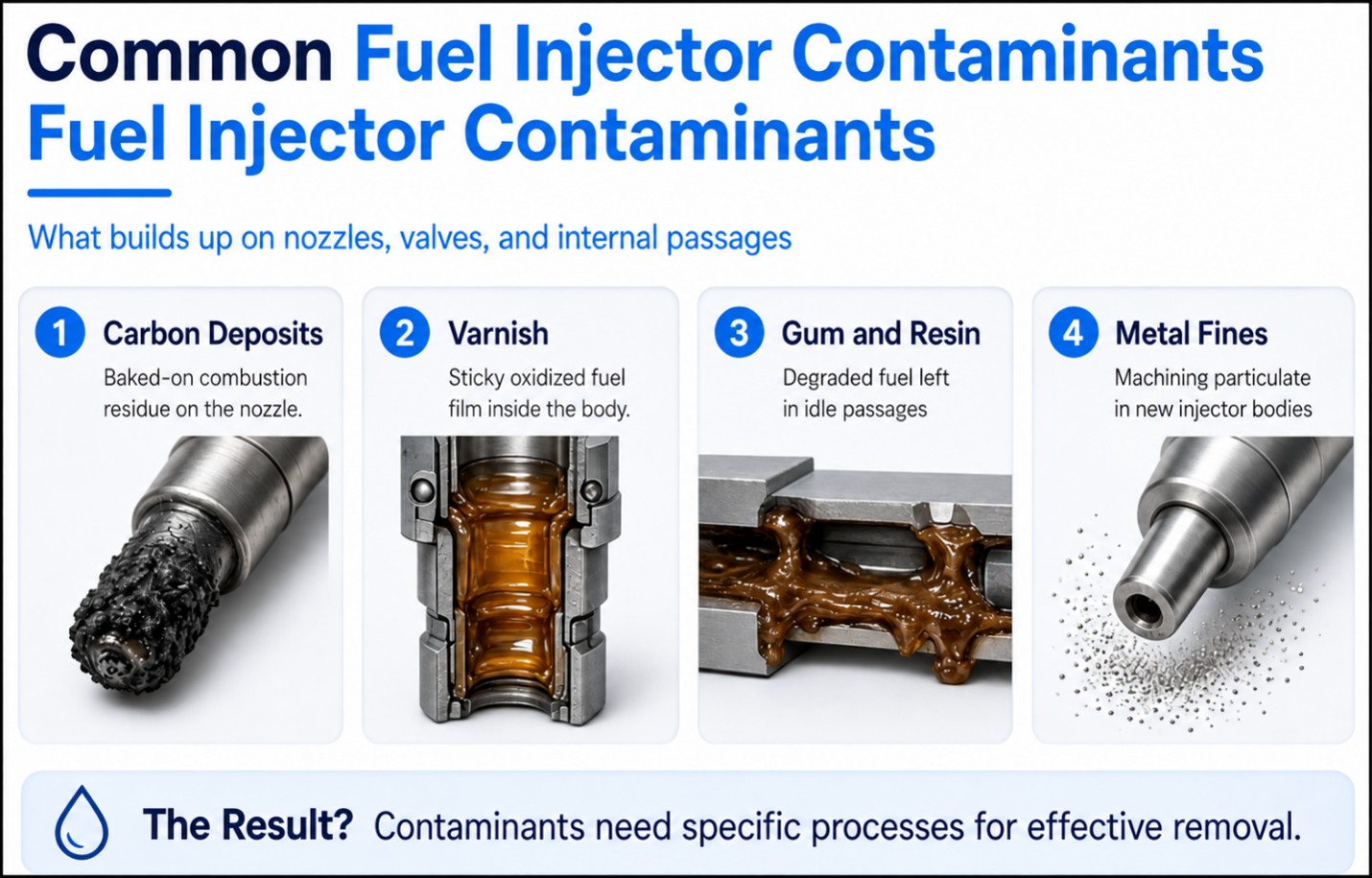
- Carbon deposits: Baked-on carbon from combustion byproducts, typically the hardest contaminant to remove and the most likely to distort nozzle spray pattern.
- Varnish: Oxidized fuel residue that forms a sticky film on internal surfaces, restricting fuel flow and valve movement.
- Gum and resin deposits: Degraded fuel byproducts that accumulate in fuel passages, particularly in injectors that have sat with fuel in the system for extended periods.
- Metal fines and machining residue: Relevant primarily in production – fine particulate from drilling and honing of injector bodies and nozzle orifices.
Ultrasonic Cleaning Applications for Fuel Injectors
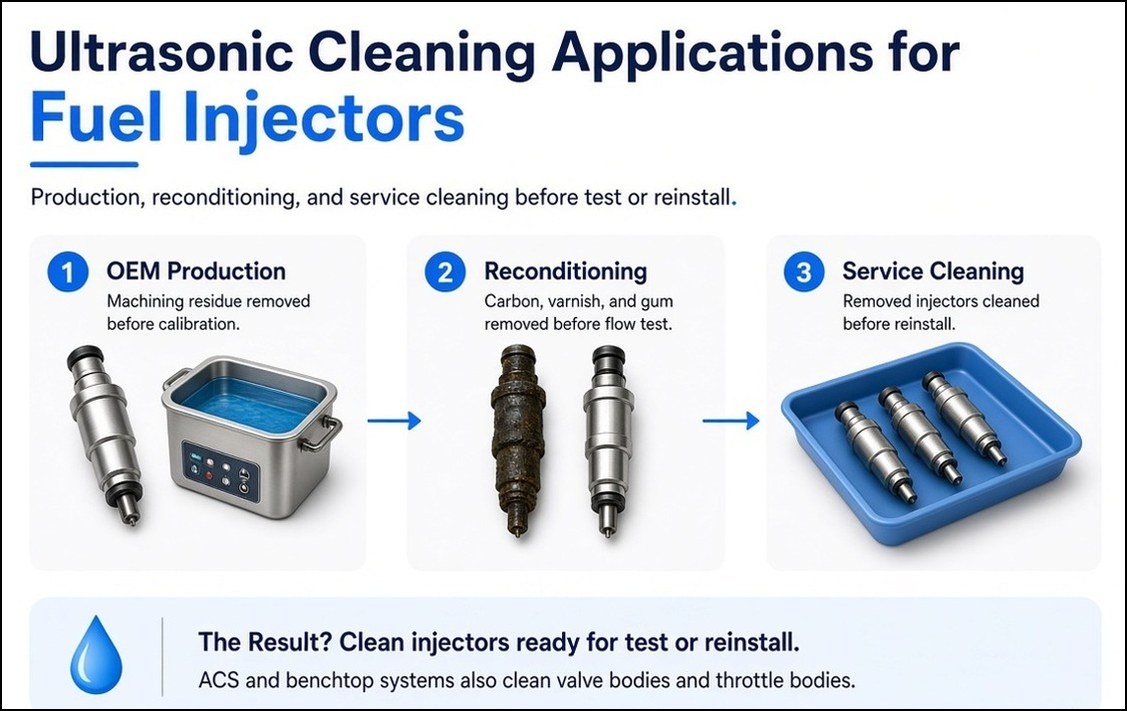
- OEM Production Cleaning: Post-machining and pre-assembly cleaning of new injector components to remove manufacturing residues before final calibration and testing.
- Fuel Injector Reconditioning: Removing carbon, varnish, and gum deposits from used injectors as part of a remanufacturing process, ahead of flow and spray testing.
- Service and Maintenance Cleaning: Cleaning injectors removed for diagnostic or maintenance purposes before reinstallation or further testing.
The same platforms used for injector cleaning, particularly Zenith’s ACS and benchtop lines – are also commonly applied as an ultrasonic engine parts cleaner more broadly, handling valve bodies, throttle bodies, and other precision engine components that share the same contamination profile: machining residue, carbon, and varnish in restrictive internal geometry. For larger high-volume applications, manual or automated multi-stage cleaning systems would apply.
The Benefits of Using an Ultrasonic Fuel Injector Cleaner
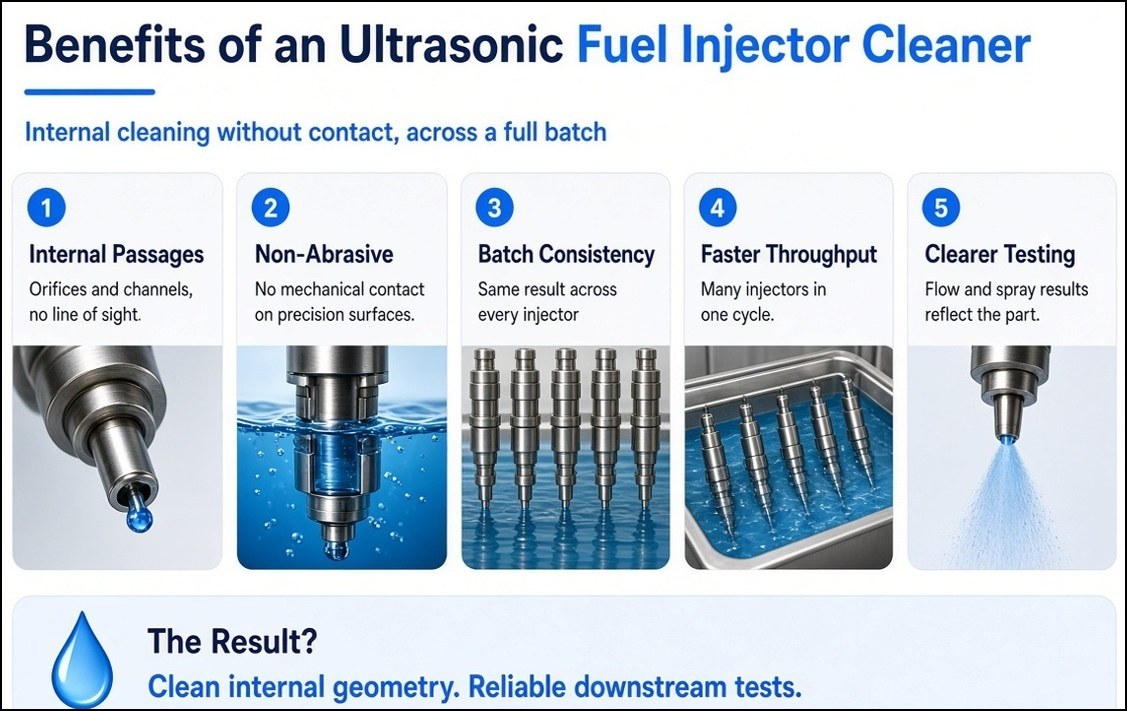
- Reaches internal passages: Cavitation cleans nozzle orifices and internal channels with no line-of-sight requirement.
- Non-abrasive process: Contamination is removed without mechanical contact, protecting delicate internal components and precision-machined surfaces.
- Consistent batch results: Controlled process parameters deliver equivalent cleanliness across every injector in a batch, supporting both production consistency and reconditioning quality standards.
- Faster throughput: Multiple injectors can be cleaned simultaneously in a single cycle rather than processed one at a time.
- Supports downstream testing: Thorough, consistent cleaning gives flow and spray pattern testing results that reflect the injector’s actual mechanical condition, not residual contamination.
Ultrasonic Systems for Fuel Injector Cleaning
Zenith offers a range of platforms suited to different injector cleaning volumes and levels of automation:
- ADVANTAGE® Automated Ultrasonic Washer: Patented automation (US Patent 10,112,221) that eliminates internal basket support structures, maximizing ultrasonic energy delivery – suited to higher-volume production and reconditioning lines.
- ULTRAMATIC HV Multi-Process Cleaning System: Combines ultrasonic cleaning, ultrasonic and spray rinsing, and oscillation with a multi-position conveyor for queuing multiple baskets.
- NOVA Semi-Automated Ultrasonic Cleaner: Positioned between manual benchtop systems and full automation, suited to growing reconditioning operations not yet ready for a fully automated line.
- Automotive/Aviation Parts Cleaners (ACS): Single-tank washers built around Zenith’s patented CROSSFIRE® dual-frequency system (25 kHz and 40 kHz simultaneously), combining raw cleaning power with the penetration needed for threaded and recessed injector features.
- Benchtop Ultrasonic Cleaners / Clean & Rinse: Bench-top systems for lower-volume reconditioning operations, service shops, or facilities not yet ready for full production automation.
Common Mistakes to Avoid When Cleaning Fuel Injectors
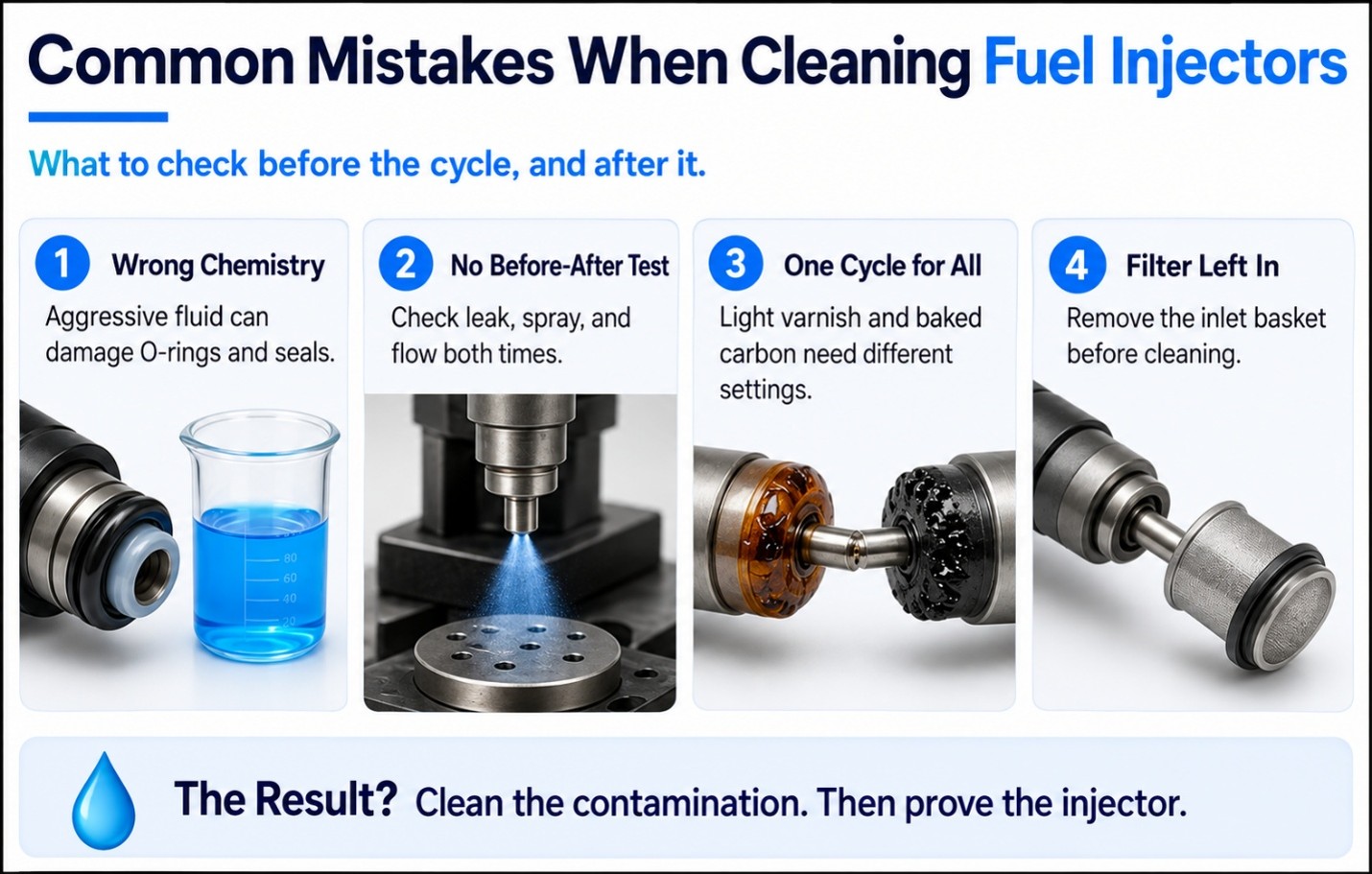
- Using the wrong cleaning chemistry: A solution aggressive enough to dissolve heavy carbon and varnish can also attack rubber O-rings, filter baskets, and other elastomer components if it isn’t formulated for injector materials. A seal damaged during cleaning can cause a fuel leak even after the injector cleans up perfectly.
- Skipping pre- and post-clean verification: Leakage, spray pattern, and flow rate testing before and after cleaning confirm the cycle actually restored the injector to specification — without that data, a visually clean injector may still be out of flow tolerance.
- Mismatched frequency for the deposit type: Running every injector through the same generic cycle regardless of whether the contamination is light varnish or heavy baked-on carbon under-cleans some parts and over-processes others.
- Not removing the filter basket before cleaning: Injector inlet filter baskets can shield internal passages from cavitation energy if left in place during cleaning, and should typically be removed and cleaned or replaced separately.
- Treating ultrasonic cleaning as a replacement for electrical and leak testing: Ultrasonic cleaning addresses contamination, not electrical faults in the solenoid or coil – a full reconditioning process still needs electrical verification alongside the cleaning cycle.
Why Manufacturers and Remanufacturers Choose Zenith Ultrasonics
- CROSSFIRE® Multiple Frequency Technology: US Patent 5,865,199 and 6,019,852, running multiple frequencies simultaneously to address both heavier external deposits and fine internal passages in a single cycle.
- Application-specific configuration: Frequency, chemistry, and cycle time configured around your specific injector type and contamination profile – production and reconditioning facilities often need different process parameters even when using the same equipment platform.
- Application testing: Zenith can test cleaning performance against your actual injectors before a purchase commitment, particularly valuable in reconditioning, where incoming contamination severity varies and process parameters benefit from validation against real parts.
- Scalable platforms: From bench-top systems for lower-volume reconditioning to fully automated production lines, Zenith’s product range supports scaling without switching equipment vendors.
- Custom-engineered systems: Available where standard configurations don’t fit a specific injector family or facility layout. See Custom Ultrasonic Cleaners.
- Manufacturing experience since 1935: Zenith has engineered industrial ultrasonic cleaning systems in the United States for decades, supporting automotive production and reconditioning operations.

