
Will an ultrasonic cleaner remove rust from metal parts? Ultrasonic cleaning can help remove rust when it is paired with a compatible rust-removal chemistry and suitable process conditions. It cannot restore metal that has already been lost to corrosion, and it does not repair pitting or restore structural integrity. Zenith Ultrasonics builds industrial ultrasonic cleaning equipment – tabletop units, multi-tank clean/rinse systems, and custom multi-stage lines that can be configured for rust-related applications once the part, contaminant, and process requirements are understood through application testing.
How Does Ultrasonic Cleaning Remove Rust?
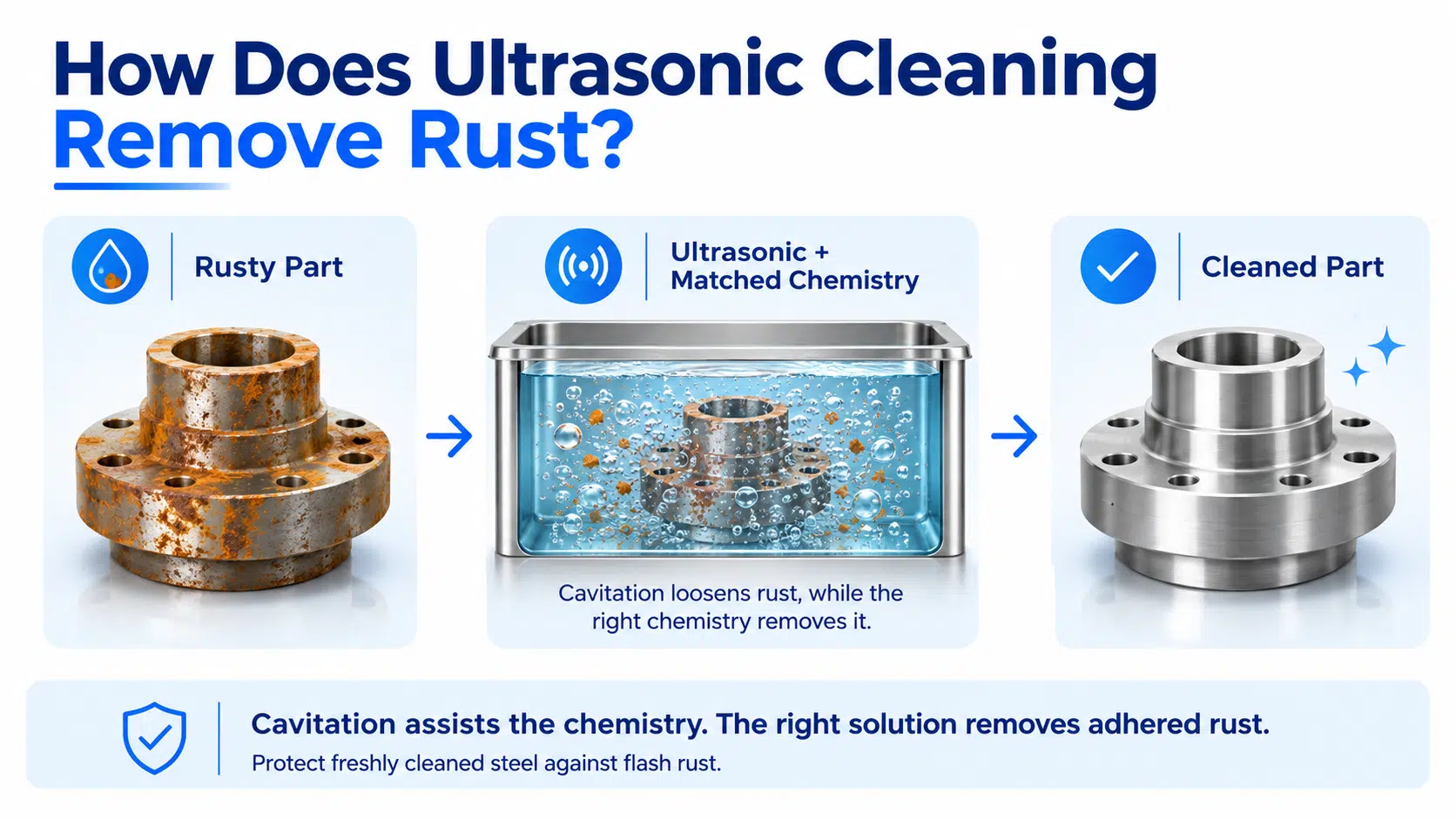
Ultrasonic cleaners generate high-frequency sound waves that create and collapse microscopic cavitation bubbles in a liquid. When those bubbles collapse near a part surface, the energy helps loosen and dislodge material from exposed areas and from small crevices that a brush or spray cannot easily reach. The mechanical action of cavitation assists the cleaning solution; it does not, by itself, chemically dissolve bonded iron oxide.
Does ultrasonic cleaning remove rust? Only when the bath chemistry is formulated to attack or lift the iron oxide. Plain water or a neutral detergent may remove loose debris or oil, but it will not meaningfully remove adhered rust. Rust-removal chemistry (often mildly acidic, chelating, or specialized alkaline formulations matched to the base metal) does the chemical work. Ultrasonic energy improves contact and accelerates the process. Removing existing rust is a different task from preventing new rust. Freshly cleaned steel is more prone to flash rusting because protective oils and films have been stripped away, exposing bare metal to oxygen and moisture.
What Levels of Rust Can Ultrasonic Cleaning Remove?
Results depend on how tightly the rust is bonded, how thick it is, the base material, and the chemistry used. Light surface rust and flash oxidation are usually the most responsive. Moderate rust can often be reduced or removed with the right chemistry and cycle, though multiple cycles or a pre-brush to remove loose scale may help. Heavy, thick, or deeply pitted rust frequently requires longer times, more aggressive (but still compatible) chemistry, or additional mechanical steps; complete removal is not guaranteed, and the underlying metal loss remains.
| Rust Severity | Potential Results with Suitable Chemistry + Ultrasonics | Key Limitations |
|---|---|---|
| Light surface / flash rust | Often removed or greatly reduced in a single cycle | Parts become more susceptible to new flash rust afterward |
| Moderate surface rust | Significant reduction or removal possible; may need longer cycles or a second pass | Pitting or metal loss already present is not repaired |
| Heavy / thick or scale | Partial removal; residual scale common | Aggressive chemistry risks surface attack; additional treatment often needed; structural integrity unchanged |
Additional mechanical or chemical treatment may be required when rust is thick or when the part has deep recesses that shield some areas from full cavitation intensity. Removing corrosion products does not restore the original dimensions or strength of the part.
Which Metal Parts Are Suitable for Ultrasonic Rust Removal?
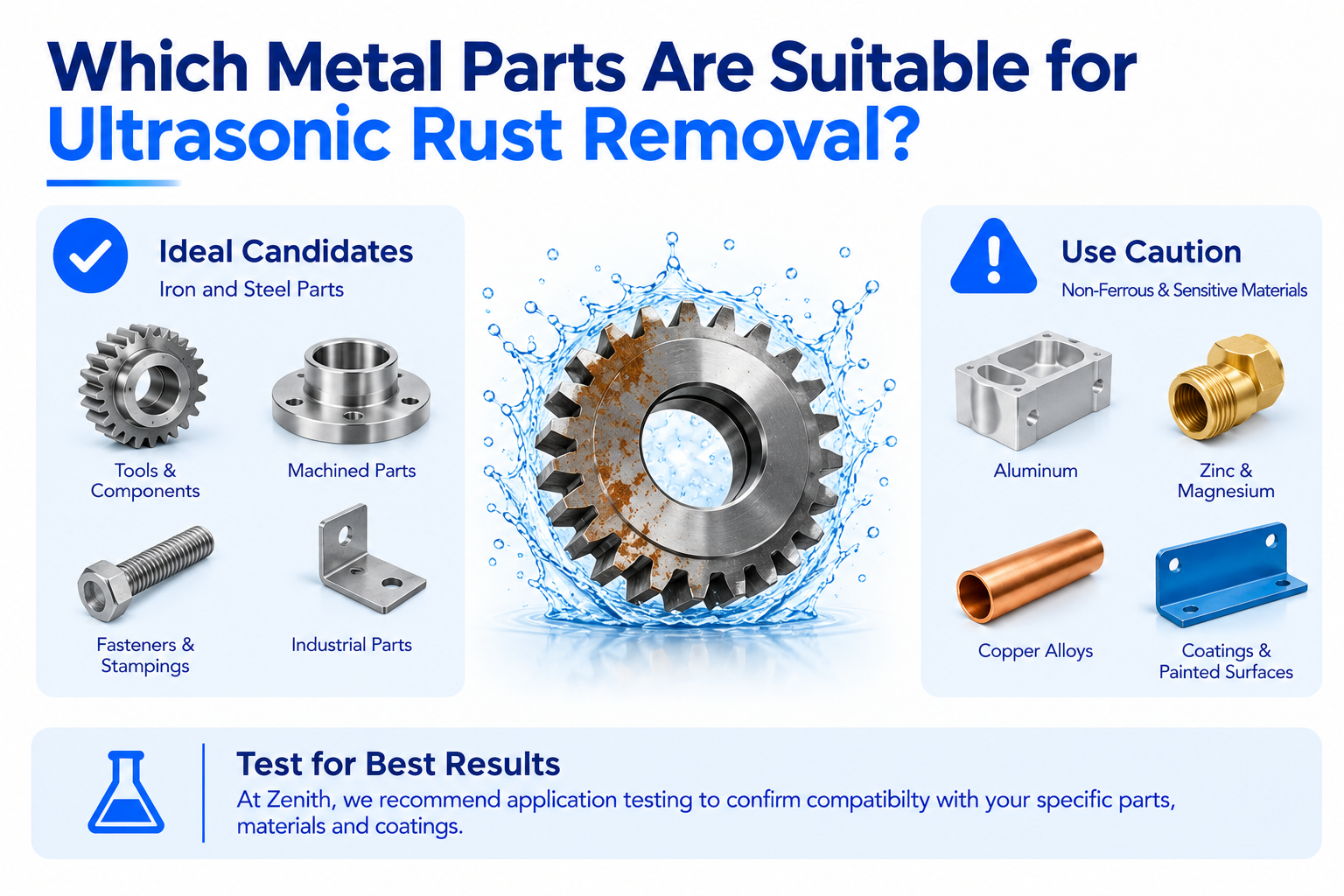
Compatible iron and steel tools, fittings, machined components, stampings, and many other industrial parts are common candidates for ultrasonic rust removal, provided the chemistry is matched to the alloy and any coatings. These ferrous materials form iron oxide (true rust) that can be addressed with appropriately formulated rust-removal chemistry combined with ultrasonic action.
Rust on iron and steel is chemically and process-wise distinct from oxidation on other metals. Aluminum, for example, forms aluminum oxide rather than iron oxide. Zinc, magnesium, and certain copper alloys also oxidize differently. The chemistry that effectively loosens iron oxide on carbon steel or cast iron can attack, etch, or discolor aluminum, zinc, and some non-ferrous alloys. Coatings, thin platings, and painted surfaces may also lift or degrade when exposed to the same chemistry. Assemblies that combine ferrous and non-ferrous metals, or that contain sensitive finishes, therefore require careful evaluation before any rust-removal process is applied.
At Zenith, suitability is confirmed through application testing on the actual part material, geometry, and contamination level rather than generalized claims. Zenith systems are frequently evaluated for steel tooling, machined ferrous components, and similar industrial parts where rust removal is a secondary or intermittent requirement alongside other manufacturing contaminants. For non-ferrous metals or mixed-metal assemblies, different chemistry and process parameters are typically required, and testing is used to confirm that the chosen approach will not damage the substrate or coatings.
How to Remove Rust from Metal Parts Using an Ultrasonic Cleaner
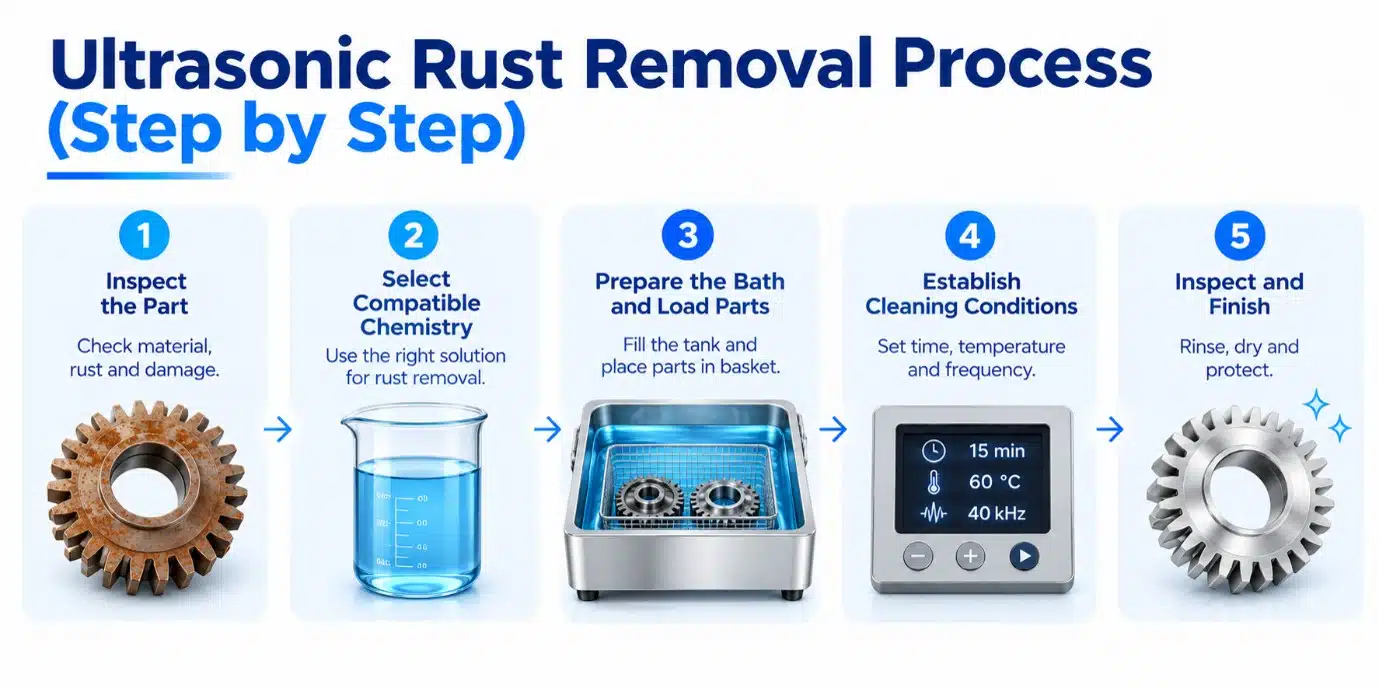
- Inspect the part: Identify the material, any coatings or platings, the severity and location of the rust, and existing pitting or damage.
- Select compatible chemistry: Follow the equipment manufacturer’s and cleaning-solution supplier’s instructions for metal compatibility, concentration, and temperature limits. Confirm the chemistry is intended for rust removal rather than general degreasing.
- Prepare the bath and load the parts: Fill the tank according to equipment guidance, heat if required by the chemistry, and place parts in baskets or fixtures with adequate spacing so surfaces and recesses are fully wetted and not shadowed.
- Establish cleaning conditions: Determine suitable time, temperature, and frequency through application testing on sample parts. Results vary; do not assume a universal cycle.
- Inspect and finish the parts: Rinse if the process requires it, dry thoroughly, and apply suitable corrosion protection (rust-preventative dip, inhibitor-containing chemistry, or controlled storage) before the parts can flash rust.
Many buyers specifically ask will an ultrasonic cleaner remove rust on tools or machined components before committing to a system? Only when the full process – chemistry, parameters, and finishing is matched to the specific parts.
What Factors Affect Ultrasonic Rust Removal Results?
| Factor | Effect on Results | Practical Consideration |
|---|---|---|
| Rust severity & thickness | Heavier scale takes longer or may not fully release | Pre-remove loose material; test samples |
| Base material & coatings | Chemistry that works on steel may etch aluminum or lift plating | Verify compatibility before production |
| Cleaning chemistry | Primary driver of oxide removal | Match concentration and type to metal and soil |
| Frequency | Lower frequencies (e.g., ~25–40 kHz range common in industry) produce more aggressive cavitation for heavy soils; higher frequencies are gentler | Confirm with application testing; do not assume one frequency is universally best |
| Temperature | Most rust-removal chemistries perform better when heated within their recommended range | Stay inside chemistry and equipment limits |
| Cleaning time | Longer exposure increases removal but also risk of over-processing | Stop when acceptable cleanliness is reached |
| Part geometry & loading | Recesses, blind holes, and dense packing reduce local cavitation intensity | Use proper baskets, spacing, and agitation if available |
Results vary because every combination of part, rust load, chemistry, and equipment setting is different. There are no guaranteed cleaning times or removal percentages that apply across applications. Do ultrasonic cleaners remove rust the same way every time? No, outcomes depend on the variables above.
Benefits and Limitations of Ultrasonic Rust Removal
Benefits
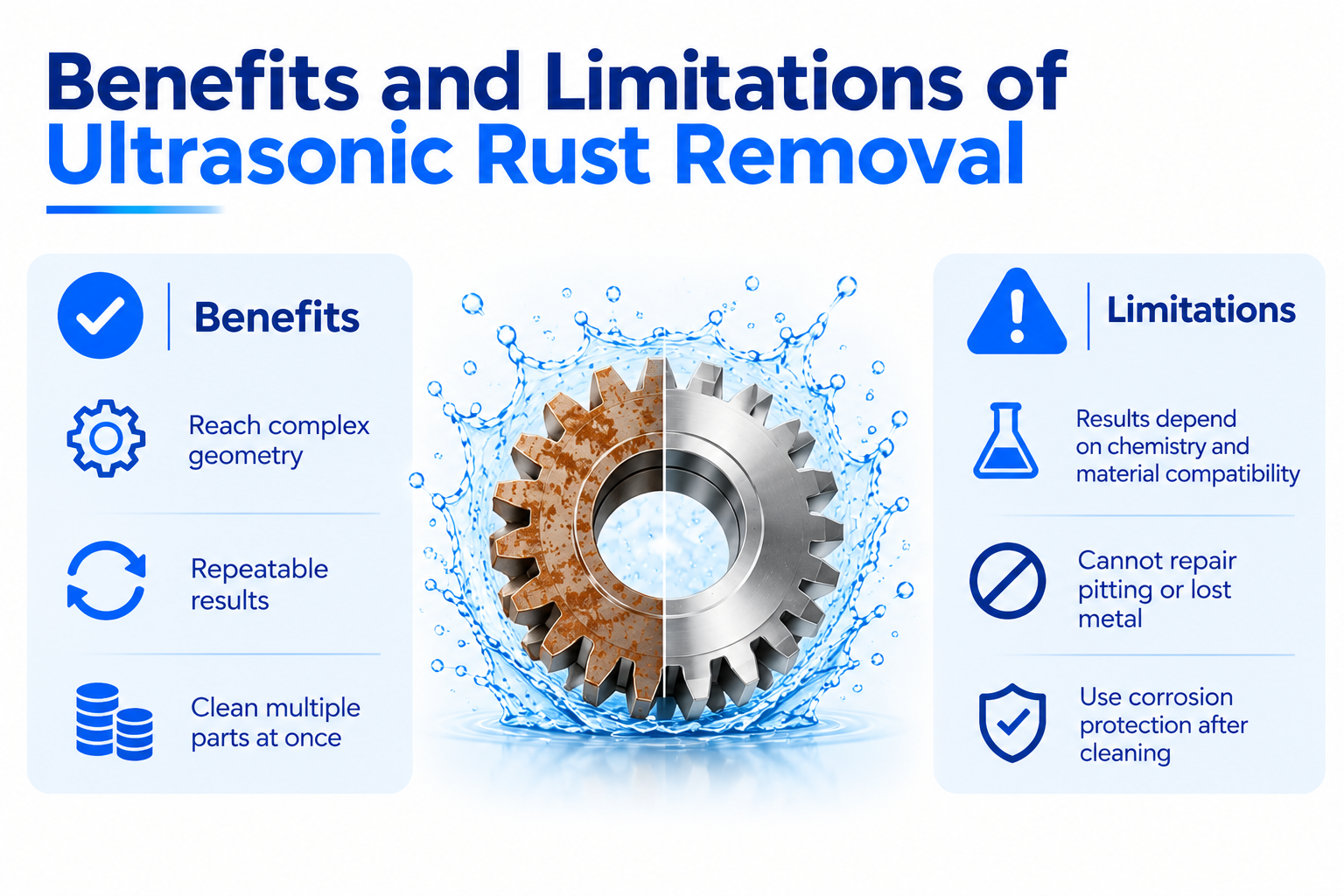
Ultrasonic cleaning can reach wetted recesses, blind holes, and complex geometry that are difficult to scrub by hand. Once parameters are established, the process is more repeatable than manual methods and supports batch cleaning of multiple parts at the same time, reducing labor for suitable production volumes.
Limitations
Results depend on material and chemistry compatibility. Aggressive rust-removal chemistry can attack or discolor some alloys, coatings, or platings if not properly matched. Ultrasonic cleaning cannot repair pitting or restore metal already lost to corrosion. Freshly cleaned surfaces are also more prone to new rust, so corrosion protection remains a necessary follow-up step.
How to Choose an Ultrasonic Cleaning System for Rust Removal
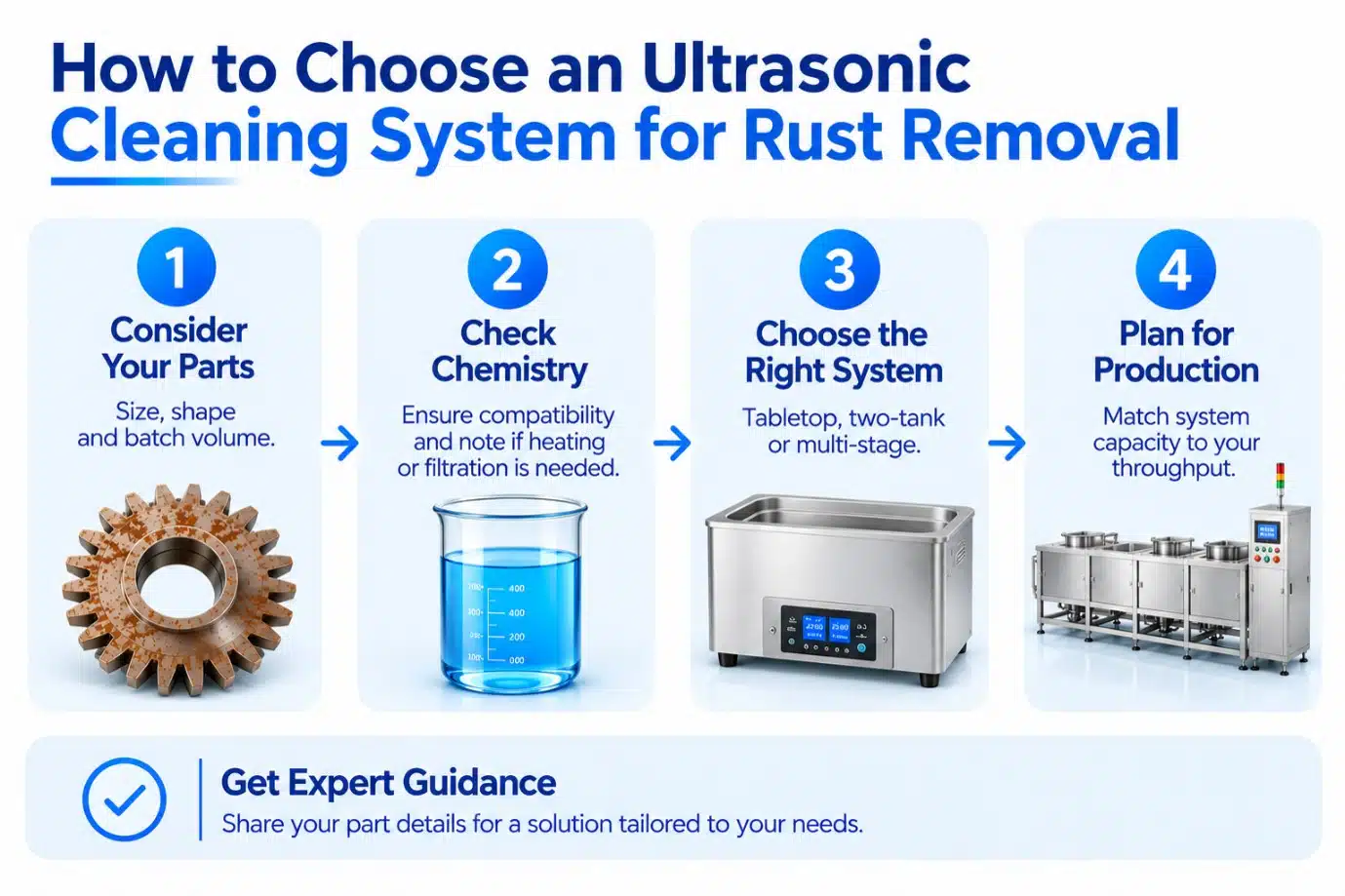
Consider part dimensions, batch size or throughput, chemistry compatibility (including any need for heated tanks or filtration), and whether rinsing and drying are required. Zenith offers tabletop ultrasonic cleaners for smaller batches, two-tank clean/rinse configurations, and custom multi-stage systems that can incorporate rinsing, drying, and rust-preventative stages. The ASTRO automated clean-and-dry system is designed for steel parts where a chemistry with built-in rust inhibitors is used and zero-residue cleaning is not required; it is not presented as a universal rust-removal solution.
Larger industrial and automated ultrasonic cleaners can be configured for higher volume. Sharing part material, dimensions, rust severity, photographs, and production volume is recommended before selecting equipment.
See Zenith’s guide on preventing rust and oxidation after ultrasonic cleaning and the range of industrial ultrasonic cleaning systems.
Frequently Asked Questions About Ultrasonic Rust Removal
Matching the right equipment, chemistry, and process conditions is what determines whether ultrasonic cleaning will effectively address rust on your parts. Share the part material, dimensions, rust severity, photographs, and production requirements so Zenith’s application engineers can evaluate options and recommend a practical configuration – whether a tabletop unit, a clean/rinse system, or a multi-stage line that includes corrosion protection.
Contact us to discuss an ultrasonic cleaning system suited to your metal parts and process requirements.


Leave A Comment