
How Ultrasonic Cleaning Works: A Complete Guide for Industrial Buyers
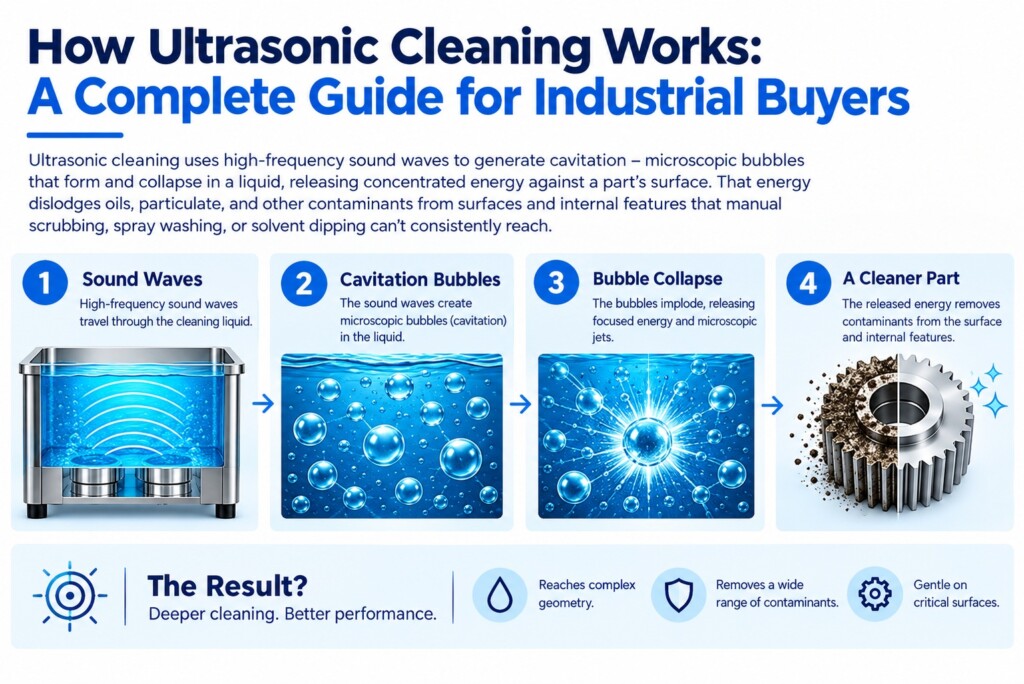
Ultrasonic cleaning uses high-frequency sound waves to generate cavitation – microscopic bubbles that form and collapse in a liquid, releasing concentrated energy against a part’s surface. That energy dislodges oils, particulate, and other contaminants from surfaces and internal features that manual scrubbing, spray washing, or solvent dipping can’t consistently reach.
This guide covers the complete process from the underlying physics through the practical factors that determine cleaning performance, the range of industrial applications ultrasonic cleaning supports, and just as importantly where its limitations lie. It consolidates and connects Zenith’s existing technical resources into a single reference, rather than duplicating them.
What Is Ultrasonic Cleaning?
Ultrasonic cleaning is a process that uses cavitation, the rapid formation and violent collapse of microscopic vacuum bubbles in a liquid – to remove contamination from submerged parts. Ultrasonic transducers convert electrical energy into high-frequency mechanical vibrations. Those vibrations create rapid pressure cycles in the cleaning solution: during the low-pressure phase, microscopic bubbles form; during the high-pressure phase that follows almost immediately, those bubbles collapse.
Each collapse, occurring tens of thousands of times per second throughout the tank, releases a concentrated burst of energy directly against whatever surface is nearby, producing microscopic jets of liquid that scrub the part clean. Local conditions at the point of implosion have been reported at temperatures as high as 10,000°C and pressures as high as 10,000 PSI, though these effects are extremely localized and momentary rather than affecting the bulk solution temperature.
What makes this more effective than conventional cleaning methods is reach: because cavitation occurs throughout the liquid rather than only where a brush or spray nozzle makes contact, it cleans blind holes, threaded features, internal channels, and complex geometries with the same action applied to open, accessible surfaces – with no shadowing and no mechanical contact with the part.
Ultrasonic energy also has the ability to transmit through metal walls, allowing cavitation to occur inside recessed holes and enclosed detail areas that are not directly open to the bath, a capability that further distinguishes ultrasonic cleaning from any line-of-sight method.
How Ultrasonic Cleaning Works (Step by Step)
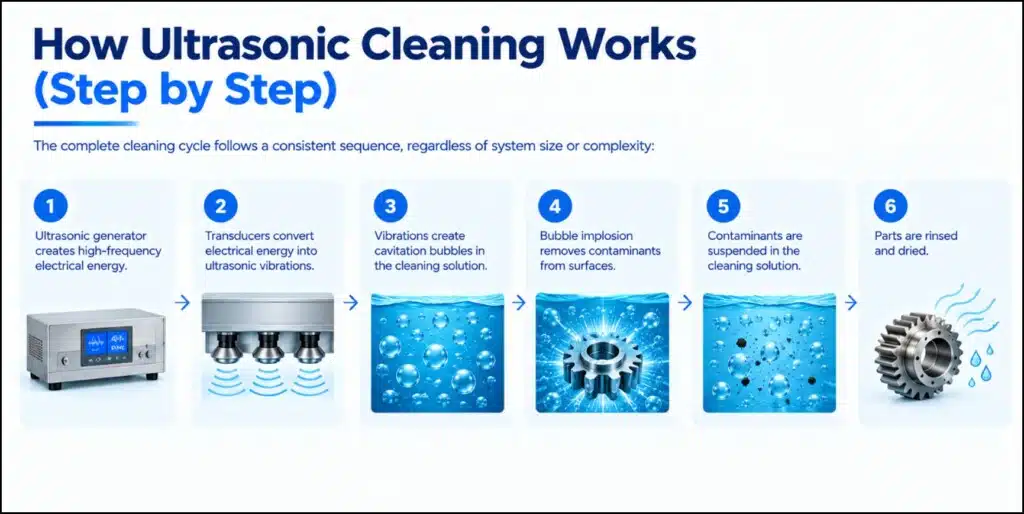
The complete cleaning cycle follows a consistent sequence, regardless of system size or complexity:
- Ultrasonic generator creates high-frequency electrical energy: The generator converts standard electrical input into a high-frequency electrical signal matched to the transducer’s operating frequency.
- Transducers convert electrical energy into ultrasonic vibrations: Piezoelectric or similar transducer elements – bonded directly to the tank on table-top systems, or mounted as submersible, replaceable transducer packs on larger equipment – convert that electrical signal into mechanical vibrations at the target frequency.
- Vibrations create cavitation bubbles in the cleaning solution: The vibrations produce rapid pressure cycles in the liquid, nucleating microscopic bubbles during each low-pressure phase.
- Bubble implosion removes contaminants from surfaces: Bubbles collapse violently during the high-pressure phase, releasing energy that dislodges contamination from every submerged surface.
- Contaminants are suspended in the cleaning solution: Dislodged contamination is carried into the bulk solution, where filtration (if present) removes it to prevent redeposit.
- Parts are rinsed and dried: Depending on the system, this occurs as a separate manual step or as an integrated stage within a multi-stage cleaning line.
What Is Cavitation?
Cavitation is the mechanism that makes ultrasonic cleaning work – the formation and collapse of microscopic bubbles in a liquid under rapidly alternating pressure. As ultrasonic waves pass through the cleaning solution, the low-pressure phase of each cycle causes microscopic vapor bubbles to nucleate; the high-pressure phase that follows collapses them, releasing concentrated energy at the point of implosion.
Controlled cavitation is what distinguishes effective ultrasonic cleaning from either ineffective cleaning (too little cavitation intensity to dislodge the contaminant) or part damage (too much cavitation intensity concentrated in the wrong place for too long). Cavitation intensity is not, however, spread evenly throughout the tank – a simple foil test on any ultrasonic system will show concentrated high-pressure and low-pressure zones rather than uniform coverage.
This uneven distribution is a real, physical characteristic of standing waves in a liquid-filled tank, not a flaw specific to any one manufacturer. It’s also exactly why tank design and multi-frequency operation (covered later in this guide) matter as much as raw ultrasonic power – they’re the practical tools for reducing the inconsistency that uneven cavitation would otherwise cause across a batch of parts.
See What Is Cavitation for additional technical detail.
Factors That Influence Cleaning Performance
Ultrasonic cleaning performance is not a fixed property of the equipment – it depends on how several variables are configured together for a specific application.
Ultrasonic Frequency
Frequency determines cavitation bubble size and force. Lower frequencies produce larger, more forceful bubbles suited to heavy, bonded contamination; higher frequencies produce smaller, more numerous, gentler bubbles suited to precision and delicate parts.
| Frequency | Cavitation Characteristics | Typical Fit |
| 20–25 kHz | Largest, most forceful cavitation bubbles; widest standing wave spacing | Heavy, deeply bonded soils; structural, less finish-sensitive parts |
| 40 kHz | Balanced force and distribution; most widely used general-purpose frequency | General manufacturing cleaning |
| 80 kHz | Smaller bubbles, gentler and more evenly distributed cavitation | Precision, finish-sensitive, or delicate components |
| 130 kHz+ | Very fine, low-force cavitation | Highly sensitive parts (e.g., electronics) |
See Ultrasonic Frequency Selection for a deeper explanation of standing wave behavior at different frequencies.
Power Density
Power density – ultrasonic power relative to tank volume determines overall cavitation intensity. Too little power for the tank volume produces weak, inconsistent cavitation; excessive power for delicate parts risks damage. Power requirements scale with tank size and contamination load, not just part count.
Cleaning Solution
The cleaning solution does the chemical work cavitation makes possible: cavitation physically dislodges contamination, while the solution’s chemistry breaks the bond between the contaminant and the part surface. Zenith’s own guidance treats cleaning fluid selection as the second most important decision in the process, after the equipment itself, an aggressive solvent-based chemistry might strip heavy grease effectively but attack aluminum, while a mild aluminum-safe formulation may not fully remove stubborn baked-on residue.
See Ultrasonic Cleaning Fluid Selection.
Temperature
Temperature affects the ultrasonic scrubbing action itself, not just chemistry performance – cavitation intensity and bubble behavior change with solution temperature, and many industrial systems operate at well over half the boiling point of the fluid in use. Heating generally improves detergent effectiveness, but the part material’s heat tolerance sets a practical limit.
Degassing
Fresh or freshly heated cleaning solution contains dissolved gases that reduce cavitation efficiency by cushioning bubble collapse. Running a brief degas cycle before loading production parts allows the solution to reach full cavitation effectiveness.
See Degassing.
Cleaning Time
Longer cycles generally clean more thoroughly, up to a point of diminishing returns – beyond which additional time adds no meaningful cleaning benefit while increasing cumulative exposure for heat- or cavitation-sensitive materials.
Part Orientation
Part position within the tank affects how effectively cavitation reaches all surfaces. Blind holes and recesses should generally be oriented to allow solution and displaced contamination to escape rather than trapping air pockets or debris.
Basket Selection
Basket material and mesh size affect both part containment and cavitation transmission, an overly restrictive basket can shield parts from cavitation energy, while an inappropriate material can itself be damaged or contribute contamination.
Tank Design
Transducer placement, tank geometry, and construction all affect how evenly cavitation distributes throughout the volume. It’s worth noting plainly here: ultrasonic cleaners, regardless of manufacturer, do not distribute scrubbing action perfectly evenly throughout the tank – standing wave patterns exist in every design, which is precisely the engineering problem multi-frequency approaches like CROSSFIRE® attempt to address.
Load Size
Overloading a tank beyond its rated capacity reduces cavitation reach to parts in the interior of the load and restricts solution circulation. Load size should be matched to the tank’s rated capacity, not maximized for throughput at the expense of consistent results.
Types of Contaminants Removed
- Oil & grease: Machining and assembly lubricants, typically addressed with alkaline or degreasing chemistry paired with moderate heat.
- Carbon deposits: Baked-on or oxidized carbon from thermal processes, generally requiring stronger cavitation intensity and specialized chemistry.
- Rust: Surface oxidation, addressed through a combination of frequency, temperature, and acid-based or chelating chemistry matched to the base material, see Ultrasonic Cleaner for Rust Removal.
- Machining coolants: Water- or oil-based coolant residues left on machined parts after production.
- Polishing compounds: Buffing and finishing residues that accumulate in surface texture and recessed features.
- Flux residue: Post-solder residue on electronic assemblies, requiring carefully matched frequency and chemistry to avoid stressing delicate components.
- Dust & particulates: General handling and environmental contamination, typically among the easier contaminant types to remove.
- Biological contaminants (where applicable): Relevant in specific medical device and food-contact applications; process validation requirements apply in regulated environments.
Industrial Applications
- Automotive: Fuel injectors, transmission housings, valve bodies, and cylinder heads – removing metallic fines, cutting fluids, and coolant residues.
- Aerospace: Turbine housings, landing gear assemblies, and structural parts, often under documented cleanliness requirements. See Aerospace Industry Solutions.
- Medical Devices: Instruments and device components requiring validated, high-cleanliness processes. See Medical Industry Solutions.
- Electronics: Circuit boards and assemblies requiring flux and ionic residue removal without stressing fine-pitch components.
- Precision Machining: Machined components with tight tolerances and internal features requiring thorough contaminant removal without surface alteration.
- Manufacturing: General industrial parts cleaning across metal stampings, assemblies, and production components. See Manufacturing Industry Solutions.
- Tool & Die: Tooling and mold components requiring removal of release agents, resin buildup, and carbon deposits without damaging precision surfaces.
- Additive Manufacturing (3D Printed Parts): Metal AM components requiring residual powder removal from internal channels and lattice structures inaccessible to other cleaning
Benefits of Ultrasonic Cleaning
- Precision cleaning: Reaches internal features, blind holes, and complex geometries without mechanical contact.
- Faster cleaning cycles: Cavitation acts on the entire submerged surface simultaneously, generally faster than sequential manual methods.
- Reduced manual labor: Automated cycles reduce the hands-on scrubbing and wiping conventional cleaning requires.
- Cleaning complex geometries: No line-of-sight requirement means recesses and internal channels receive the same cleaning action as exposed surfaces.
- Consistent results: Controlled process parameters reduce the operator-to-operator variability inherent in manual cleaning.
- Reduced chemical consumption: Cavitation reduces reliance on aggressive chemistry concentrations compared to some conventional cleaning methods.
- Improved product quality: More thorough, consistent contaminant removal supports downstream processes like coating, plating, and assembly.
Limitations of Ultrasonic Cleaning
Ultrasonic cleaning is not universally appropriate for every material, contaminant, or application – a balanced evaluation includes where it falls short:
- Not suitable for every contaminant: Some heavily bonded or specialized contamination requires pre-treatment or a different cleaning method entirely, not just longer ultrasonic cycle time.
- Correct chemistry is essential, not optional: Incorrect chemistry selection can result in incomplete cleaning or surface damage regardless of how well-tuned the ultrasonic parameters are.
- Frequency selection carries real trade-offs: There is no single frequency that performs best across all applications – the wrong frequency can under-clean heavy soils or over-stress delicate parts. Zenith commonly addresses this limitation directly with its patented CROSSFIRE® Multiple Frequency Technology, which provides the cleaning properties of more than one frequency simultaneously rather than forcing a single-frequency compromise.
- Material compatibility varies: Some porous, flexible, or reactive materials are not well suited to standard ultrasonic cleaning without modified process conditions, see Ultrasonic Damage for how cavitation can affect sensitive materials if parameters aren’t matched correctly.
- Proper system sizing matters: An undersized or overloaded system produces inconsistent results regardless of how correctly other parameters are set.
How to Improve Cleaning Performance
- Select the correct frequency for your contamination and part sensitivity: Rather than defaulting to whatever frequency the equipment happens to run.
- Use the appropriate cleaning solution: Matched to both the contaminant and the part material, not selected on cost alone.
- Maintain solution temperature within the effective range: For your specific chemistry and contaminant.
- Degas new solutions before production use: To reach full cavitation effectiveness from the first cycle.
- Avoid tank overloading: Load to rated capacity, not maximum physical capacity.
- Perform regular equipment maintenance: Transducer inspection, tank cleaning, and solution management all affect long-term consistency.
How Zenith Optimizes Ultrasonic Cleaning
Zenith applies the same variables covered throughout this guide – frequency, chemistry, tank design, automation – to engineer systems around specific applications rather than offering a single fixed configuration:
- CROSSFIRE® Multiple Frequency Technology (US Patent 5,865,199 and 6,019,852): Drives multiple frequencies simultaneously from the same radiating surface, addressing standing wave distribution more directly than a single fixed frequency or sweep frequency alone.
- Custom-engineered systems: Tank size, frequency, and configuration built around specific part geometry and production requirements, see Custom Ultrasonic Cleaners.
- Automated cleaning solutions: Load handling and multi-stage processing for higher-volume production environments.
- Application testing: Testing cleaning performance against actual customer parts before a purchase commitment.
- Engineering support: Chemistry and process parameter guidance as part of the application engineering process, not a one-time equipment sale.
Discuss Your Application
Cleaning performance depends on how frequency, chemistry, temperature, and system design work together for your specific parts and contamination, not on any single variable in isolation. Zenith’s application engineers can help evaluate the right configuration for your process.
