
Yes, ultrasonic cleaning can help remove rust, as long as it’s paired with a compatible rust-removal chemistry and suitable process conditions. It can’t bring back metal that corrosion has already eaten away, so a pitted part will still be pitted when it comes out clean.
If you’re wondering will an ultrasonic cleaner remove rust from a batch of fittings, tooling or machined components, the answer comes down to three things: how much rust there is, what the part is made of, and what’s in the tank. Zenith Ultrasonics has built industrial ultrasonic cleaning equipment since 1935, and rust questions tend to be chemistry and application questions as much as equipment questions. Here’s how the process works, what it can and can’t do, and what to think through before choosing a system.
How Does Ultrasonic Cleaning Remove Rust?
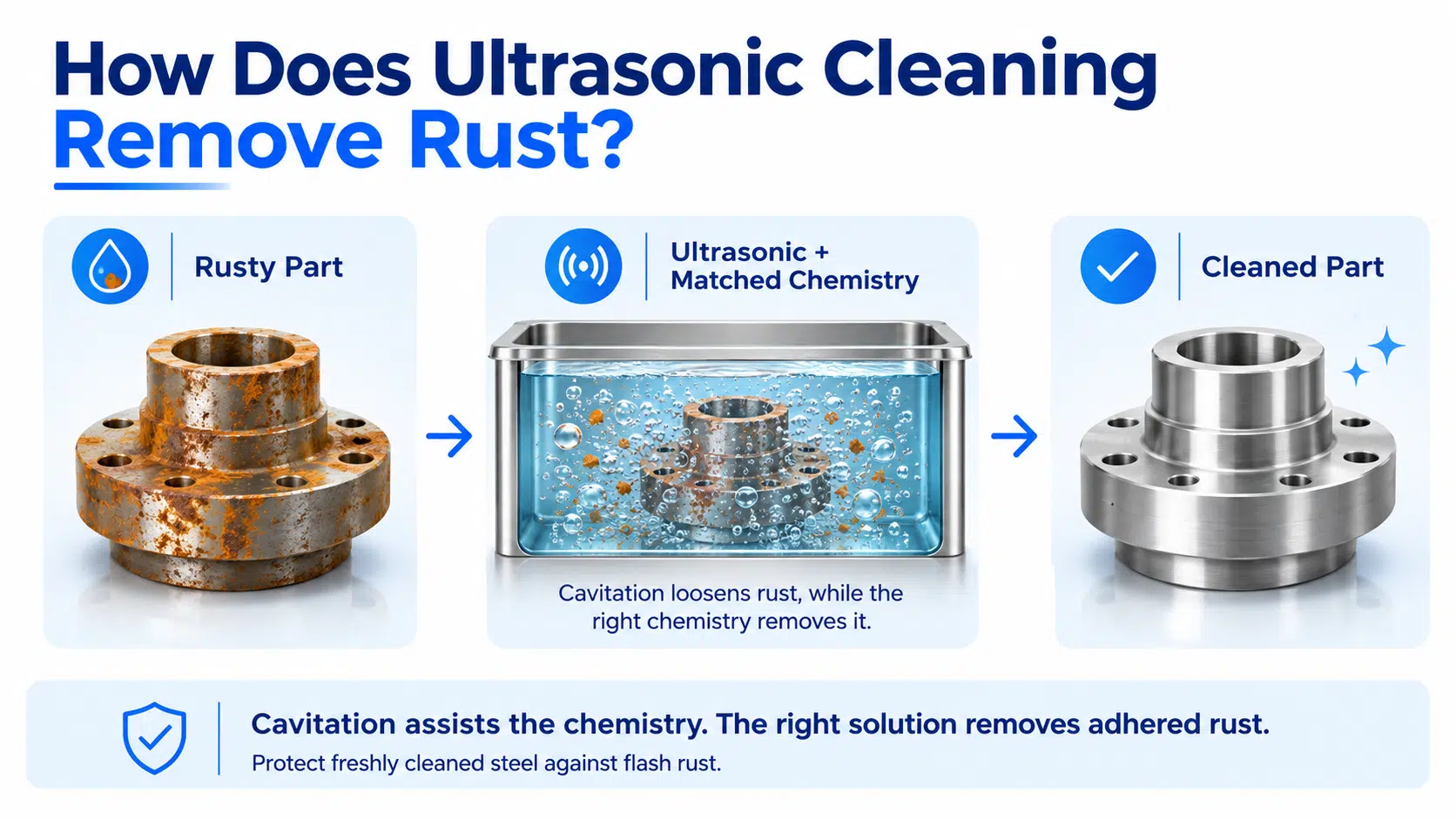
An ultrasonic cleaner drives high-frequency vibrations into the cleaning solution. The resulting pressure swings form microscopic bubbles that collapse against the wetted surfaces of the part. That’s cavitation, and it’s where the scrubbing action comes from, with no brush or spray nozzle needed.
So, does ultrasonic cleaning remove rust on its own? Not really. Cavitation is the mechanical half of the job. The rust-removal chemistry is the other half: it dissolves or loosens the iron oxide, while cavitation keeps fresh solution moving against the surface and helps carry loosened material away. Because the energy acts throughout the liquid and travels through the metal itself, it can work inside threads, blind holes and detailed areas a brush never reaches, as long as the solution fills them. Cavitation isn’t perfectly even across any tank, which is why loading and spacing matter.
One distinction trips people up: removing existing rust and preventing new rust are separate jobs. Ultrasonic cleaning strips away protective oils and coolants, so freshly cleaned steel can flash rust quickly if it’s left bare. Stopping that takes a rust-preventative step, either a cleaning solution containing rust preventatives or a rust-preventative dip after the final rinse. Zenith explains the options in its guide to preventing rust and oxidation.
What Levels of Rust Can Ultrasonic Cleaning Remove?
Rust severity sets the ceiling on what any cleaning process can do. Treat the categories below as a starting point, not a promise, since results also depend on the material, chemistry and conditions.
| Rust severity | What to realistically expect | Limitations |
|---|---|---|
| Light surface rust (orange film, flash rust) | Often a good fit. With matched chemistry, the surface can usually be returned to clean metal. | Bare steel needs protection afterward, or the rust comes back. Faint staining can remain. |
| Moderate rust (rust layer, light scale, no significant pitting) | Often removable with the right chemistry, sometimes with longer exposure or more than one pass. | Light pitting or a rough texture may show once the rust is gone. Recheck critical dimensions. |
| Heavy rust (thick, flaking, pitted) | Loose scale usually comes off first by mechanical means. Ultrasonic cleaning can then work on what remains. | Metal already lost can’t be restored. Pitting and thinning stay, and the part may not be worth reusing. |
Light and moderate rust is where the question ‘do ultrasonic cleaners remove rust’ gets its most confident yes. Heavy rust is a different conversation. Flaking scale usually comes off faster with a wire brush or scraper before the part goes in the tank, which also keeps the bath useful for longer. Whether a stronger chemistry or an extra pass makes sense after that depends on the part and what the supplier allows.
And a clean surface isn’t a repaired one. Removing rust doesn’t fill pits, restore wall thickness or bring back structural strength. If a part depends on its dimensions or load capacity, measure it after cleaning, not just before.
Which Metal Parts Are Suitable for Ultrasonic Rust Removal?
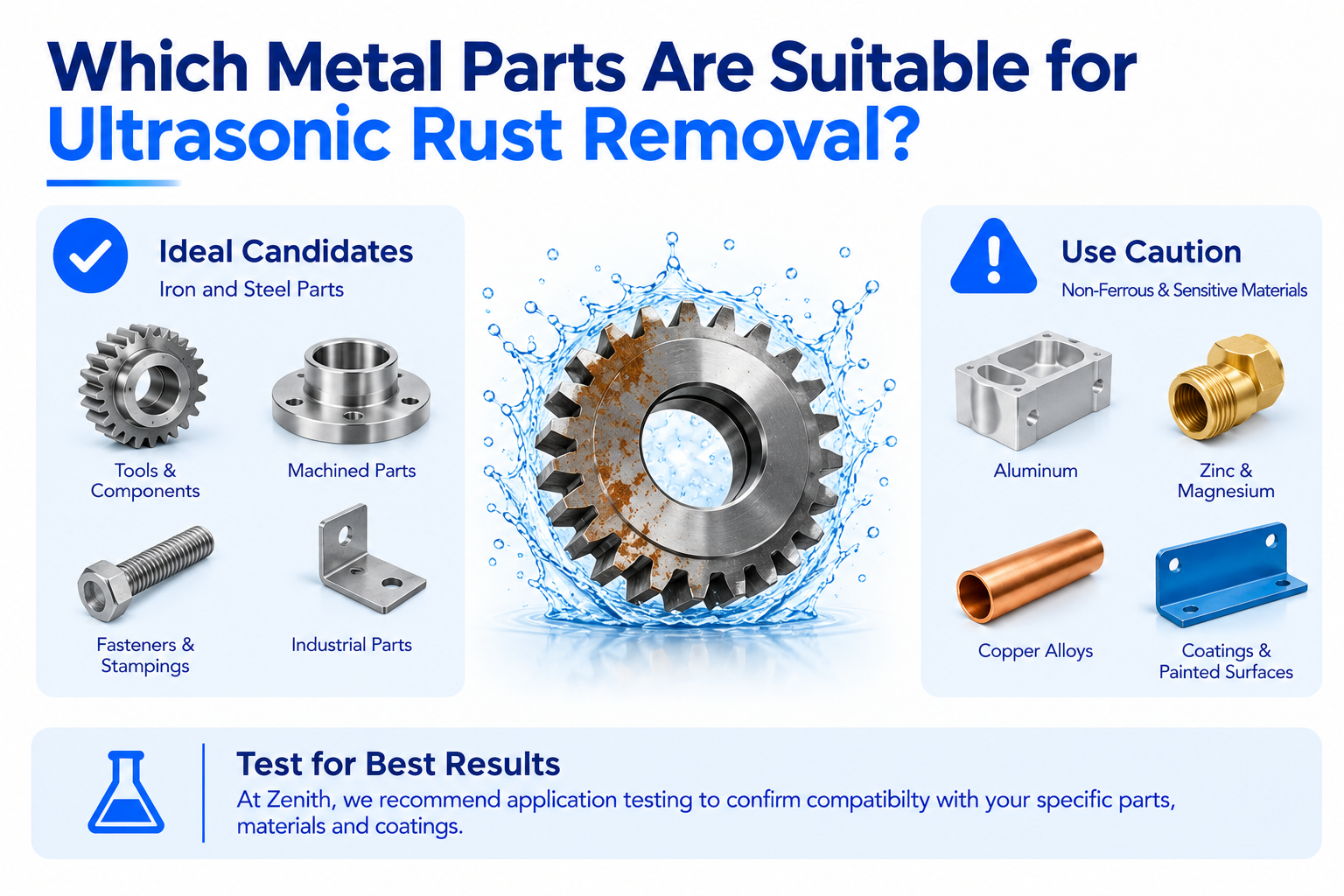
Iron and steel are the natural fit, because rust is specifically iron oxide. That covers hand tools, fittings, fasteners, machined components, tooling and other industrial parts. Zenith lists machined parts and tooling, molds and dies, automotive and aerospace components, and maintenance and remanufacturing work among its rust and oxidation applications. Stainless steel and cast iron can be cleaned too, but the chemistry should be chosen for the specific alloy.
Other metals are a different story. Aluminum, brass and copper corrode and tarnish, but that oxidation isn’t iron rust, and a chemistry that works on steel can etch or discolor them. Before anything goes in the tank, check:
- Coatings and finishes. Plating, paint, phosphate and oxide finishes can be removed or attacked by rust-removal chemistry.
- Dissimilar metals. Steel mixed with aluminum, brass or copper in the same load, or the same assembly, can react badly.
- Seals, bearings, gaskets and tight crevices can trap solution or be affected by it. Disassemble where practical.
- Hardened or high-strength steels. Ask the chemistry supplier before using an acid-based bath.
How to Remove Rust from Metal Parts Using an Ultrasonic Cleaner
The exact recipe depends on the part and the chemistry, but the sequence stays fairly consistent:
- Inspect the part. Identify the material, any coatings, how severe the rust is, and any existing damage such as pitting or cracks. Remove loose, flaking rust mechanically first.
- Select compatible chemistry. Follow the equipment manufacturer’s and the cleaning-solution supplier’s instructions for dilution, temperature and material compatibility. Zenith’s ultrasonic cleaning fluids page is a good place to start.
- Prepare the bath and load the parts. Mix and fill according to equipment guidance. Use baskets, keep parts from touching each other or the tank bottom, and make sure everything is fully immersed without overloading.
- Establish cleaning conditions. Time, temperature and frequency should come from application testing on representative parts, not from a number someone quoted. Check parts at intervals while you dial it in.
- Inspect and finish. Rinse where the process requires it, dry thoroughly, and apply suitable corrosion protection right away. Recheck dimensions on anything critical.
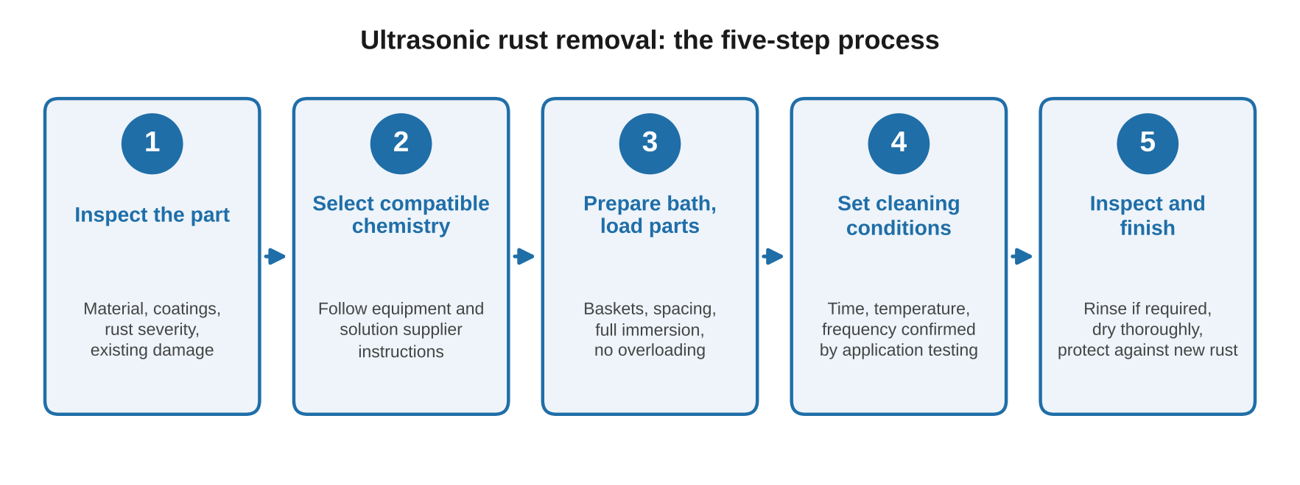
Figure: The five-step ultrasonic rust removal process
What Factors Affect Ultrasonic Rust Removal Results?
Two shops can run similar ultrasonic cleaners on rusty parts and get different results. The cause is usually one of the variables below rather than the equipment alone, which is also why there’s no universal setting and no honest way to promise a cleaning time or removal percentage.
| Factor | How it affects results | Practical consideration |
|---|---|---|
| Rust severity | Light rust releases readily. Thick or flaking rust needs more chemical exposure and may need pre-treatment. | Remove loose scale first and inspect before and after. |
| Base material | Determines which chemistries are safe and how the surface responds. | Confirm the alloy and any coatings before choosing a bath. |
| Cleaning chemistry | This helps with dissolving or loosening. The wrong choice can leave rust behind or attack the metal. | Match it to the metal and follow the supplier’s instructions. |
| Frequency | Lower frequencies produce more forceful cavitation. Higher frequencies are gentler. | Match to part sensitivity. Some Zenith systems offer CROSSFIRE® Multiple Frequency Technology, which combines more than one frequency at the same time. |
| Temperature | Heat generally helps chemistry work, but each chemistry has its own working range, and the part and tank set limits. | Stay within the supplier’s range. Acidic chemistries are generally run as low as effective, since heat can attack stainless steel tank construction. |
| Cleaning time | Longer exposure can finish stubborn rust, but it also lengthens chemical contact with the metal. | Check parts at intervals during testing instead of assuming a time. |
| Part geometry | Recesses, blind holes and overlapping surfaces change how solution and cavitation reach the rust. | Orient parts so air and loosened rust can escape. Open up assemblies where practical. |
| Loading | Overloaded or touching parts block cavitation and limit solution circulation. | Space parts in baskets and stay within the rated tank capacity. |
Benefits and Limitations of Ultrasonic Rust Removal
Where it helps
- Access to wetted recesses. Threads, blind holes and detailed areas that brushes miss, provided solution reaches them.
- Less manual scrubbing. Less hands-on brushing, and less of the scratching that can come with it.
- Repeatable processing. A defined chemistry, temperature and cycle time repeats more easily than hand work that varies by operator.
- Batch cleaning. Many parts can be processed in one cycle using baskets.
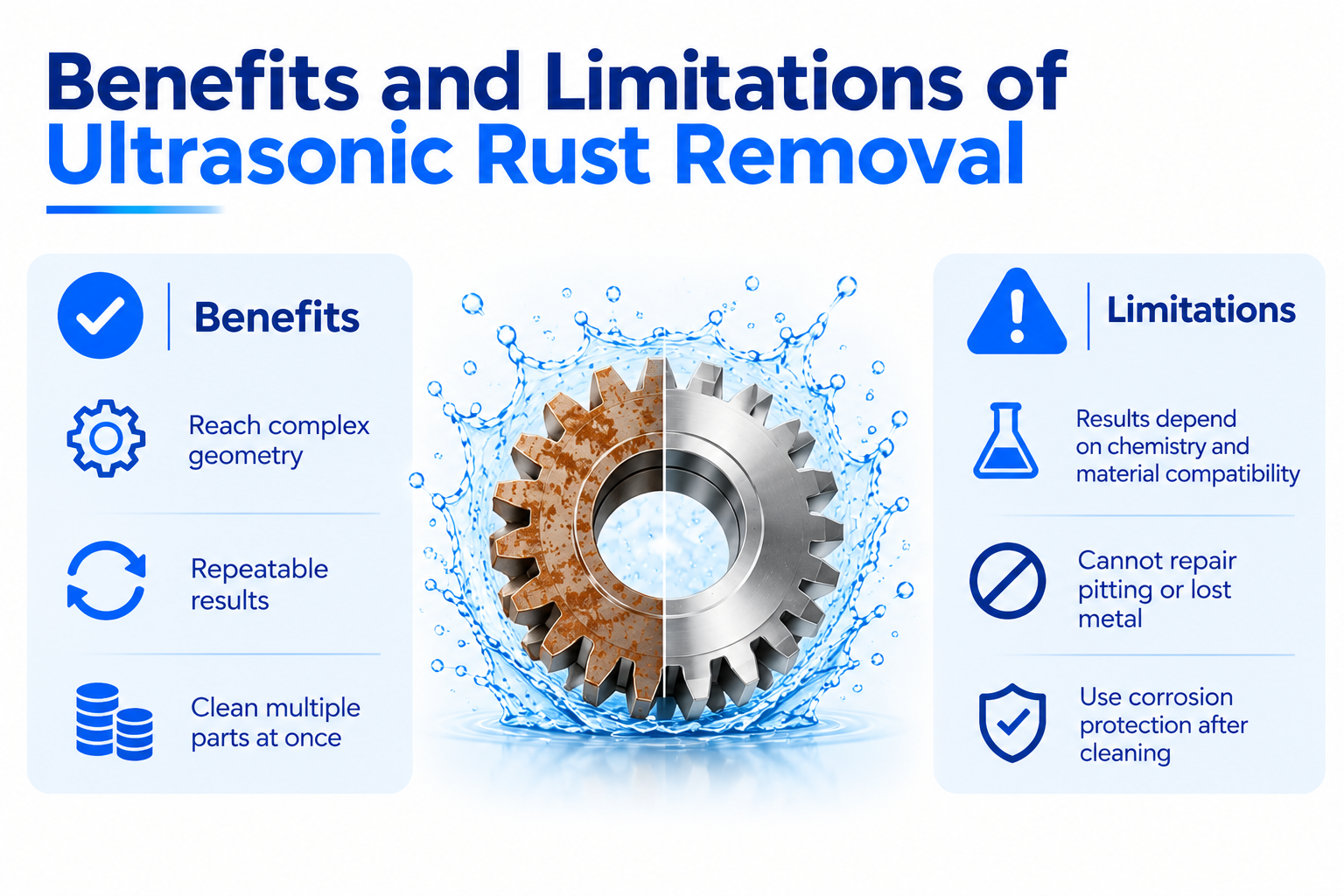
Where it falls short
- Material and chemistry compatibility. What removes rust from steel can attack coatings, other metals and some assembly components.
- Possible surface damage. The wrong chemistry or too much exposure can etch the metal, strip a finish or change dimensions on tight-tolerance parts.
- No corrosion repair. Pitting and lost material stay lost.
How to Choose an Ultrasonic Cleaning System for Rust Removal
Start with the parts, not the machine. Four questions do most of the narrowing:
- Part dimensions. The largest part, plus room around it and its basket, sets the tank size.
- Batch size and throughput. A few parts a day and a full production shift point toward very different systems.
- Chemistry compatibility. Tank construction, heating and filtration have to suit the chemistry you plan to run.
- Rinsing and drying. Chemistry residue has to come off, and bare steel has to be dried and protected quickly.
Zenith’s tabletop ultrasonic cleaners suit smaller parts and lower volumes. A two-tank clean and rinse system adds a separate rinse stage for chemistry residue. For larger volumes, heavier parts or a longer process sequence, a custom multi-stage system can combine cleaning, rinsing, a rust-preventative dip and drying in one line. You can browse the full range of ultrasonic cleaners or explore custom ultrasonic cleaning systems if your parts don’t fit a standard configuration.
The ASTRO automated steel cleaning system belongs in this conversation only for a specific kind of job. It’s a clean-and-dry system for steel parts, built around a detergent with rust inhibitors, for applications where zero-residue cleaning isn’t required or where parts need protection after cleaning. That protection is separate from removing rust already on the part, so ASTRO isn’t a rust-removal answer by itself.
Whatever you’re considering, evaluate the application before choosing equipment. Zenith’s application engineers can review your parts and rust condition, and test cleaning on representative parts shows how a chemistry and process behave on your metal.
Frequently Asked Questions About Ultrasonic Rust Removal
Whether ultrasonic rust removal works for you comes down to matching the equipment, the chemistry and the processing conditions to the actual part. A short conversation before you buy tends to save a lot of trial and error later.
Send us your part material, dimensions, how bad the rust is and your production requirements. Photos help.
Contact Zenith to discuss an ultrasonic cleaning system suited to your metal parts and process requirements.


Leave A Comment