
Every stainless steel manufacturing operation eventually asks the same question: nitric or citric? The debate over citric vs nitric passivation is common among process engineers, quality managers, and procurement teams evaluating how to remove free iron contamination and restore corrosion resistance on finished parts. Both chemistries are proven, both meet industry standards, and both have advantages depending on the application.
This guide explains how each process works, where they differ in safety, cost, environmental impact, and performance, and which industries and stainless steel grades typically prefer one over the other.
What Is Stainless Steel Passivation?
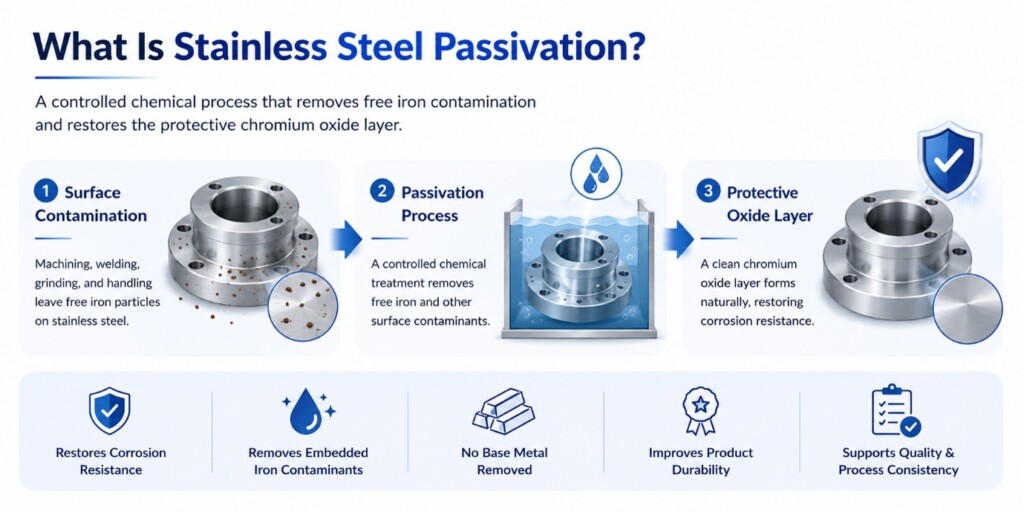
Passivation is a controlled chemical process that removes free iron and other surface contaminants from stainless steel without removing the base material. During machining, grinding, forming, welding, and handling, iron particles can become embedded in or transferred onto the stainless steel surface. If these contaminants remain, they can rust and compromise the chromium-rich oxide layer that gives stainless steel its corrosion resistance.
Passivation removes the embedded iron and allows a clean chromium oxide layer to form naturally on the surface, restoring the corrosion-resistant condition of the stainless steel.
Why Is Passivation Important?
Without passivation, stainless steel components can experience premature rusting, staining, or corrosion even when the correct alloy has been specified. For industries such as aerospace, medical device manufacturing, food processing, and pharmaceutical production, corrosion is not merely a cosmetic issue – it is a quality, safety, and compliance concern.
Passivation is commonly specified under standards such as ASTM A967 and AMS 2700, and many manufacturers require documented passivation as part of their quality assurance process.
What Is Nitric Acid Passivation?
Nitric acid passivation is the traditional method used for stainless steel passivation and has been widely used for decades. In this process, parts are immersed in a nitric acid solution that removes free iron while leaving the chromium-rich stainless steel matrix intact.
Typical nitric acid passivation processes use concentrations ranging from approximately 20% to 55% nitric acid, with immersion times generally ranging from 20 minutes to several hours depending on the stainless steel grade and process specification.
What Is Citric Acid Passivation?
Citric acid passivation is a newer alternative that has become increasingly popular because of its improved safety and environmental profile. Citric acid is an organic acid that effectively removes free iron contamination and promotes formation of the protective chromium oxide layer.
Citric acid solutions are typically used at concentrations of 4–10%, often with significantly shorter cycle times than nitric acid. Many formulations are effective at or near room temperature, reducing both energy consumption and process complexity.
Citric vs. Nitric Passivation: Side-by-Side Comparison
| Factor | Nitric Acid Passivation | Citric Acid Passivation |
| Safety | Hazardous; requires PPE and ventilation | Non-hazardous; easier to handle |
| Environmental impact | Produces NOx emissions | Biodegradable; no toxic emissions |
| Typical cycle time | 20 minutes to several hours | Often 5–20 minutes |
| Process temperature | Frequently elevated | Often effective at room temperature |
| Iron oxide removal | Effective | Fast and efficient |
| Equipment impact | More corrosive to equipment | Less aggressive on equipment |
| Cost profile | Lower chemistry cost; higher disposal and ventilation costs | Higher chemistry cost; lower handling and disposal costs |
| Standards supported | ASTM A967, AMS 2700 | ASTM A967, AMS 2700 |
Key Differences Between Citric and Nitric Passivation
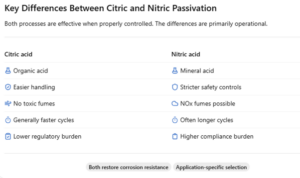
The primary distinction in nitric vs citric acid passivation is not whether one works and the other does not – both are effective when properly controlled. The differences are operational.
- Chemical type: Nitric acid is an inorganic mineral acid; citric acid is an organic acid.
- Handling requirements: Nitric acid requires ventilation systems, chemical-resistant PPE, and stricter safety procedures.
- Fumes and emissions: Nitric acid can produce nitrogen oxide (NOx) fumes, while citric acid does not generate toxic fumes.
- Cycle time: Citric acid processes are generally faster.
- Regulatory burden: Citric acid is significantly easier to handle, transport, and dispose of in many manufacturing environments.
Advantages of Nitric Passivation
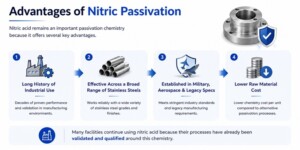
Nitric acid remains an important passivation chemistry because it offers several advantages.
- Long history of industrial use and validation
- Effective across a broad range of stainless steel grades
- Well established in military, aerospace, and legacy manufacturing specifications
- Lower raw material cost per unit of chemistry
Many facilities continue using nitric acid because their processes have already been validated and qualified around this chemistry.
Advantages of Citric Passivation
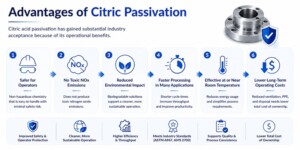
Citric acid passivation has gained substantial industry acceptance because of its operational benefits.
- Safer for operators
- No toxic NOx emissions
- Reduced environmental impact
- Faster processing in many applications
- Often effective at room temperature
- Lower long-term operating costs due to reduced ventilation, PPE, and disposal requirements
These advantages have made citric acid vs nitric acid passivation an increasingly important consideration for manufacturers modernizing their finishing operations.
Disadvantages of Each Process
Nitric Acid Passivation
- Hazardous chemical handling requirements
- Ventilation and emission control systems required
- Greater regulatory compliance burden
- Potential equipment corrosion over time
Citric Acid Passivation
- Higher chemistry cost
- Not specified for certain specialized applications such as some titanium passivation standards
- Some legacy production lines may require process requalification before switching chemistries
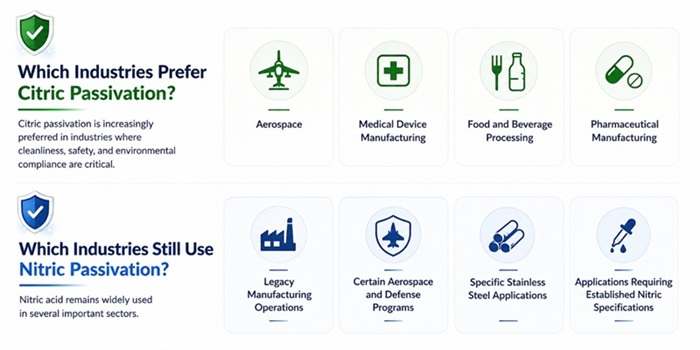
Which Industries Prefer Citric Passivation?
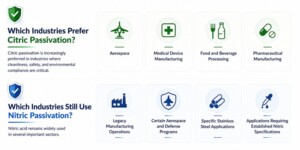
Citric passivation is increasingly preferred in industries where cleanliness, safety, and environmental compliance are critical.
- Aerospace: Aerospace manufacturers frequently adopt citric acid because of reduced environmental impact and simplified regulatory compliance.
- Medical Device Manufacturing: Medical device manufacturers benefit from the cleaner process environment and reduced chemical handling risks.
- Food and Beverage Processing: Food-contact components often favor citric acid because of its non-toxic and biodegradable characteristics.
- Pharmaceutical Manufacturing: Pharmaceutical equipment manufacturers increasingly specify citric passivation for high-purity applications.
- Which Industries Still Use Nitric Passivation?: Nitric acid remains widely used in several important sectors.
- Legacy Manufacturing Operations: Facilities with validated nitric acid processes may continue using them to avoid expensive process requalification.
- Certain Aerospace and Defense Programs: Some customer specifications and legacy military requirements continue to reference nitric acid passivation.
- Specific Stainless Steel Applications: Certain lower-chromium ferritic grades and specialized applications may still perform more consistently with established nitric acid formulations.
Which Stainless Steel Grades Can Be Passivated?
Both nitric and citric acid passivation are effective on most stainless steel families, including:
- Austenitic stainless steels (304, 304L, 316, 316L)
- Martensitic stainless steels
- Precipitation-hardened stainless steels
- Most ferritic stainless steels
For the majority of common stainless steel grades, passivation nitric acid vs citric acid is not a question of capability – both processes can produce excellent corrosion resistance when properly applied.
Common Misconceptions About Citric and Nitric Passivation
- Citric Acid Is a Weaker Process: Citric acid is fully recognized under ASTM A967 and AMS 2700. It is not a lower-quality alternative; it is simply a different chemistry.
- Nitric Acid Always Produces Better Corrosion Resistance: Modern citric acid formulations can achieve corrosion resistance equivalent to nitric acid on most stainless steel grades.
- Passivation Changes Part Dimensions: Passivation removes surface contamination only. It does not significantly remove base material or alter part dimensions.
- A Facility Must Use Only One Chemistry: Many manufacturers successfully operate both nitric and citric passivation processes for different product families and customer requirements.
Which Passivation Process Is Better?
For most new stainless steel manufacturing operations, citric passivation is increasingly becoming the preferred choice because it offers:
- Improved operator safety
- Reduced environmental impact
- Shorter cycle times
- Lower long-term operating costs
- Compliance with the same major industry standards
However, nitric passivation remains the better choice when:
- Existing production lines are already validated with nitric acid
- Customer specifications require nitric acid
- Specialized alloys or applications are involved
In other words, the best process depends on your material, production requirements, compliance obligations, and existing manufacturing infrastructure.
The Importance of Cleaning Before Passivation
Passivation is not a cleaning process. Oils, machining fluids, polishing compounds, particulate, and other manufacturing residues must be removed before passivation begins.
If contaminants remain on the surface, the passivation chemistry may be consumed reacting with those residues instead of removing free iron, resulting in inconsistent or incomplete passivation.
Thorough pre-cleaning is therefore one of the most important factors affecting passivation quality.
How Zenith Ultrasonics’ Ultrasonic Cleaning and Passivation Systems Improve Results
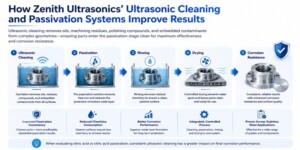
Ultrasonic cleaning is particularly effective before passivation because cavitation removes oils, machining residues, polishing compounds, and embedded contaminants from threads, blind holes, internal passages, and other complex geometries that conventional spray or immersion cleaning may not fully reach.
Zenith Ultrasonics designs integrated ultrasonic cleaning and passivation systems that combine pre-cleaning, passivation, rinsing, and drying into a controlled process sequence. By ensuring that parts enter the passivation stage free of surface contamination, ultrasonic cleaning helps improve passivation consistency, reduce chemistry consumption, and produce more reliable corrosion resistance across a wide range of stainless steel components.
For manufacturers evaluating nitric acid vs citric acid passivation, the chemistry is only part of the equation. Consistent cleaning before passivation often has a greater impact on final corrosion performance than the choice between nitric and citric acid alone.
Don’t Guess Which Passivation Process Fits Your Manufacturing Line
Citric and nitric passivation each have advantages, but the right choice depends on your stainless steel grade, contamination type, production volume, cleanliness requirements, and downstream process. Zenith’s application engineers will evaluate your process and recommend the passivation solution that delivers the best combination of corrosion resistance, process efficiency, and long-term operating performance.
Talk to a Zenith Applications Engineer Today

