
Do I Need a Filtration System for an Ultrasonic Cleaner?
Most industrial applications benefit from an ultrasonic cleaner filtration system – filtration removes metal chips, burned carbon, and other particulate from the cleaning fluid, extending solution life, reducing redeposit onto parts, and lowering tank maintenance. Whether it’s essential depends on your contamination volume and part cleanliness requirements; light-duty, low-particulate applications may not need one.
What Does a Filtration System Do?
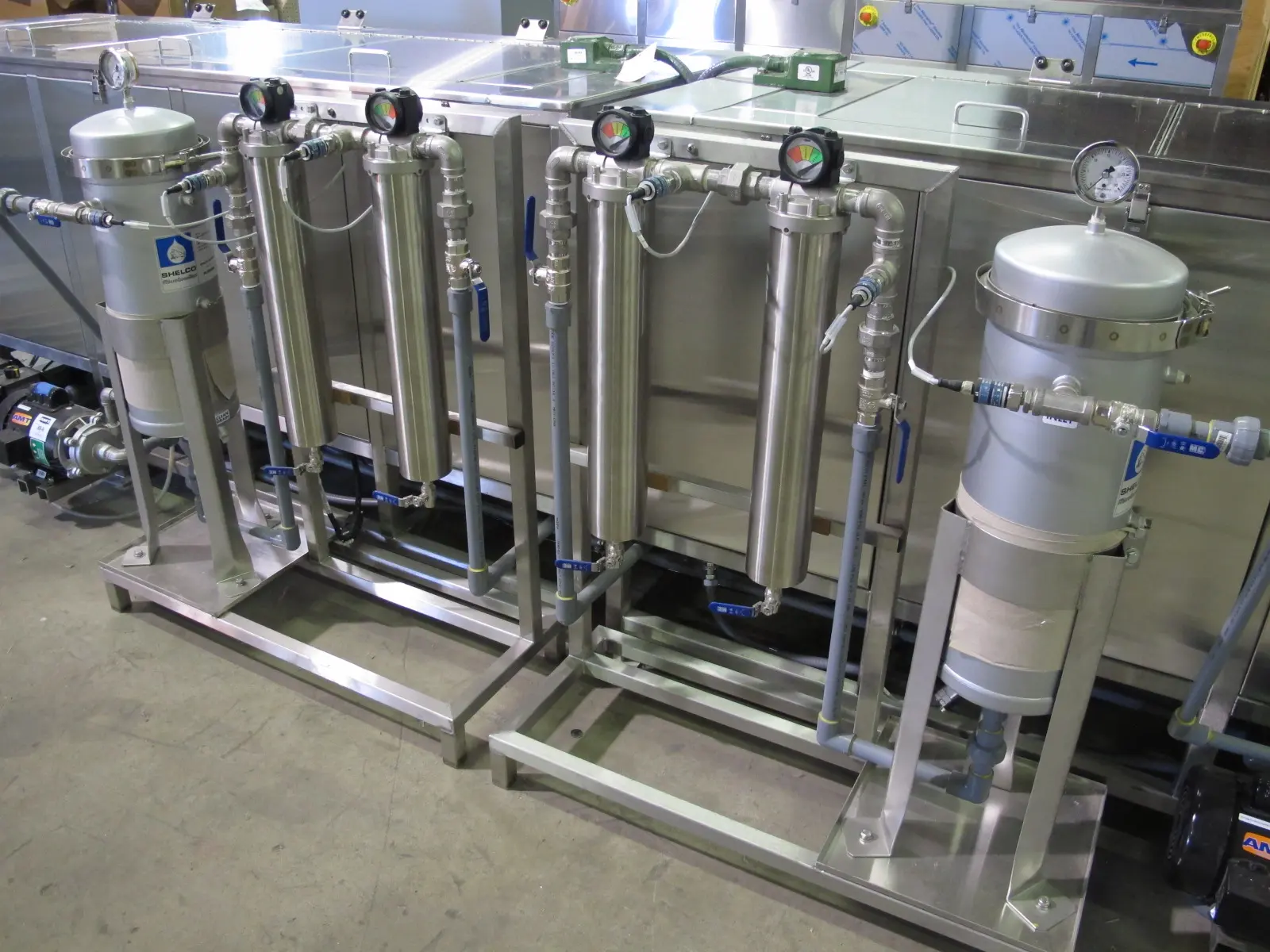
A filtration system filters the cleaning fluid used in the ultrasonic tank, removing metal chips and fines, burned carbon, and other particulate residue displaced from parts during cleaning. Filtration extends the usable life of the cleaning solution, reduces the potential for contaminants to redeposit onto parts still in the bath, reduces interference with the ultrasonic cleaning action itself, and reduces overall tank maintenance.
When Is Filtration Needed?
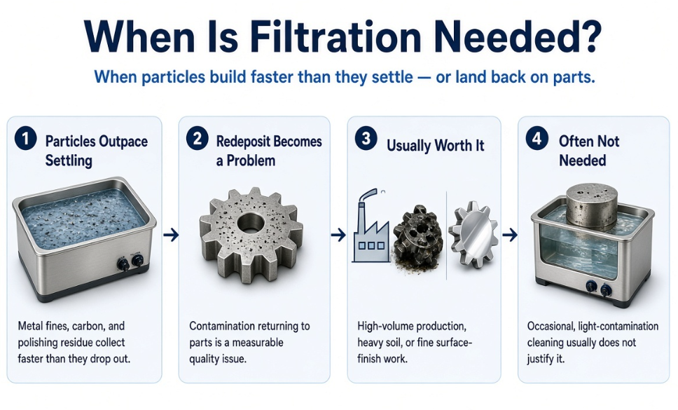
Filtration becomes worthwhile once particulate contamination – metal fines, carbon, buffing or polishing compound residue – accumulates faster than it settles naturally, or when redeposit onto cleaned parts is a measurable quality issue. High-volume production, heavy-soil applications, and processes with fine surface finish requirements typically justify it; occasional, light-contamination cleaning often doesn’t.
How Do You Filter Ultrasonic Cleaning Fluid?
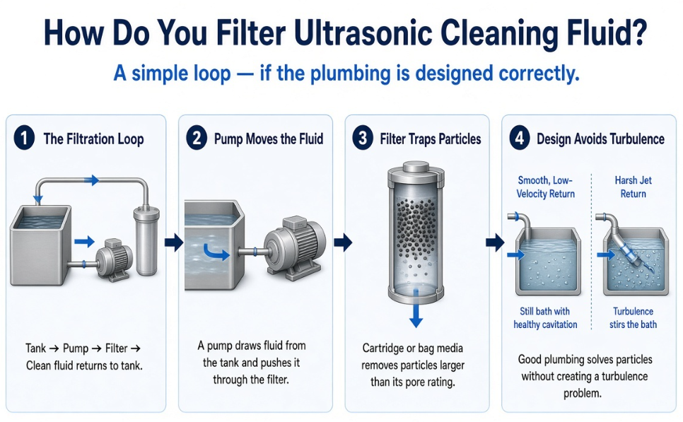
Filtration follows a simple loop: Tank → Pump → Filter → Clean Solution Returns to Tank.
A pump draws fluid from the tank and forces it through a filter cartridge or filter bag, which strips out particles above the media’s rated pore size, before returning clean fluid to the tank. Properly engineered plumbing and pump selection are what keep this loop from working against the ultrasonic process itself – a poorly designed system solves the particulate problem while creating a turbulence problem.
What Are the Benefits of Filtration in an Ultrasonic Cleaning System?
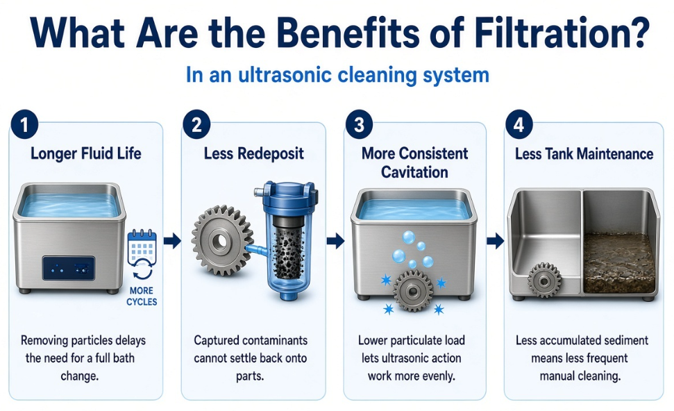
- Extended cleaning fluid life: Removing particulate delays the point at which the bath needs full replacement.
- Reduced redeposit: Contaminants captured in the filter can’t settle back onto parts still in the tank.
- Reduced interference with cleaning action: Lower particulate load in the fluid supports more consistent cavitation.
- Lower tank maintenance: Less accumulated sediment means less frequent manual tank cleaning.
Cartridge Filters vs. Bag Filters
Two general filter housing styles are available: Cartridge Filter Housings, the most common configuration, house a replaceable filter cartridge and can support single or multiple cartridges depending on the application.
Bag Filter Housings, a more expensive option, hold a filter bag capable of capturing larger contaminant volumes before requiring replacement, making them the preferred choice for buffing and polishing compound removal, or any application generating substantial particulate, as well as for filtering very large tanks.
Both housing types include pressure gauges that signal when filter media needs replacement, since clogging media causes pressure to build as the pump works harder to force fluid through it.
What Filter Pore Size Should You Use?
Filter media is rated by pore size, typically in microns – the smaller the pore size, the smaller the particles it captures. Selecting too fine a pore size for your particulate load causes rapid clogging and constant maintenance; selecting too coarse a size fails to capture enough contamination to be effective. The right pore size depends on your specific contaminant type and volume, Zenith can help determine the appropriate media for a given application.
What Type of Pump Is Used for Ultrasonic Filtration?
The filtration pump must generate enough pressure to force fluid through the filter media, move particulate toward the tank’s suction port, and remain chemically compatible with the cleaning agent in use. Plumbing is available in PVC or stainless steel, selected to match pressure requirements and chemical compatibility.
Should the Filtration System Run During Ultrasonic Cleaning?
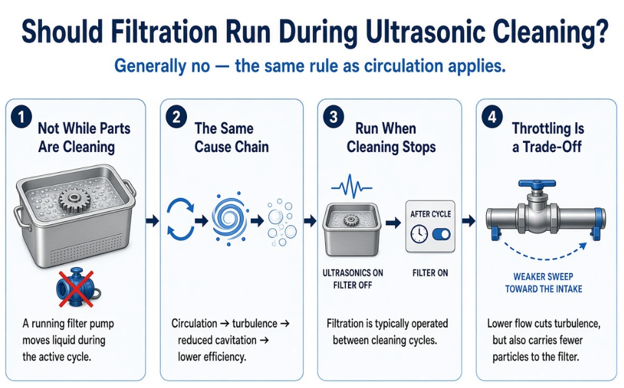
Generally, no – the same logic that governs fluid circulation applies directly to filtration: Circulation → Turbulence → Reduced Cavitation → Lower Cleaning Efficiency.
Filtration systems are typically operated only when parts are not actively being cleaned. A flow control valve can reduce turbulence, but it also reduces the sweeping action that carries contaminants toward the filter intake – trading filtration effectiveness for reduced interference. See Fluid Circulation in Ultrasonic Cleaning Systems for the underlying mechanism.
Can Filtration Be Integrated into an Ultrasonic Cleaning System?
Yes. Filtration is commonly integrated directly into single-tank ultrasonic cleaning consoles and multi-stage systems like 2-Tank Clean & Rinse Systems, where the filtration loop is engineered around the tank design from the start rather than added afterward.
Zenith Ultrasonic Cleaning Solutions
- Automated Ultrasonic Cleaners: Integrated filtration for continuous production environments.
- Large Ultrasonic Cleaners: Filtration engineered for high-volume tank capacities.
- Custom Ultrasonic Cleaners: Filtration configured around your specific particulate load and pore size requirements.
How does a filtration system affect ultrasonic cleaning?
Care must be taken to reduce the turbulence created by the filtration system in the ultrasonic cleaning tank. As discussed in the Technical Info section on Fluid Circulation, fluid turbulence will drastically reduce or eliminate all ultrasonic cleaning action. As a result, filter systems for ultrasonic tanks are typically only operated when parts are NOT being cleaned. A less favorable option is a Flow Control Valve which can be used to reduce fluid turbulence. However, by reducing the fluid turbulence, you simultaneously reduce the effectiveness of the filter system. A properly-designed filter system will continuously sweep the bottom of the tank, pushing the contaminants towards the filter intake. By reducing the filter system flow, this sweeping action is reduced and greater volumes of contaminants will be found at the bottom of the tank rather than inside of the filter housings.
Get a Filtration Recommendation
Zenith can help determine the right filtration configuration – housing type, pore size, and pump – for your specific application.
