
Energy Industry Ultrasonic Cleaning Systems
Overcome the Cleaning Challenges of Energy Industry Components
Energy industry equipment runs in some of the harshest operating environments in industrial manufacturing – exposed to heat, pressure, abrasive media, and heavy hydrocarbon or mineral buildup. Components come off the line or off the field coated in machining oils, drilling mud, scale, carbon deposits, paraffin, corrosion products, and metal fines lodged in threads, ports, and internal bores.
Line-of-sight cleaning methods – power washing, manual scrubbing, solvent wiping can clear an accessible outer surface, but they leave contamination behind in blind holes, cross-drillings, and internal passages that determine whether a valve seals, a heat exchanger flows efficiently, or a precision assembly meets tolerance.
Ultrasonic cleaning addresses this by working through the liquid itself rather than along a direct line of sight. Cavitation reaches into the same restrictive geometry that traps contamination in the first place, without the abrasive contact that can damage sealing surfaces, coatings, or precision-machined features.

Made in the USA

Custom Engineered Solution

Comprehensive Warranty
Advanced Ultrasonic Cleaning Systems for Energy Industry Cleaning
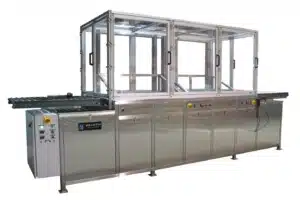
Energy industry components range from small precision fittings to oversized housings and vessels, which is why Zenith offers a range of platforms suited to different part sizes, volumes, and automation requirements:
- Large Custom Single-Tank Cleaners: Oversized single-tank systems built for large components such as heat exchanger sections and sizeable valve or pump assemblies.
- ULTRAMATIC HV Multi-Process Cleaning System: A multi-process system supporting sequenced clean, rinse, and dry stages for components requiring a documented, multi-step process.
- Submersible Transducers: For retrofitting ultrasonic cleaning capability into existing large tanks or vessels, a common need for oversized energy equipment.
- ADVANTAGE Automated Ultrasonic Washer: Automated multi-stage cleaning for higher-volume component processing.
- NOVA Semi-Automated Ultrasonic Cleaner: Semi-automated processing suited to moderate volumes or MRO environments transitioning from manual cleaning.
Ultrasonic Cleaning Applications Across the Energy Industry
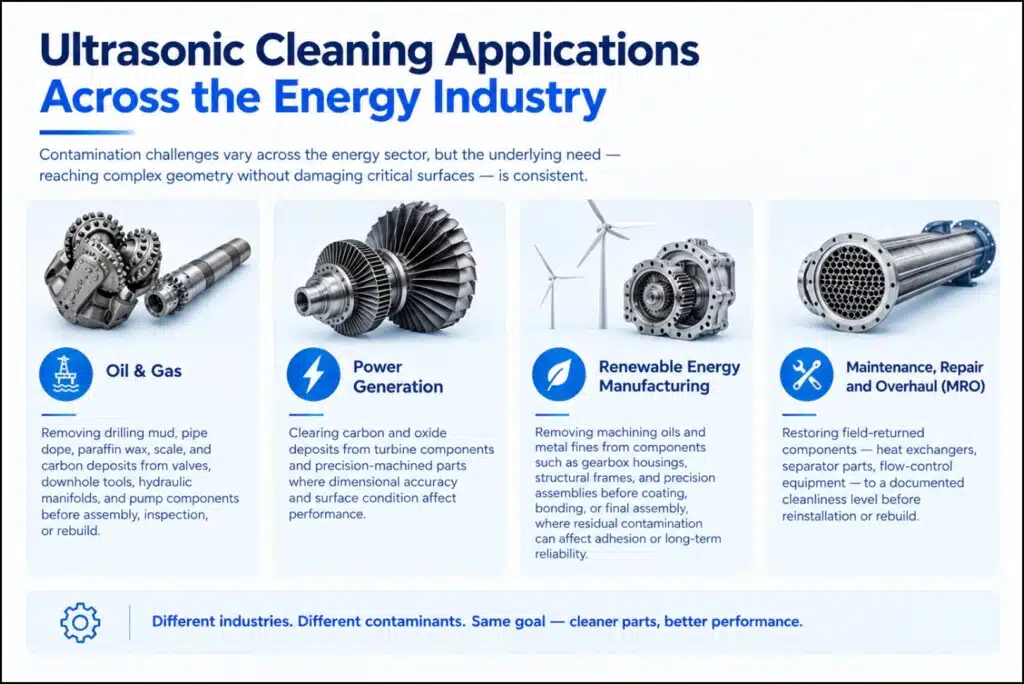
Contamination challenges vary across the energy sector, but the underlying need – reaching complex geometry without damaging critical surfaces is consistent:
- Oil & Gas: Removing drilling mud, pipe dope, paraffin wax, scale, and carbon deposits from valves, downhole tools, hydraulic manifolds, and pump components before assembly, inspection, or rebuild.
- Power Generation: Clearing carbon and oxide deposits from turbine components and precision-machined parts where dimensional accuracy and surface condition affect performance.
- Renewable Energy Manufacturing: Removing machining oils and metal fines from components such as gearbox housings, structural frames, and precision assemblies before coating, bonding, or final assembly, where residual contamination can affect adhesion or long-term reliability.
- Maintenance, Repair, and Overhaul (MRO): Restoring field-returned components – heat exchangers, separator parts, flow-control equipment – to a documented cleanliness level before reinstallation or rebuild.
What Energy Industry Components Can Be Cleaned?
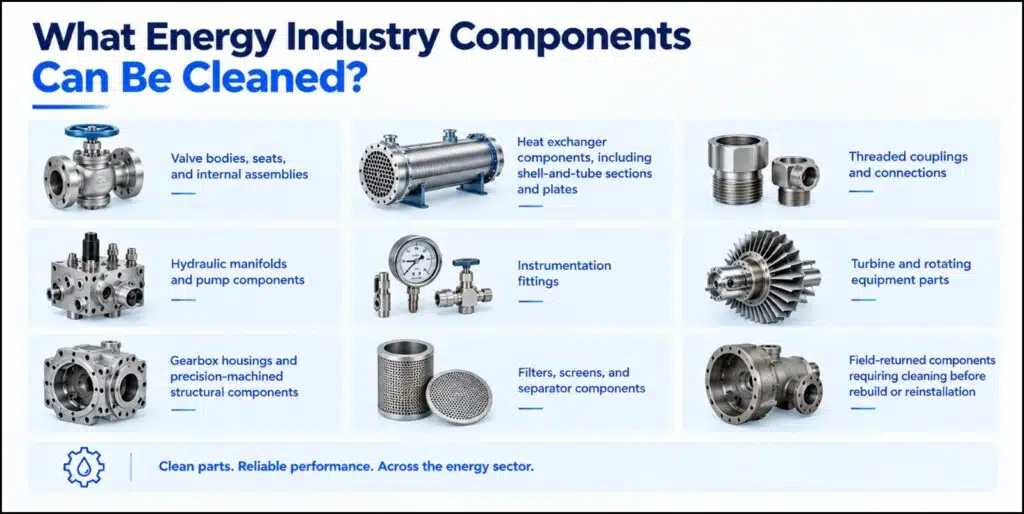
- Valve bodies, seats, and internal assemblies
- Heat exchanger components, including shell-and-tube sections and plates
- Threaded couplings and connections
- Hydraulic manifolds and pump components
- Instrumentation fittings
- Turbine and rotating equipment parts
- Gearbox housings and precision-machined structural components
- Filters, screens, and separator components
- Field-returned components requiring cleaning before rebuild or reinstallation
Why Use Ultrasonic Cleaning for Energy Industry Components?
- Reaches internal bores, cross-drillings, and blind holes that power washing and manual cleaning cannot access.
- Non-abrasive process that removes contamination without damaging sealing surfaces, coatings, or precision-machined features.
- Consistent, repeatable results across a full batch, supporting documented cleanliness standards ahead of assembly, inspection, or coating.
- Handles a wide range of contaminants – carbon, drilling mud, scale, paraffin, corrosion products, and machining oils, within a single process.
- Reduces the labor and cycle time associated with manual scrubbing or repeated solvent wiping on complex geometries.
Cleaning performance in every case depends on the specific contaminant, base material, part geometry, and the frequency, chemistry, and cycle time applied, which is why energy industry cleaning applications are typically evaluated and tested on the actual component rather than assumed from a general specification.
Why Energy Industry Manufacturers Choose Zenith Ultrasonics
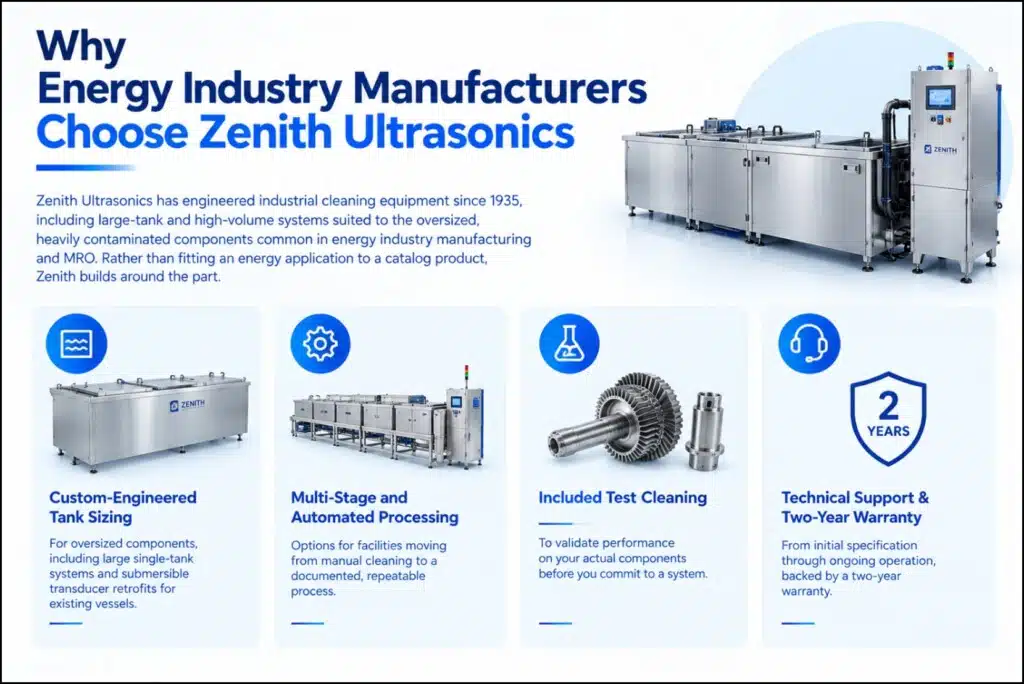
Zenith Ultrasonics has engineered industrial cleaning equipment since 1935, including large-tank and high-volume systems suited to the oversized, heavily contaminated components common in energy industry manufacturing and MRO. Rather than fitting an energy application to a catalog product, Zenith builds around the part:
- Custom-engineered tank sizing for oversized components, including large single-tank systems and submersible transducer retrofits for existing vessels.
- Multi-stage and automated processing options for facilities moving from manual cleaning to a documented, repeatable process.
- An included test cleaning to validate performance on your actual components before you commit to a system.
- Technical support from initial specification through ongoing operation, backed by a two-year warranty.
Discuss your energy industry cleaning application with Zenith’s engineering team or request a test cleaning on your actual components.

