
Industrial Ultrasonic Cleaning Tanks
Sizes, Specifications & Custom Solutions
Industrial parts cleaning affects coating adhesion, assembly quality, and component life. For manufacturers dealing with oils, carbon, chips, and polishing residue, an ultrasonic cleaning tank is often the only method thorough enough to reach every surface, using transducers to generate cavitation that dislodges contamination without abrasive contact.
Tank design directly affects performance: frequency, size, construction, and filtration all determine consistency. Aerospace, automotive, medical device, electronics, and metal stamping manufacturers rely on properly specified ultrasonic wash tank systems. Zenith has engineered industrial ultrasonic tanks since 1935 – from standard units to fully custom platforms.
What Is an Ultrasonic Cleaning Tank?
An ultrasonic cleaning tank is a stainless-steel vessel with ultrasonic transducers that generate high-frequency sound waves, creating microscopic cavitation bubbles that remove oils, chips, carbon, and other contaminants from part surfaces.
Transducers convert electrical energy into cavitation throughout an aqueous solution matched to the contaminant. Industrial ultrasonic cleaning tank systems differ from consumer-grade units in construction and durability, built for continuous production.
How Does an Industrial Ultrasonic Cleaning Tank Work?
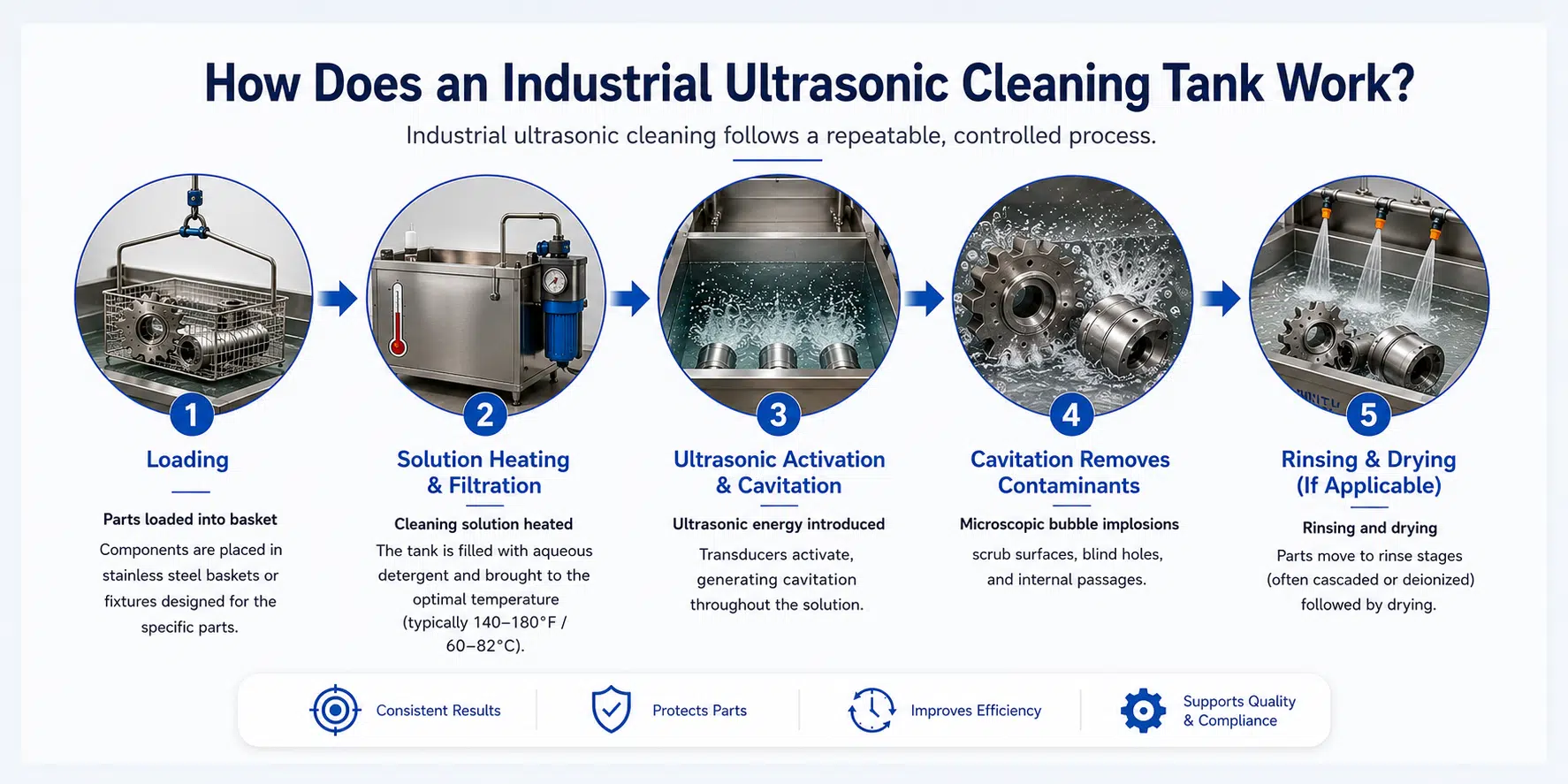
- Parts are loaded into a basket suited to part geometry and load size.
- Cleaning solution is heated to the specified temperature.
- Ultrasonic energy is introduced, generating cavitation.
- Cavitation implosions remove contaminants from every surface.
- Parts proceed to rinsing and drying – manual or integrated.
Key Components of an Ultrasonic Cleaning Tank
Tank Construction: 304 or 316 stainless steel, heavy-duty construction rated for continuous production and chemical resistance.
Ultrasonic Transducers: Bottom-mounted, side-mounted, or immersible, chosen based on tank size and part geometry.
Generator Technology: Digital generators drive the transducers, with sweep and multi-frequency options available.
Heating & Filtration: Temperature control, filtration, and oil separation extend solution life and performance.
Zenith Industrial Ultrasonic Cleaning Tank Sizes
No single tank size fits every application – dimensions should match part size, volume, contamination, and throughput.
Note: frequency is selected based on the part being cleaned, not the tank size – see Choosing the Right Ultrasonic Frequency section.
| Tank Capacity | Typical Application | Heating | Filtration |
|---|---|---|---|
| Up to 50 Gallons | Small machined parts | Available | Optional |
| 50–150 Gallons | Automotive components | Available | Optional |
| 150–300 Gallons | Aerospace & industrial assemblies | Available | Optional |
| 300–500 Gallons | Large manufacturing components | Available | Optional |
| 500+ Gallons | High-volume production systems | Available | Custom |
Zenith builds custom tank dimensions for parts outside standard ranges.
Standard Features Available on Zenith Ultrasonic Tanks
| Feature | Standard | Optional |
|---|---|---|
| Stainless Steel Construction | ✓ | |
| Digital Ultrasonic Generator | ✓ | |
| Sweep Frequency Technology | ✓ | |
| Temperature Controls | ✓ | |
| Tank Insulation | ✓ | |
| Filtration System | ✓ | |
| PLC Controls | ✓ | |
| Oil Skimmer | ✓ | |
| Automatic Lift System | ✓ | |
| Multi-Frequency Operation | ✓ |
Ultrasonic Tank Specifications & Design Options
| Specification | Available Options |
|---|---|
| Tank Material | 304 SS, 316 SS |
| Frequency | 25 kHz, 40 kHz, 80 kHz, 130 kHz |
| Technology | Sweep Frequency, Multi-Frequency |
| Heating | Electric heaters |
| Controls | Manual, Digital, PLC |
| Automation | Semi-Automatic, Fully Automatic |
| Filtration | Cartridge, Bag, Custom |
| Material Handling | Baskets, Hoists, Conveyors |
Choosing the Right Ultrasonic Frequency
| Frequency | Best For |
|---|---|
| 20–25 kHz | Large, heavy parts; heavily-bonded contaminants (e.g. burned carbon) |
| 40 kHz | Most common industrial frequency; balances scrubbing power with distribution |
| 80 kHz | Lightly-bonded soils (oils, coolants, metal fines); smaller, sensitive parts like semiconductors |
| 130 kHz | Highly sensitive parts (electronics, precision components) |
| Multi-Frequency | Combines raw power of low frequencies with even distribution of high frequencies |
Every frequency produces standing waves – bands of strong and weak cavitation. Lower frequencies clean with more force but wider gaps; higher frequencies distribute energy more evenly with less force. CROSSFIRE™ combines both – typically 40/80 kHz in one multi frequency ultrasonic tank.
Single Tank vs Multi-Stage Ultrasonic Cleaning Systems
| Feature | Single Tank | Multi-Stage System |
|---|---|---|
| Cleaning Stage | Yes | Yes |
| Rinse Stage | Separate | Integrated |
| Drying | Separate | Integrated |
| Throughput | Lower | Higher |
| Automation | Limited | Advanced |
For integrated rinse/drying, higher throughput, or automation, consider a Multi-Stage Ultrasonic Cleaning System instead.
Industries & Applications
- Aerospace: Engine components, machined parts.
- Automotive: Transmission components, fuel systems.
- Medical Device Manufacturing: Precision cleaning applications.
- Electronics: Sensitive components.
- Metal Stamping & Machining: Production cleaning operations.
Why Manufacturers Choose Zenith Ultrasonics
- Industrial systems only – no consumer or hobbyist-grade equipment.
- Custom-engineered custom ultrasonic cleaning tank solutions for non-standard parts and volumes.
- Large tank manufacturing capabilities for high-volume production.
- CROSSFIRE® Multi-Frequency Technology (US Patent 5,865,199 and 6,019,852).
- Integrated heating and filtration; automation expertise including the patented ®
- Application engineering support and after-sales service, backed by a 2-year/10-year warranty.
Need Help Selecting the Right Ultrasonic Cleaning Tank?
Whether you need a standalone stainless steel ultrasonic cleaning tank, a heated ultrasonic cleaning tank with integrated filtration, or a fully automated multi-stage solution, Zenith Ultrasonics can engineer a system tailored to your production requirements.
