
Ultrasonic Cleaning Baskets: The Complete Industrial Guide
The ultrasonic cleaning basket is one of the most functionally important and most frequently overlooked components in an ultrasonic cleaning system. The right basket protects parts from surface contact damage, ensures cavitation energy reaches every surface uniformly, and acts as a carrier through cleaning, rinsing, and drying stages in multi-stage and automated systems.
Understanding basket design, materials, and selection and how basket technology evolves across Zenith systems helps manufacturers achieve consistent, repeatable cleaning results from day one.
What Is an Ultrasonic Cleaning Basket?
An ultrasonic cleaning basket suspends parts inside the cleaning solution during the ultrasonic cycle, preventing direct contact with the tank bottom and improving the distribution of ultrasonic waves throughout the part load. In multi-stage processes, baskets act as carriers – moving parts from wash to rinse to drying stages without manual re-handling.
Most industrial ultrasonic cleaning baskets are fabricated from stainless steel mesh, which resists corrosion from aqueous cleaning chemistries and transmits ultrasonic energy effectively throughout the load.
Why the Right Basket Matters for Cleaning Performance
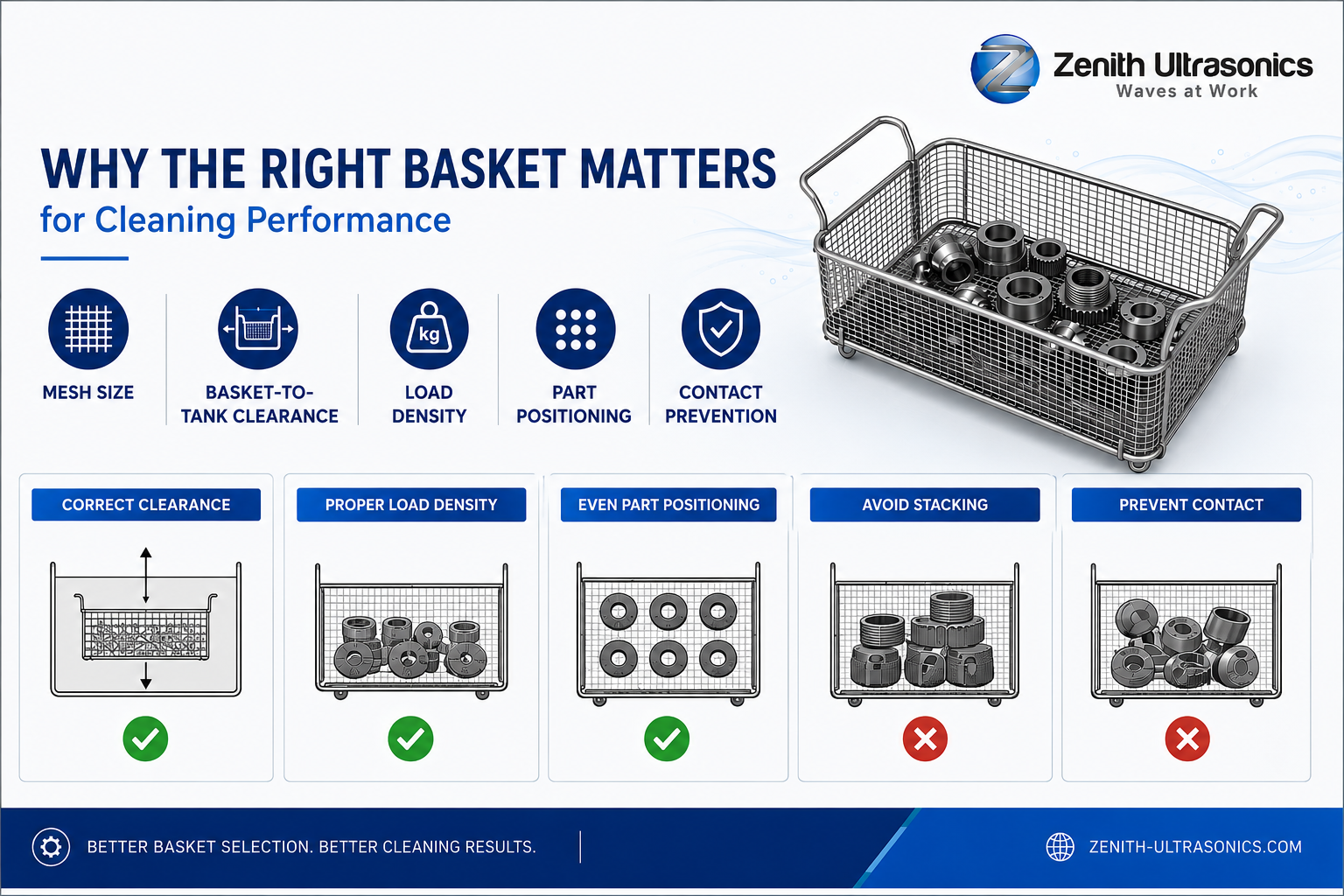
- Mesh size: Affects both cavitation transmission and solution drainage. Finer mesh contains smaller parts but can restrict energy flow coarser mesh maximizes transmission for larger, heavier loads.
- Basket-to-tank clearance: Proper spacing between basket and tank walls is essential for solution circulation and preventing ultrasonic wave interference.
- Load density: Overloading reduces cavitation access to interior parts and compromises cleaning uniformity. Load to the correct capacity.
- Part positioning: Even distribution ensures consistent cavitation exposure. Stacking of parts should generally be avoided, as stacked parts can create shielded zones that cleaning solution cannot reach, though stacking may be permissible depending on available ultrasonic power and the type of contaminants being removed.
- Contact prevention: Parts touching each other or resting against basket walls risk surface abrasion. Dividers or correct load sizing prevents this.
Ultrasonic Cleaning Basket Materials: What Works and When
- Stainless steel: The industrial standard. Transmits ultrasonic energy efficiently, resists chemical corrosion, and withstands repeated thermal cycling under continuous production use.
- Polypropylene inserts: Used selectively within stainless frames such as thin mesh lining along the basket floor to prevent part damage, preserving the structural and acoustic advantages of a stainless-steel basket.
How Basket Technology Evolves Across Systems
- Manual Multi-Stage Systems: Operators load parts into stainless ultrasonic cleaning baskets and transfer them by hand between wash, rinse, and dry tanks. Basket design focuses on ease of handling, part protection, and reliable cavitation access at every stage.
- TRANSTAR Automation Systems: The TRANSTAR precision cleaning system uses an automated gantry to transfer baskets between tanks, eliminating manual handling. Controlled basket oscillation (vertical movement) improves cleaning in blind holes and deep recesses by continuously refreshing the cleaning solution against part surfaces.
- PATENTED ADVANTAGE Automated Ultrasonic Washer Systems: The PATENTED ADVANTAGE automated washer uses a basket design that eliminates internal support structures from the cleaning zone. This allows more ultrasonic energy to reach the part load directly, improving cleaning performance by reducing shadowed areas created by conventional basket frames.
- VORTEX Centrifugal Ultrasonic Cleaning Systems: The VORTEX centrifugal washer replaces traditional flat baskets with a rotating drum that spins parts through the cleaning solution. Centrifugal force securely holds parts in place while exposing all surfaces to ultrasonic cavitation, minimizing part movement and reducing the risk of damage compared to tumbling systems.
- AEROCLEAN Aerospace Parts Washer: For aerospace and other high-precision applications, Zenith uses custom fixtures instead of standard baskets. These fixtures position parts precisely to ensure validated cleaning of critical surfaces, including blind holes, cavities, and internal channels, while meeting stringent aerospace and precision manufacturing cleanliness standards. The system also permits rotation of parts to ensure that all blind holes, cavities, and internal channels are properly cleaned.
How to Load an Ultrasonic Cleaning Basket
- Distribute parts evenly across the basket. Avoid concentrating the load in one area.
- Avoid stacking parts where possible, as stacking can block cavitation access to lower layers, though it may be permissible depending on ultrasonic power levels and the contaminants being removed.
- Orient blind holes and deep recesses facing downward to improve solution drainage and prevent air pockets.
- Do not exceed the basket’s rated load capacity.
- Use dividers or compartments to prevent part-to-part contact, especially on parts with sensitive surface finishes or tight tolerances.
Caring for Your Ultrasonic Cleaning Basket
- Most Zenith systems include an integrated rinsing process that rinses both parts and baskets before next use, so additional manual rinsing is not typically required.
- Inspect mesh welds and frame joints regularly for fatigue, separation, or corrosion.
- Watch for broken wires, mesh deformation, or frame distortion that could allow parts to shift during cleaning.
- Replace damaged baskets immediately, since a compromised basket risks part damage and cleaning inconsistency.
- Most Zenith systems include an integrated drying process, so baskets are normally dry and ready for the next production cycle without additional handling.
Not Sure Which Basket Configuration Is Right?
Zenith’s VeriClean Testing Program allows customers to submit actual production parts for evaluation before committing to a system or basket configuration. Zenith engineers run test cleaning cycles with candidate basket designs and document the results – including cleanliness levels achieved and process observations – giving customers validated performance data tied to their specific parts and contamination profile.
