
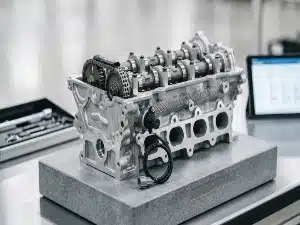
Engineered Solutions for the Cleaning Problems Automotive Manufacturers Actually Have
Automotive components accumulate contamination at nearly every stage of production – machining oils, cutting fluids, carbon deposits, metal particles, and assembly residues all settle into surfaces, threads, and internal passages long before a part reaches final inspection. An ultrasonic cleaner for automotive parts solves what conventional cleaning methods consistently struggle with: reaching contamination in blind holes, internal channels, folds, and complex geometries that a brush, spray nozzle, or solvent wipe simply cannot access.
Not every automotive cleaning problem calls for the same equipment. The right automotive ultrasonic parts cleaner depends on your part geometry, material, contamination type, production volume, required cleanliness level, and drying needs – not a single machine marketed as a universal solution.
Zenith Ultrasonics works as an engineering partner first: helping you determine the right ultrasonic cleaning process for your specific application, then configuring the equipment to match it.
Need Help Cleaning a Difficult Automotive Component?

Made in the USA

Custom Engineered Solution

Comprehensive Warranty
Ultrasonic Cleaning Systems for Automotive Applications
Zenith offers a range of ultrasonic parts cleaner automotive systems, from manual bench-top units to fully automated production lines:
ADVANTAGE® Automated Ultrasonic Washer: Patented automation (US Patent 10,112,221) that eliminates basket support structures from the cleaning zone, maximizing ultrasonic energy delivery to the parts.
ULTRAMATIC HV Multi-Process Cleaning System: A high-performance clean/rinse/dry system combining ultrasonic cleaning, ultrasonic rinsing, spray rinsing, and cleaning/rinsing oscillation with a multi-position conveyor for queuing multiple baskets.
NOVA Semi-Automated Ultrasonic Cleaner: A semi-automated platform positioned between manual bench-top systems and fully automated production lines — suited to growing operations not yet ready for full automation.
ASTRO Automated Steel Cleaning System: Purpose-built automated 2 tank clean/dry steel-parts cleaning system that takes advantage of Zenith’s exclusive chemistries to eliminate the need for rinsing parts, thereby creating a less-costly and smaller system for automotive parts cleaning applications.
Ultrasonic Automotive Parts Cleaners: Zenith’s dedicated line of single-tank washers that do not provide rinsing or drying operations for automotive and aviation components, built to maximize the features that actually matter for automotive cleaning performance in heavy-duty production environments. Designed specifically for smaller operations that can allow parts to air dry or those that can be dried with compressed air.
Table-Top Cleaners: Compact single-tank systems for lower-volume cleaning, tool room use, or maintenance and prototype applications.
Benchtop Ultrasonic Cleaners / Clean & Rinse: Bench-top clean-and-rinse configurations for facilities needing a straightforward two-stage process without full production automation.
Automotive Parts Cleaning Problems Zenith Can Help Solve
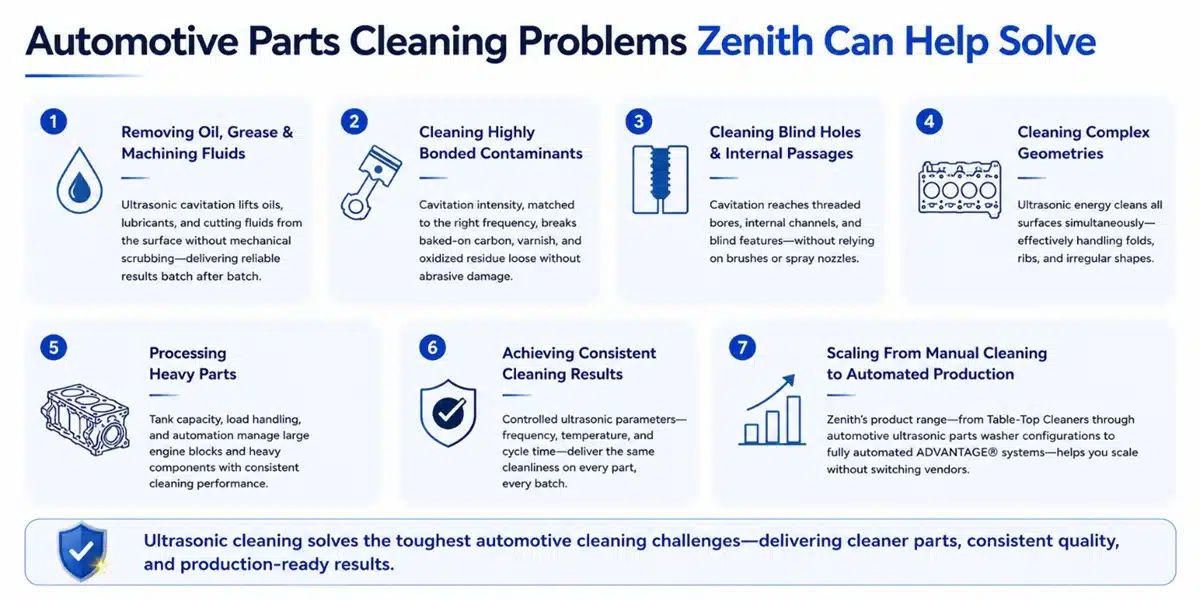
Removing Oil, Grease & Machining Fluids
Cutting fluids, lubricants, and assembly greases coat automotive components after nearly every production step. Ultrasonic cavitation lifts these contaminants from the surface without the mechanical scrubbing that can damage finished parts – an ultrasonic cleaner for auto parts handles this reliably across batch after batch.
Cleaning Highly Bonded Contaminants
Baked-on carbon, varnish, and oxidized residue resist manual cleaning methods. Cavitation intensity – matched to the right frequency for your contamination type – breaks these deposits loose without abrasive damage to the part surface.
Cleaning Blind Holes & Internal Passages
Threaded bores, internal channels, and blind features common in engine and transmission components have no line-of-sight access for brushes or spray nozzles. Cavitation reaches these areas directly, since it doesn’t rely on physical contact or direct spray access.
Cleaning Complex Geometries
Cylinder heads, throttle bodies, and cast components with folds, ribs, and irregular surfaces are difficult to clean uniformly with manual methods. Ultrasonic energy cleans the entire submerged surface simultaneously, regardless of geometric complexity.
Processing Heavy Parts
Engine blocks and large cast components require tank capacity, load handling, and automation capable of managing weight and size without compromising cleaning consistency – a consideration in matching the right system, not just the right chemistry.
Achieving Consistent Cleaning Results
Manual cleaning introduces operator-to-operator variability. Controlled ultrasonic parameters – frequency, temperature, cycle time – deliver the same cleanliness result on every part, every batch, supporting quality documentation requirements.
Scaling From Manual Cleaning to Automated Production
As production volume grows, manual and semi-automated systems reach their throughput limits. Zenith’s product range – from Table-Top Cleaners through the automotive ultrasonic parts washer configurations to fully automated ADVANTAGE® systems – supports scaling without switching vendors.
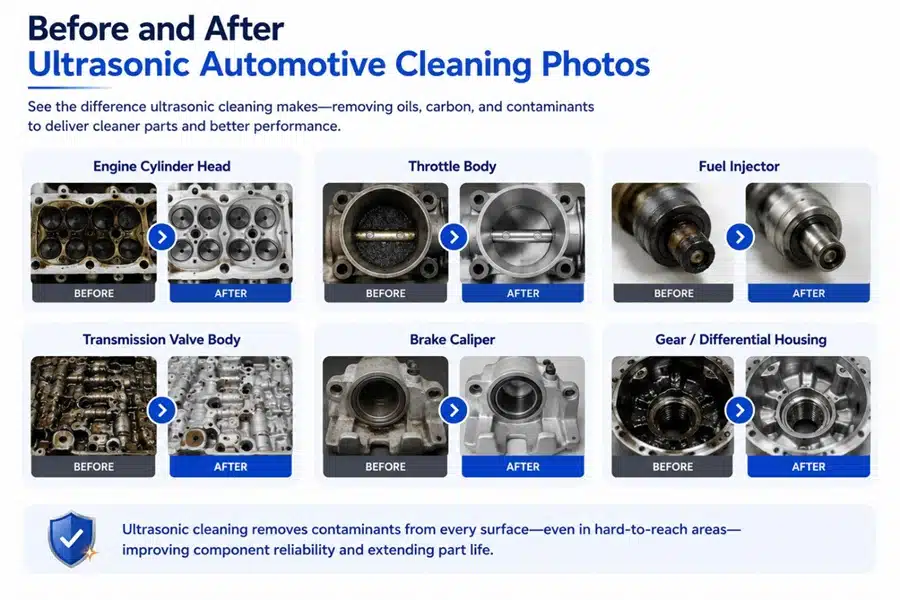
Before and After Ultrasonic Automotive Cleaning Photos
What Automotive Parts Can Be Cleaned with Ultrasonics?
An ultrasonic engine parts cleaner and related Zenith systems are used across the full range of automotive components:
- Cylinder heads
- Engine blocks
- Transmission components
- Carburetors
- Throttle bodies
- Fuel injectors
- Brake components
- Assembly hardware
- Hand tools
- Machined automotive parts
- Hydraulic components
- Fuel-system components
Why Choose Zenith Ultrasonics for Your Automotive Parts Cleaner?
Application-Focused Engineering
Rather than recommending a single machine for every automotive application, Zenith works through the specifics of your process:
- Evaluate part geometry and material
- Assess contaminant type
- Consider production volume
- Determine required cleanliness level
- Review rinsing and drying requirements
- Evaluate automation needs
The result is an application-specific recommendation, not a one-size-fits-all sale.
Custom-Engineered Cleaning Systems
When standard configurations don’t fit the application, Zenith builds custom ultrasonic cleaning systems:
- Customize tank size and configuration
- Select appropriate ultrasonic frequency
- Configure cleaning and rinsing stages
- Customize part handling
- Integrate automation where required
- Configure drying systems
Every solution is designed around your component sizes, geometries, contamination types, and production requirements – not adapted from a generic platform.

