
Ultrasonic Parts Washers
Parts contamination is a critical issue in precision manufacturing, impacting inspection accuracy, coating adhesion, assembly fit and performance. Machining oils, stamping lubricants, metallic chips, and particulate residues require reliable cleaning. Zenith Ultrasonics provides industrial ultrasonic parts washers that use acoustic cavitation to clean every surface, including hard-to-reach areas like internal passages and blind holes. Designed for production-scale environments, Zenith’s systems are built for sustained industrial use. Since 1935, Zenith delivers both standardized and custom ultrasonic parts washing systems tailored to specific parts, contamination profiles and production needs, serving industries like aerospace, automotive, defense, and metal fabrication.
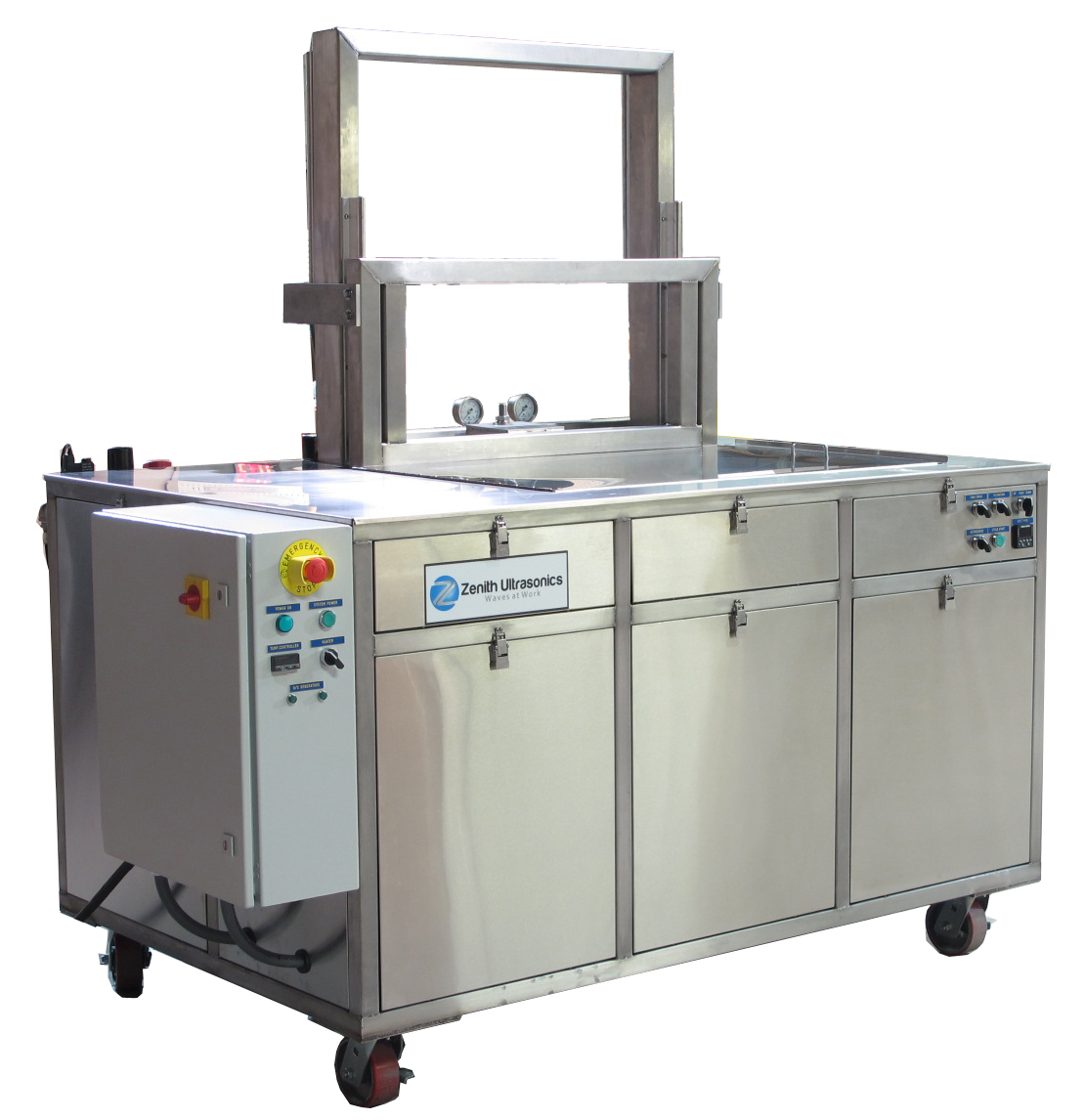
Zenith ultrasonic parts washers are engineered for continuous industrial production. Each system is designed around the specific part geometry, contaminants, cleanliness requirements and throughput. Built with heavy-duty construction, high-efficiency ultrasonic generators and industrial-grade transducers, Zenith systems deliver consistent cavitation performance. Our team also provides full application support, including process engineering, chemistry guidance, validation, and long-term service.

Made in the USA

Custom Engineered Solution

Comprehensive Warranty
Get In Touch
Ultrasonic Parts Washing Technology
How Ultrasonic Parts Washers Work?
Ultrasonic parts washers operate on acoustic cavitation. An ultrasonic generator converts electrical input into high-frequency mechanical energy which is transmitted into the cleaning solution through transducers bonded to the tank walls or deployed in sealed submersible assemblies. That energy creates rapid alternating pressure cycles in the liquid. During low-pressure phases, microscopic vapor bubbles nucleate throughout the bath. During the high-pressure phase, those bubbles collapse with concentrated localized energy producing an intensive scrubbing action across every wetted surface.
This mechanism enables ultrasonic parts washing to remove contaminants that conventional cleaning methods cannot effectively address. Blind holes, threaded features, internal bores, undercuts and precision-formed contours receive the same cleaning action as open, accessible surfaces. There is no shadowing, no mechanical contact, and no surface abrasion. The process is continuous, uniform, and repeatable across every part in the bath.
Frequency Selection and Its Effect on Cleaning Performance
Frequency is a primary configuration variable in any industrial ultrasonic parts washer. Lower operating frequencies, typically 25 to 40 kHz produce larger cavitation bubbles that collapse with greater force. These are appropriate for heavy soils, structural metal components and applications where surface finish is not a primary constraint.
Higher frequencies in the 80 to 170 kHz range generate smaller, more densely distributed bubbles with a finer, more controlled cleaning action. These are specified for precision parts with delicate surface finishes, intricate geometries, electronic assemblies and components where surface integrity must be preserved alongside cleanliness verification.
Zenith engineers determine the correct frequency based on the part material, surface condition, contamination profile, and the cleanliness level the application requires. Many production systems incorporate CROSSFIRE Multiple Frequency technology, which cycles through frequency ranges to produce a hybrid cleaning action suited to parts that fall between the extremes.
Not sure which ultrasonic frequency is right for your application?
Our engineers can help determine the optimal configuration for your parts and cleaning requirements.
Ultrasonic Parts Cleaner Fluid and Solution Selection
The ultrasonic parts cleaner solution is an equally important process variable for successful ultrasonic cleaning operations. Aqueous detergent chemistry must be selected based on the base material of the part and the specific contaminants being removed. An incompatible chemistry can reduce cleaning effectiveness significantly, cause surface reactions on sensitive alloys, or shorten bath service life significantly.
Zenith provides chemistry guidance as part of the application engineering process, identifying suitable ultrasonic parts cleaner fluid formulations and establishing concentration ranges, operating temperature parameters, and bath management procedures appropriate to the production environment and discharge requirements.
Applications of Industrial Ultrasonic Parts Washers
Industrial ultrasonic parts washers from Zenith serve a range of sectors where cleanliness standards are defined, verified, and consequential to product performance.
- Aerospace Manufacturing: Propulsion components, hydraulic assemblies, and avionics hardware carry strict cleanliness requirements that define both particle size limits and allowable chemical residues. Zenith aerospace ultrasonic parts washers are configured to handle titanium, aluminium and nickel alloy components while meeting the cleanliness standards that aerospace quality systems require.
- Automotive Components: Fuel injectors, transmission housings, valve bodies and cylinder heads accumulate metallic fines, cutting fluids, drawing compounds and coolant residues during machining and forming operations. Ultrasonic parts washing removes these contaminants efficiently before assembly, functional testing or surface coating, achieving cleanliness levels that spray washing and solvent methods frequently cannot reach.
- Precision Metal Machining and Stamping: CNC-machined and stamped metal parts carry chips, lubricant films, and stamping compounds that affect inspection accuracy, coating adhesion, and dimensional verification. Industrial ultrasonic parts washers process these parts at production scale, supporting in-line inspection and downstream finishing without creating a throughput bottleneck.
- Military and Defense Programs: Defense component cleaning requirements are frequently derived from established military standards specifying particle size limits, chemical residue thresholds, and process documentation. Zenith has extensive experience building ultrasonic parts washing systems for defense contractors and government programs, with the configuration control and documentation support those environments require.
High-Technology and Regulated Manufacturing: Precision electronics, medical devices, and optical components operate under contamination limits that are quantified and audited by regulatory bodies. Zenith systems are configured for these environments and deliver verifiable cleanliness that regulated manufacturing demands.
Need help selecting the right cleaning fluid or configuring your ultrasonic system?
Zenith engineers can evaluate your parts, contaminants, and production requirements to recommend the optimal solution.
Request an Application Consultation
Process Challenges Addressed by Zenith’s Ultrasonic Parts Washing Systems
Effective parts cleaning is a process, not a single step. Manufacturers operating industrial ultrasonic parts washing lines also manage operational and environmental factors that must be controlled systematically to maintain process reliability.
- Waste Stream Management: Cleaning baths accumulate removed contaminants during production. Without active management, bath degradation reduces cleaning effectiveness and increases disposal frequency and cost. Zenith systems can be configured with oil separators, particulate filtration, and bath monitoring to extend bath service life and reduce waste stream volume.
- Process Water Quality: Feed water quality directly affects cleaning chemistry performance and bath stability. High mineral content, inconsistent pH, and dissolved solids interfere with detergent function and can deposit residues on cleaned parts. Zenith addresses water quality as part of the system design process, incorporating conditioning or treatment equipment where production conditions require it.
- Cycle Time and Throughput: Cleaning equipment sized for average loads rather than peak production demand creates bottlenecks that affect overall line efficiency. Zenith designs ultrasonic parts washing systems with the full production workflow in mind, accounting for part load dimensions, staging requirements, cycle times, and the integration of rinsing and drying stages.
Process Parameter Control and Repeatability: A cleaning process that varies across shifts, operators, or bath life stages is a process control failure. Zenith systems incorporate automated controls for temperature, generator output, chemistry dosing, and cycle timing, maintaining process conditions within specified limits without requiring manual intervention at each cycle.

Download the ACS Brochure
Press the button below to access the ACS brochure which..
Download
Looking for something else?
Our Product Page will provide you with general descriptions and..
Learn More
Smaller Automotive Parts Cleaners
Zenith also offers smaller table-top systems that can also be..
Learn More