
Ultrasonic Cleaner

Made in the USA

Custom Engineered Solution

Comprehensive Warranty
No posts found.
How do Ultrasonic Cleaners Work?
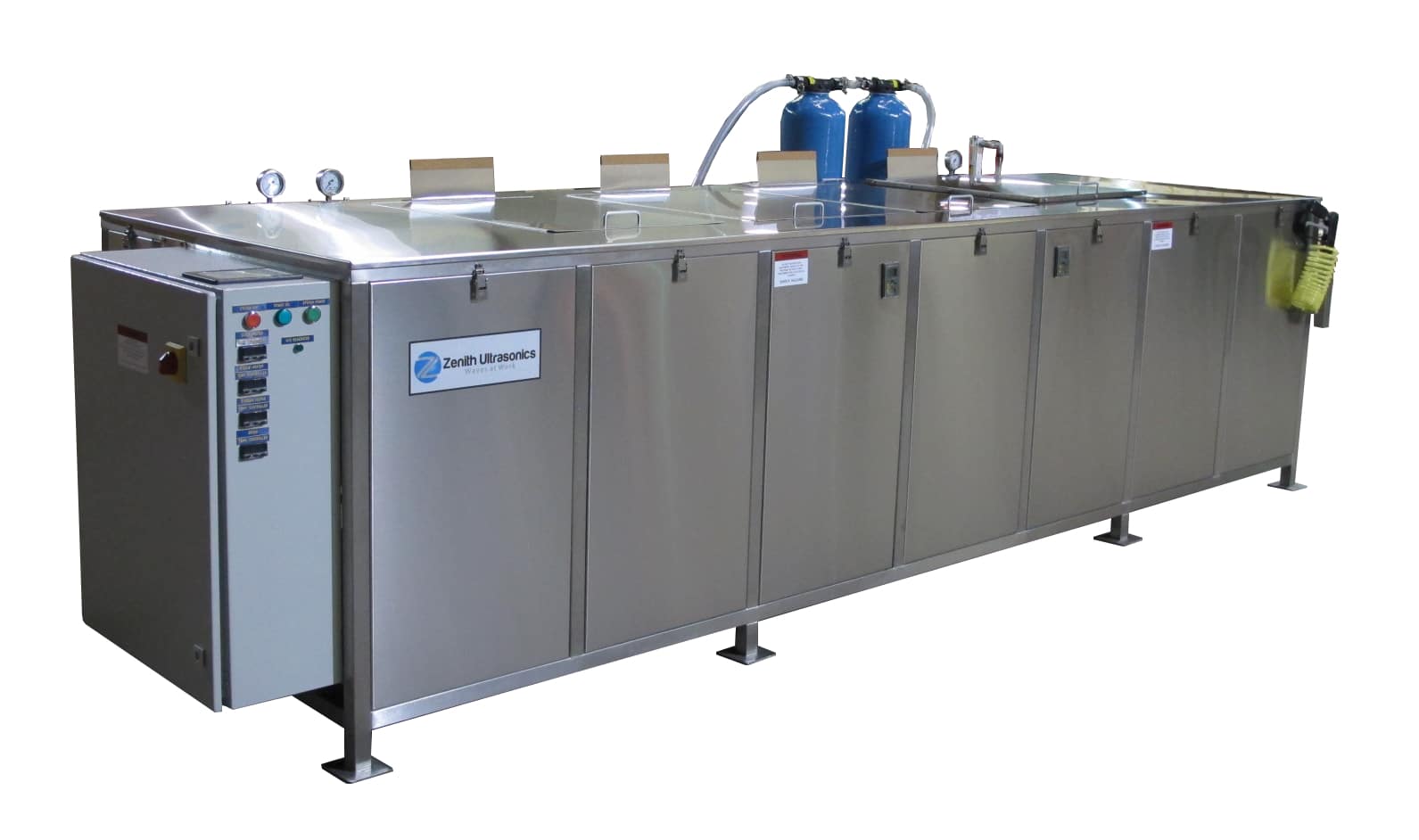
Ultrasonic cleaning operates on the principle of acoustic cavitation. An ultrasonic generator converts electrical energy into high-frequency mechanical vibrations which are transmitted into the cleaning solution through transducers bonded to the tank walls or in sealed submersible transducer packs. These vibrations create alternating pressure cycles within the liquid. During low-pressure phases, microscopic vapor-filled bubbles form throughout the solution. During high-pressure phases, those bubbles collapse with significant localized energy release. This process, known as transient cavitation, produces intensive scrubbing action at every surface the liquid contacts. Blind holes, threaded features, internal passages, undercuts and complex surface geometries that are physically inaccessible by mechanical means are cleaned with the same consistency as open surfaces. The action is uniform, continuous and non-abrasive.
Frequency Selection and Its Effect on Cleaning Performance
Ultrasonic frequency is one of the primary variables in system configuration. Lower frequencies, typically in the range of 25 to 40 kHz, generate larger cavitation bubbles that collapse with greater force but are less evenly distributed across the surface of parts being cleaned. This is appropriate for heavy soils, robust metal parts with larger holes and detailed areas, and applications where surface finish is not a primary constraint.
Higher frequencies, in the range of 80 to 170 kHz, produce smaller, less aggressive bubbles that are more evenly distributed across the parts and with more precise cleaning action that is capable of cleaning smaller holes and fine detail. These frequencies are specified for delicate components, finely finished surfaces with fine detail, electronic assemblies and applications where surface integrity must be preserved while achieving a defined cleanliness level.
Zenith engineers select frequency based on part material, surface condition, contaminant type and the cleanliness specification the application requires. In many cases, systems include our CROSSFIRE Multiple Frequency Systems to provide a hybrid cleaning action.
Cleaning Chemistry and Its Role in the Process
Frequency and power alone do not determine cleaning effectiveness. The chemical composition of the cleaning solution is equally significant. Aqueous detergent chemistry is selected based on the base material of the part and the nature of the contaminants to be removed. Incorrect chemistry can reduce cleaning effectiveness, cause surface reactions or shorten bath service life.
Zenith provides chemistry guidance as part of the application engineering process, identifying suitable formulations and establishing concentration, temperature, and bath life management parameters appropriate to the production environment.
Applications of Industrial Ultrasonic Cleaners
Our systems support a wide range of industries where the advantages of ultrasonic cleaners are critical to production performance:
- Aerospace Manufacturing: Our aerospace ultrasonic cleaners meet strict cleanliness standards for critical components in propulsion systems, avionics, and hydraulic assemblies. We design equipment to handle titanium, aluminum, and nickel alloys. These ultrasonic cleaners help prevent performance issues, wear, or failure due to contaminants like machining oils and metallic particles.
- Automotive Components: Fuel injectors, valve bodies, transmission housings, and cylinder heads require cleaning that reliably removes metallic fines, cutting fluids, drawing compounds, and coolant residues before assembly or coating. Our ultrasonic systems are engineered to meet the demands of automotive manufacturing environments, where traditional mechanical parts washing fails to achieve the cleanliness levels required by assembly and performance specifications.
- Metal Machining and Metal Stamping Operations: CNC-machined and precision-stamped metal parts accumulate chips, burrs, lubricants, and stamping compounds that affect inspection accuracy, adhesion of functional coatings, and dimensional verification. Our industrial ultrasonic cleaners remove these contaminants efficiently and at production scale, supporting both in-line inspection processes and downstream finishing operations.
- High-Technology Manufacturing: Applications in precision electronics manufacturing operate under contamination limits that are quantified and verified by regulatory bodies. Particulate and chemical contamination on components in these sectors can cause product failure or create regulatory compliance issues. Our ultrasonic cleaners are configured to these environments and deliver verifiable cleanliness with the process control documentation that regulated manufacturing requires.
- Military and Defense Programs: Military components and assemblies frequently carry cleanliness requirements derived from defense standards that specify both particle size limits and chemical residue thresholds. Zenith Ultrasonics has extensive experience building systems for defense contractors and government programs with configuration and documentation support appropriate to these environments.
Process Challenges Addressed By Zenith’s Industrial Ultrasonic Cleaning Systems
Achieving part cleanliness is only a step in the cleaning process. Manufacturers operating industrial cleaning lines also face operational and environmental challenges that must be managed systematically.
- Waste Stream Management: Cleaning baths accumulate removed contaminants over time. Without proper management, bath degradation reduces cleaning effectiveness and increases disposal frequency. Our systems can be configured with oil separation, particulate filtration and bath monitoring to extend service life and reduce the volume and frequency of waste stream disposal events.
- Process Water Quality: Feed water quality directly affects cleaning chemistry performance and bath stability. High mineral content, inconsistent pH, and dissolved solids can interfere with detergent function and deposit residues on parts. Zenith addresses water quality as part of the system design process, incorporating treatment or conditioning equipment where the production environment requires it.
- Throughput and Cycle Time Requirements: Cleaning equipment sized for average conditions rather than peak production demand creates bottlenecks. Zenith designs systems with the full production workflow in mind, accounting for part load size, staging requirements, cycle times and the integration of rinsing and drying stages to support the overall line rate.
- Process Parameter Control and Repeatability: A cleaning process that is inconsistent across shifts, operators, or bath life stages is a process control failure. Zenith systems incorporate automated controls for temperature, frequency output, chemistry dosing and cycle timing, maintaining process conditions within specified limits without operator intervention.