
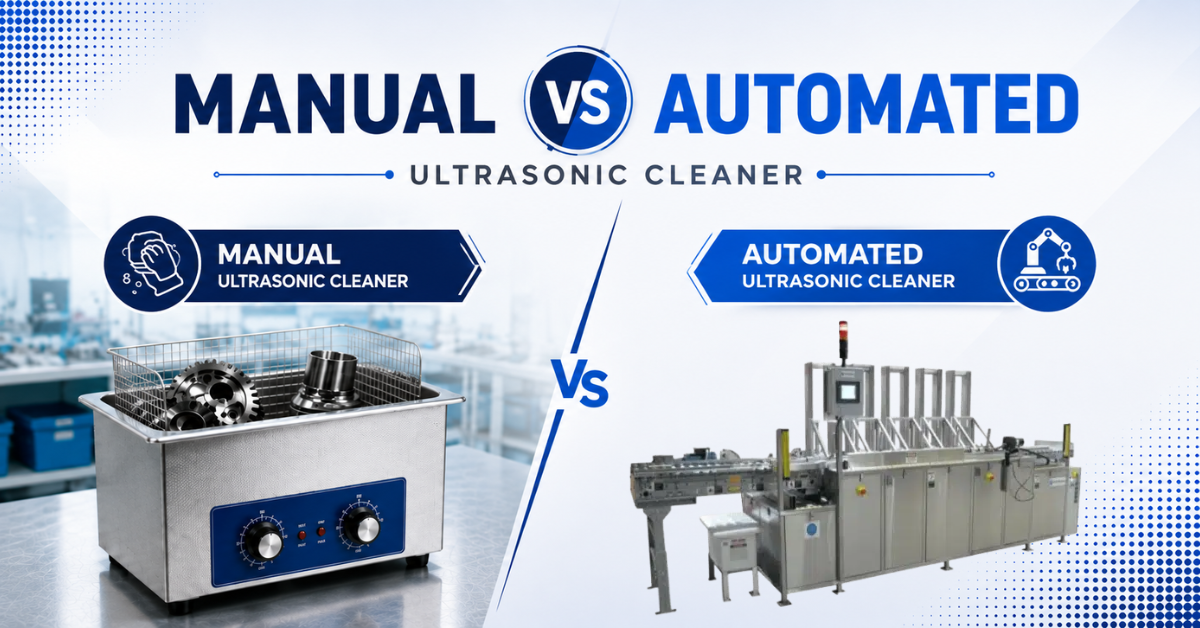
Cleaning manufactured parts is critical to component performance and longevity. On complex parts with intricate geometries, removing oil, grease, and other contaminants is a challenge and traditional cleaners often can’t reach internal features or meet the precision standards required in aerospace, automotive, and electronics. Ultrasonic cleaning solves this through cavitation, delivering thorough, damage-free cleaning for delicate and complex parts. The choice comes down to two options – manual systems and Automated ultrasonic cleaners and the right one depends on cost, throughput, chemical and water usage, and how the system fits your production goals. Here’s a clear comparison to help you decide which system is right for your operation.
How Ultrasonic Cleaning Works?
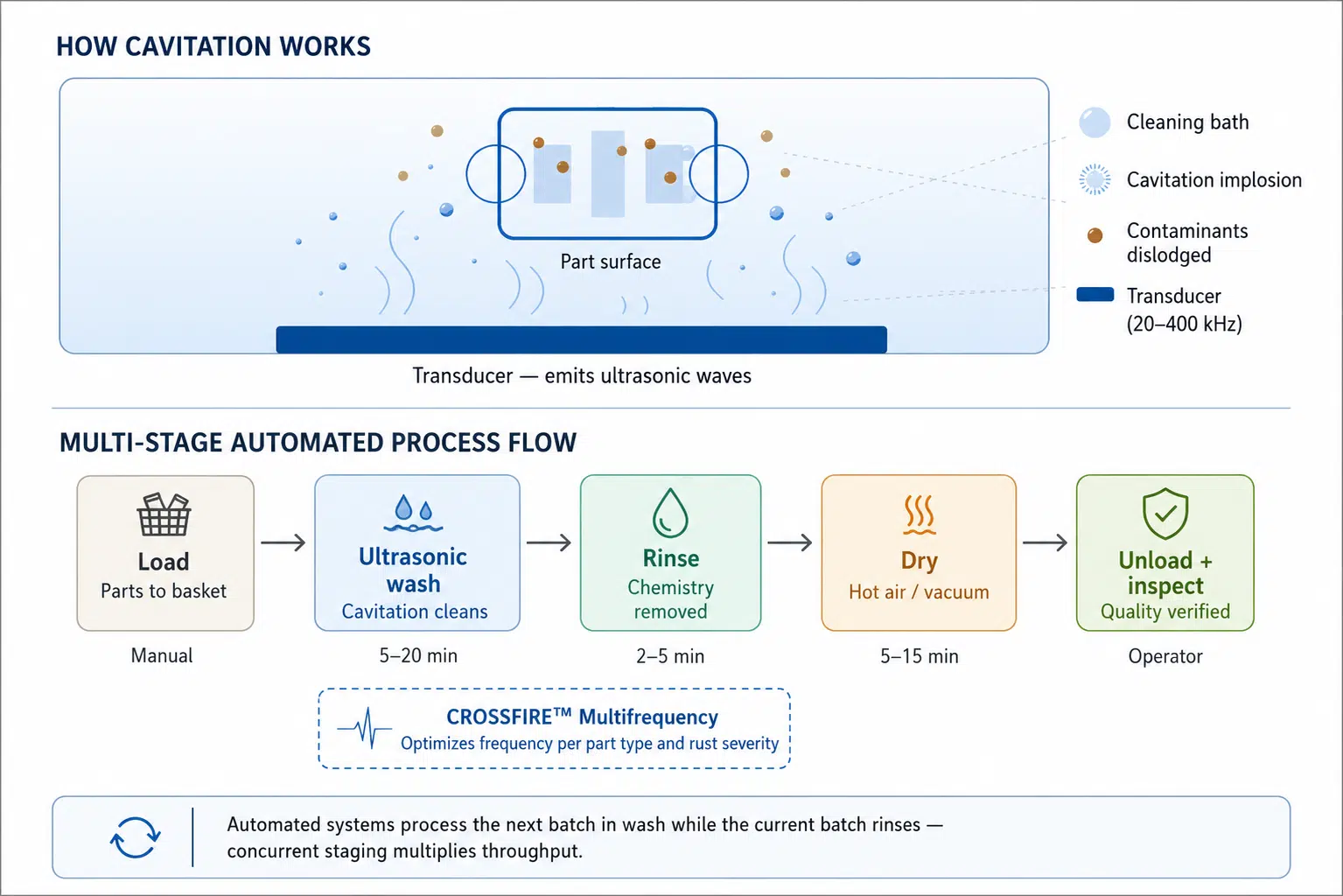
Ultrasonic cleaning works through cavitation: ultrasonic waves passing through a cleaning solution create tiny bubbles that rapidly expand and collapse. This collapsing action generates intense cleaning energy that dislodges contaminants from part surfaces and internal features – delivering uniform, repeatable results once the system is set up.
Manual Ultrasonic Cleaners: Operator-Controlled Systems
- Direct Operator Control: Operators load, unload, and monitor parts based on cleanliness requirements and part condition.
- Open Tank Configuration: Parts are loaded into baskets and immersed in cleaning solution by hand.
- Flexible for Diverse Parts: Easily accommodates varying sizes, geometries, and contamination levels without dedicated programming.
- Mid-Cycle Inspection: Operators can check quality during processing and clean again if needed.
Automated Ultrasonic Cleaners: Program-Driven Systems
An automated ultrasonic cleaning system runs predetermined sequences with minimal operator involvement:
- Multi-Stage Integration: Automated ultrasonic cleaners combine wash, rinse, and dry into one programmed workflow.
- Automatic Transfer: Parts move between stages on precise timing and temperature parameters.
- Repeatability: Identical treatment every batch, supporting strict quality requirements.
- Higher Throughput: The system processes prior batches while new parts are being loaded.
- Multi-Station Configurations: Different part families run simultaneously, each on its own protocol.
- Lower Labor Requirements: One technician oversees multiple machines; automation ROI is typically 1–2 years.
Cost, Time, and Resource Efficiency: Manual vs Automated
- Cost: Manual systems cost less upfront but carry higher ongoing labor costs. An automated ultrasonic cleaning system costs more initially but lowers per-part costs through reduced labor and rework – typically paying back within 1–2 years.
- Time Savings: Ultrasonic cleaning can cut cleaning time by 60–85% versus traditional methods, since cavitation acts on the whole submerged surface at once. Automated ultrasonic cleaners remove manual handoffs entirely, raising throughput without added labor.
- Chemical Consumption: Cavitation reduces reliance on aggressive solvents – some estimates show chemical use dropping by up to 80% versus conventional cleaning, lowering cost and disposal burden. Automated filtration extends solution life further.
- Water Consumption: Filtration and recirculation in automated systems can cut water usage by over 70% versus repeated fill-and-drain manual cycles, a key factor where discharge limits apply.
- Productivity: With Automated ultrasonic cleaners, technicians shift from constant monitoring to overseeing multiple lines, inspection, and documentation – compounding gains beyond raw cycle-time reduction.
Manual vs Automated Ultrasonic Cleaners: Side-by-Side Comparison
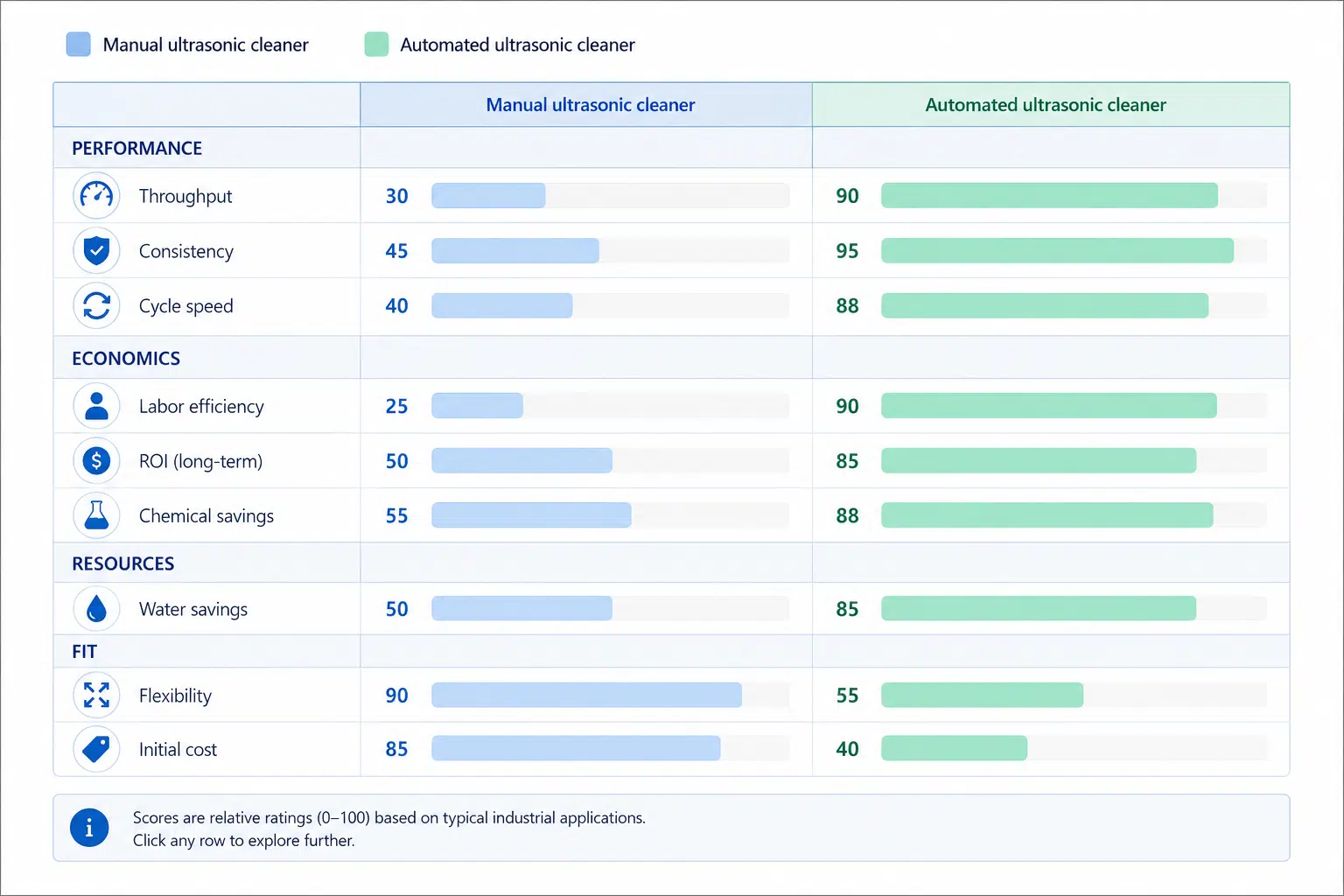
The table below summarizes how the two approaches compare across key production factors:
| Factor | Manual Ultrasonic Cleaners | Automated Ultrasonic Cleaners |
|---|---|---|
| Production Volume | Low–moderate, batch-based | Moderate–high, continuous |
| Labor Requirement | Dedicated operator per cycle | One technician, multiple lines |
| Cleaning Consistency | Varies with operator attentiveness | Identical every cycle |
| Throughput | Limited by manual handling | Higher, continuous processing |
| Cost | Lower upfront cost | Higher upfront, lower per-part cost |
| Flexibility | Handles varied parts easily | Handles varied parts easily |
| Scalability | Add units/operators to scale | Scales via multi-station configs |
| Ideal Applications | R&D, prototyping, low-volume parts | High-volume, regulated production |
Industries Using Manual and Automated Ultrasonic Cleaners
Both approaches serve critical roles across manufacturing.
- Medical Device Manufacturing: Medical device makers use automated systems for validated implant cleaning and manual systems for prototypes and small-batch instruments.
- Aerospace and Defense Manufacturing: Aerospace and defense operations use automated lines for high- and low-volume parts, with manual systems for intermittent needs.
- Automotive Manufacturing: Automotive manufacturers run automated ultrasonic cleaning system lines for fuel injectors and transmission components, alongside manual systems in tool rooms and labs.
- Electronics Manufacturing: Electronics fabricators automate circuit board cleaning while using manual systems for rework.
- Precision Engineering and Metalworking: Precision metalworking shops rely on manual systems for low-volume work, transitioning to automation as part families reach production volume.
You might also like to read:
6 Ultrasonic Cleaning Myths That Cost Manufacturers Time and Money
Case Example: Matching the System to the Operation
A precision metalworking shop running short-run, frequently changing parts benefits from a manual ultrasonic cleaner – operators can adjust load, time, and chemistry batch-by-batch without programming for parts that may never repeat.
An automotive Tier 1 supplier cleaning thousands of identical fuel injector components per shift, under strict OEM cleanliness specs, needs an automated ultrasonic cleaning system with integrated wash, rinse, and drying – delivering the repeatability, documentation, and throughput that volume demands while freeing operators for inline quality checks.
Finding the Perfect Ultrasonic Cleaner for Your Process
Manual systems offer flexibility and hands-on control for smaller batches or varying requirements. Automated ultrasonic cleaners provide consistency, speed, and scalability for high-volume, standardized production. At Zenith Ultrasonics, we engineer both. Explore our full range of ultrasonic cleaning systems, or learn about custom-engineered systems built around your parts, volumes, and process requirements.
