

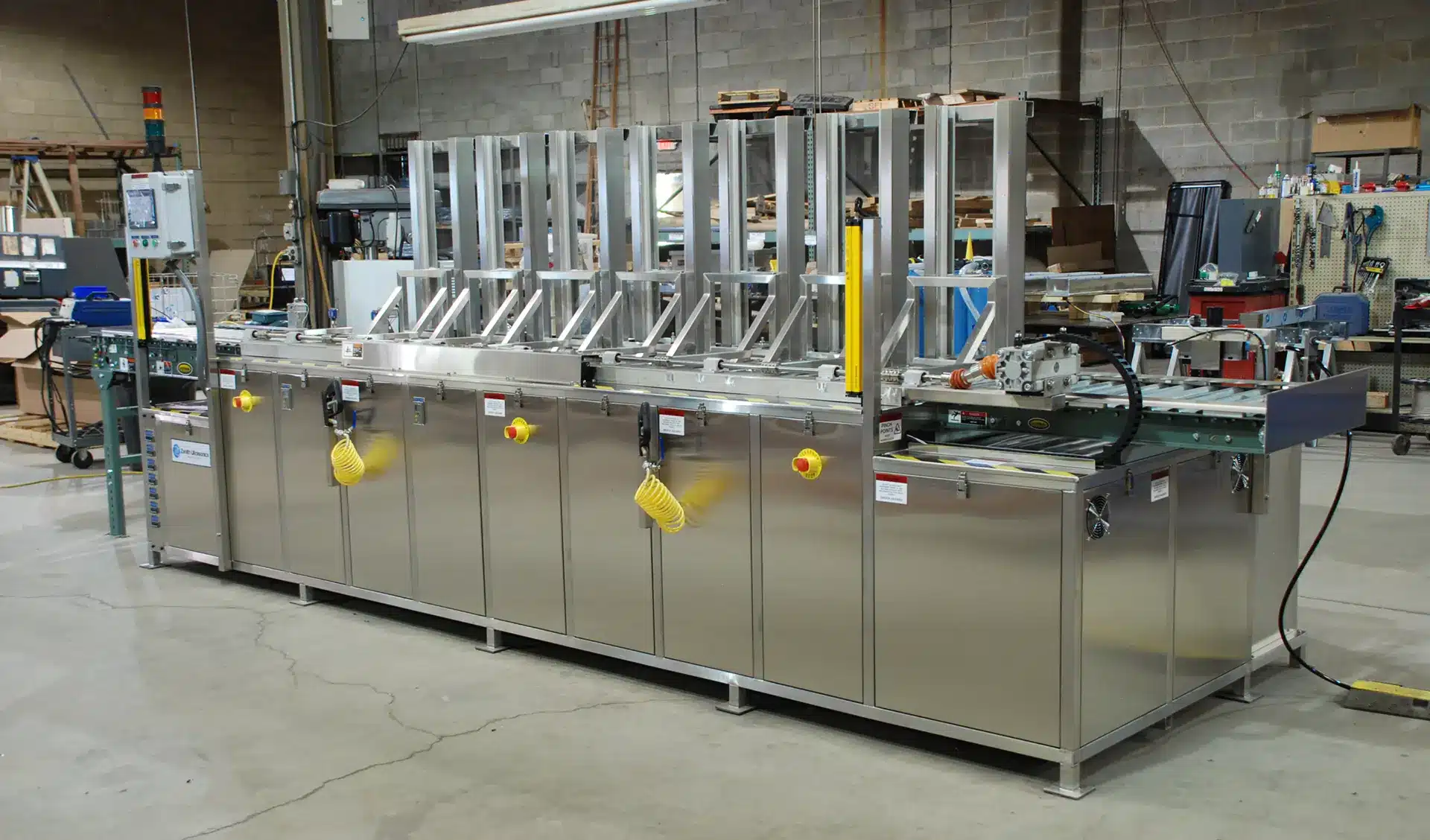
Even in highly automated environments, industrial cleaning can become a bottleneck, especially when contamination compromises product quality, drives up disposal costs, and slows production. That was the case for a well-known valve manufacturer experiencing intermittent staining on components. The manufacturer’s existing automated cleaning system wasn’t just underdelivering on part cleanliness; it was also generating approximately $2,000 per week in wastewater disposal costs.
The company needed a system that could eliminate staining, support throughput, and reduce operational expenses. But the prior vendor hadn’t fully recognized the relationship between detergent drag-out, rinse water quality, and waste generation. That gap in design—and in understanding—left the manufacturer with rising costs and inconsistent results.
Zenith Ultrasonics was brought in not to supply a standard machine, but to engineer a custom solution that accounted for the full cleaning process, including the downstream impacts of rinse chemistry and water handling.
Diagnosing the Problem Behind the Staining
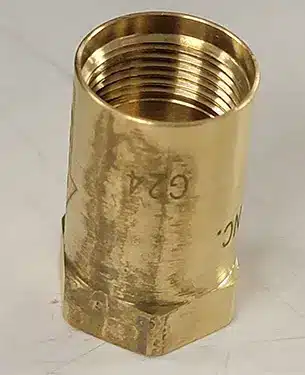
The manufacturer’s existing overhead pick-and-place system relied on single-basket movement and basic rinse staging. However, because of the part geometry, significant amounts of detergent were being carried from the cleaning tank into subsequent rinse tanks, elevating the pH above 9 and triggering costly waste handling protocols. Without a design that prioritized water quality and rinse integrity, the plant was stuck in a loop of excessive water use and persistent staining.
To reduce staining, Zenith focused first on reducing detergent transfer. That started with custom air blow-off manifolds engineered to act immediately before each basket transfer, removing surface liquids that would otherwise enter the next tank. To maximize effectiveness, Zenith reprogrammed the automation sequence to allow extra blow-off dwell time before the next tank transition. These changes alone had an immediate positive impact on rinse clarity and part outcomes.
Closed-Loop Water Reuse, without the Maintenance Burden
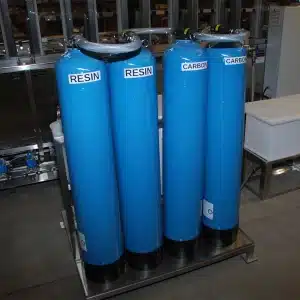
 After reducing detergent carryover, Zenith addressed the quality of the rinse stages themselves. The system introduced a multi-stage rinse progression that begins with a tap water rinse to flush away most remaining detergent. That’s followed by two deionized water tanks operating in a closed-loop configuration, continuously recirculated through activated carbon and specialized resin to purify the fluid without requiring constant water replacement.
The innovative design not only solved the staining problem but also nearly eliminated the need for hazardous waste collection. Several elements contributed to this success:
- Tap Water Rinse Pre-Stage: By removing the bulk of detergent before entering the closed-loop system, this rinse step sharply reduced contamination at the source and kept downstream stages cleaner.
- Closed-Loop Deionization Tanks: Operating continuously with activated carbon and mixed-bed resin, the DI stages ensured purified rinse water with no visible residue—critical for parts that couldn’t tolerate staining.
- Extended Resin Life: Because the water entering the DI tanks was already low in detergent, the resins required far less frequent replacement. Maintenance intervals stretched from weekly to every few months, minimizing disruptions and cutting costs.
By preserving water quality through smart sequencing and integrated controls, the system removed a major operational burden while improving part appearance and consistency.
Automation Designed for Throughput and Operator Relief
The customer’s prior system moved one basket at a time, creating a hard limit on cycle throughput. Zenith’s Advantage Automation platform changed that. With simultaneous lift and transfer of all baskets and integrated oscillation in each tank, the system now moves eight baskets in under 30 seconds. That’s simply impossible with traditional pick-and-place robotics.
Incorporating three drying tanks allowed the plant to eject cleaned parts every six minutes instead of every 18. This tripling of throughput supports growing production demands while also reducing operator involvement, thanks to less hand blow-off and simplified handling. Everything is built around the real-world workflow: efficient drying, quick turnover, and minimal operator labor.
Engineering for Long-Term Impact
 To make the system as intuitive and maintainable as it is effective, Zenith added several integrated features, such as:
- Water Quality Monitoring: Continuous sensors help operators maintain rinse performance within defined tolerances and flag degradation before it becomes an issue.
- Deionization Resin Health Sensors: These monitors track the saturation levels of the DI resin, giving teams real-time data to plan maintenance proactively.
- Oil Capture & Waste Collection: Custom drainage and capture systems isolate residual oils and waste, helping the facility stay compliant while minimizing hands-on labor.
During installation, Zenith’s engineers fine-tuned the PLC controls to align with operator preferences and reduce the learning curve. Even the air blow-off systems are optimized to prevent fluid splash back and maintain a clean transfer zone between tanks.
Results That Go Beyond Cleaning
The end result was a 95% reduction in waste generation and a system that paid for itself in disposal savings alone within two years. More importantly, the customer eliminated their staining problem, streamlined their workflow, and gained a cleaning system designed to meet their specific part geometry and production needs.
While many cleaning system providers offer “custom” solutions, few go to this level of detail or take responsibility for issues beyond the tank itself. The successful outcome illustrates Zenith’s core difference: not just building a machine that works, but building the right system to solve every part of the cleaning challenge, down to the chemistry, automation, and long-term operational impact.
Learn more about our customizable Advantage Automation System and request a complimentary demo cleaning.