
Ultrasonic cleaning is known for its precision, but many manufacturers focus solely on the equipment, such as the tanks, transducers, and automation. However, the cleaning solution plays an equally critical role. Without the right chemistry, even the most advanced system can fall short of quality standards.
Ultrasonic systems provide the mechanical action, but it’s the cleaning solution that determines whether contaminants actually break away from the part’s surface. The interaction between chemistry and cavitation is somewhat complex. Here’s a breakdown of how it all works together:
Understanding Ultrasonic Cleaning Action
Ultrasonic energy works by creating microscopic cavitation bubbles that collapse and generate intense localized scrubbing force. It’s essentially a physical brushing effect, distributed across the entire surface of a part. But, if the soil isn’t chemically loosened first, that mechanical scrubbing action can only do so much.
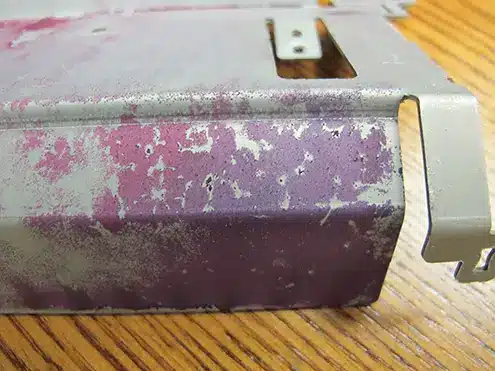
Picture trying to remove dried paint with water and a soft brush. No matter how hard you scrub, you won’t make much progress unless you introduce a solvent that breaks down the bond between the paint and the surface. The same principle applies to ultrasonic cleaning. The fluid must weaken the bond between the contaminant and the substrate so the cavitation energy can lift it away. Otherwise, the energy will only clean the areas where it’s strongest—and leave the rest untouched.
Recognizing the Importance of Ultrasonic Cleaning Solutions
Every type of contaminant—whether oil, flux, oxide, or adhesive—requires a specific chemical profile to loosen it from the substrate. And every substrate material responds differently to different chemistries. That’s why fluid selection is a primary and not a secondary decision. The wrong solution might partially clean a surface but leave behind films, discoloration, or residue. The right solution not only dissolves or emulsifies the contaminant but also conditions the part for better downstream results, including rinsing and drying.
At Zenith Ultrasonics, we frequently help customers evaluate whether an alkaline or acidic solution is appropriate, how surfactants may affect the rinse, and what materials (like aluminum or brass) require passivation or corrosion inhibitors during cleaning. These decisions affect both the cleaning process and the lifespan of the part.
Frequency Selection and Fluid Synergy
Ultrasonic frequency is another critical factor that ties directly into chemistry. Lower frequencies like 25 kHz deliver more aggressive scrubbing action, making them ideal for heavy soils or robust parts. Higher frequencies, such as 68 or 170 kHz, are gentler and better suited for delicate components or fine-featured geometries.
That said, frequency alone doesn’t clean the part. Chemistry still has to work in harmony with the energy level. A strong detergent paired with the wrong frequency may cause cavitational damage, while a mild detergent with insufficient energy won’t loosen the soil.
For complex parts or applications with varied soil types, Zenith engineers systems that combine multiple frequencies or alternate them during the cleaning cycle. That level of precision only works when the chemistry is calibrated to support each phase of the cycle. It’s not about having “more” cleaning; it’s about the right type, in the right sequence, with the right chemistry behind it.
Preventing Damage: Material Compatibility and Cavitational Risk
Aside from impacting performance, selecting the wrong combination of cleaning fluid and ultrasonic frequency can cause damage to parts. Soft metals like brass or aluminum can pit or erode under harsh cavitation. Likewise, aggressive chemistries can etch or oxidize certain surfaces, even if the ultrasonic frequency is within spec. Zenith helps customers evaluate these risks through a combination of application engineering, material compatibility review, and performance testing.
In many cases, the cleaning solution serves a dual purpose: provide effective contaminant removal, while also protecting the base material from erosion, discoloration, or chemical breakdown. Cleaning solutions should always be matched not just to the soil, but to the geometry, metallurgy, and final quality requirements of the parts. That balance is what separates effective ultrasonic cleaning from guesswork.
Engineering an Ultrasonic Cleaning System for Your Application
Because ultrasonic cleaning is both a mechanical and chemical process, Zenith’s engineering support extends beyond the machine itself. Our team works with customers to understand the nature of their parts, the soils they’re removing, and the post-cleaning performance they need to achieve.
We guide fluid selection with a deep understanding of how chemistry and cavitation interact. That includes:
- Recommending chemistries suited to the part material and soil profile
- Matching those chemistries to ultrasonic frequencies for optimal energy use
- Advising on tank configuration and rinse stages to prevent redeposition
- Identifying additives or inhibitors to protect delicate surfaces
Most importantly, we build systems that don’t just tolerate fluid variation; they’re designed to make the most of it. From tank construction to process control, every Zenith system supports the chemistry inside it.
Cleanliness Depends on Chemistry
Ultrasonic cleaning is often seen as a hardware challenge, but just as often, it’s a chemistry one. Without the right fluid, even the best-engineered system can fail to meet quality requirements. And without the right system, even the best detergent won’t reach its full potential. At Zenith, we specialize in solving both sides of the equation. Learn more about our customizable Advantage Automation System and request a complimentary demo cleaning.
